JEE Main 2004 — Electromagnetism
Physics Electromagnetism questions from JEE Main 2004.
Other Years
24 Electromagnetism Questions from 2004
A current I ampere flows along an infinitely long straight thin-walled tube, then the magnetic induction at any point inside the tube is
Two spherical conductor $B$ and $C$ having equal radii and carrying equal charges in them repel each other with a force $F$ when kept apart at some distance. A third spherical conductor having same radius as that of $B$ but uncharged brought in contact with $B$, then brought in contact with $\mathrm{C}$ and finally removed away from both. The new force of repulsion, between $B$ and $C$ is
Two long conductors, separated by a distance $\mathrm{d}$ carry current $\mathrm{I}_1$ and $\mathrm{I}_2$ in the same direction. They exert a force $F$ on each other. Now the current in one of them increased to two times and its direction reversed. The distance is also increased to $3 \mathrm{~d}$. The new value of the force between them is
The electrochemical equivalent of a metal is $3.3 \times 10^{-7} \mathrm{~kg}$ per coulomb. The mass of the metal liberated at the cathode when a 3 A current is passed for 2 seconds will be
A long wire carries a steady current. It is bent into a circle of one turn and the magnetic field at the centre of the coil is $B$. It is then bent into a circular loop of $n$ turns. The magnetic field at the centre of the coil will be
The materials suitable for making electromagnets should have
A metal conductor of length $1 \mathrm{~m}$ rotates vertically about one of its ends at angular velocity 5 radians per second. If the horizontal component of earth's magnetic field is $0.3 \times 10^{-4} \mathrm{~T}$, then the e.m.f. developed between the two ends of the conductor is
An $\alpha$-particle of energy $5 \mathrm{MeV}$ is scattered through $180^{\circ}$ by a fixed uranium nucleus. The distance of the closest approach is of the order of
An electromagnetic wave of frequency $v=3.0 \mathrm{MHz}$ passes from vacuum into a dielectric medium with permittivity $\varepsilon=4.0$. Then
The resistance of the series combination of two resistances is $S$. When they are joined in parallel through total resistance is $P$. If $S=n P$, then the minimum possible value of $n$ is
Four charges equal to $-Q$ are placed at the four corners of a square and a charge $q$ is at its centre. If the system is in equilibrium the value of $q$ is
A piece of copper and another of germanium are cooled from room temperature to $77 \mathrm{~K}$, the resistance of
A charged particle $q$ is shot towards another charged particle $Q$ which is fixed, with a speed $v$ it approaches $Q$ upto a closest distance $r$ and then returns. If $q$ were given a speed $2 v$, the closest distances of approach would be
In a LCR circuit capacitance is changed from $C$ to $2 C$. For the resonant frequency to remain unchanged, the inductance should be changed from $L$ to
In a metre bridge experiment null point is obtained at $20 \mathrm{~cm}$ from one end of the wire when resistance $X$ is balanced against another resistance $Y$. If $X < Y$, then where will be the new position of the null point from the same end, if one decides to balance a resistance of $4 X$ against Y?
A coil having $n$ turns and resistance $4 \mathrm{R} \Omega$. This combination is moved in time $t$ seconds from a magnetic field $W_1$ weber to $W_2$ weber. The induced current in the circuit is
The total current supplied to the circuit by the battery is 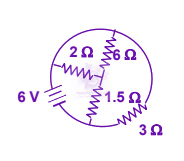
A charged oil drop is suspended in a uniform field of $3 \times 10^4 \mathrm{~V} / \mathrm{m}$ so that it neither falls nor rises. The charge on the drop will be (take the mass of the charge $=9.9 \times 10^{-15} \mathrm{~kg}$ and $\mathrm{g}=$ $10 \mathrm{~m} / \mathrm{s}^2$ )
In a uniform magnetic field of induction $B$ a wire in the form of semicircle of radius $r$ rotates about the diameter of the circle with angular frequency $\omega$. The axis of rotation is perpendicular to the field. If the total resistance of the circuit is $R$ the mean power generated per period of rotation is
An electric current is passed through a circuit containing two wires of the same material, connected in parallel. If the length and radii of the wires are in the ratio of $4 / 3$ and $2 / 3$, then the ratio of the currents passing through the wire will be
The length of a magnet is large compared to its width and breadth. The time period of its width and breadth. The time period of its oscillation in a vibration magnetometer is $2 \mathrm{~s}$. The magnet is cut along its length into three equal parts and three parts are then placed on each other with their like poles together. The time period of this combination will be
The magnetic field due to a current carrying circular loop of radius $3 \mathrm{~cm}$ at a point on the axis at a distance of $4 \mathrm{~cm}$ from the centre is $54 \mu \mathrm{T}$. What will be its value at the centre of the Loop?
In an LCR series a.c. circuit, the voltage across each of the components, $L, C$ and $R$ is $50 \mathrm{~V}$. The voltage across the LC combination will be
Alternating current can not be measured by D.C. ammeter because