JEE Main Chemistry — Physical Chemistry previous year questions with solutions.
Density of 3 M NaCl solution is $1.25 \mathrm{~g} / \mathrm{mL}$. The molality of the solution is :
Given below are two statements : 1 M aqueous solution of each of $\mathrm{Cu}\left(\mathrm{NO}_3\right)_2, \mathrm{AgNO}_3$, $\mathrm{Hg}_2\left(\mathrm{NO}_3\right)_2 ; \mathrm{Mg}\left(\mathrm{NO}_3\right)_2$ are electrolysed using inert electrodes, $\begin{aligned} & \text { Given : } \mathrm{E}_{\mathrm{Ag}^{+} / \mathrm{Ag}}^\theta=0.80 \mathrm{~V}, \mathrm{E}_{\mathrm{Hg}_2^{2+} / \mathrm{Hg}}^\theta=0.79 \mathrm{~V}, \\ & \mathrm{E}_{\mathrm{Cu}^{2+} / \mathrm{Cu}}^\theta=0.24 \mathrm{~V} \text { and } \mathrm{E}_{\mathrm{Mg}^{2+} / \mathrm{Mg}}^\theta=-2.37 \mathrm{~V}\end{aligned}$ Statement (I) : With increasing voltage, the sequence of deposition of metals on the cathode will be $\mathrm{Ag}, \mathrm{Hg}$ and Cu Statement (II) : Magnesium will not be deposited at cathode instead oxygen gas will be evolved at the cathode. In the light of the above statement, choose the most appropriate answer from the options given below
Only litre buffer solution was prepared by adding 0.10 mol each of $\mathrm{NH}_3$ and $\mathrm{NH}_4 \mathrm{Cl}$ in deionised water. The change in pH on addition of 0.05 mol of HCl to the above solution is ________ $\times 10^{-2}$, (Nearest integer) (Given : $\mathrm{pK}_{\mathrm{b}}$ of $\mathrm{NH}_3=4.745$ and $\log _{10} 3=0.477$)
Which of the following graphs correctly represents the variation of thermodynamic properties of Haber's process?
For hydrogen like species, which of the following graphs provides the most appropriate representation of E vs Z plot for a constant n ? [E: Energy of the stationary state, Z : atomic number, $\mathrm{n}=$ principal quantum number]
Sea water, which can be considered as a 6 molar $(6 \mathrm{M})$ solution of NaCl , has a density of $2 \mathrm{~g} \mathrm{~mL}^{-1}$. The concentration of dissolved oxygen $\left(\mathrm{O}_2\right)$ in sea water is 5.8 ppm. Then the concentration of dissolved oxygen $\left(\mathrm{O}_2\right)$ in sea water, is $\mathrm{x} \times 10^{-4} \mathrm{~m}$. $\mathrm{x}=$ _______. (Nearest integer) Given: Molar mass of NaCl is $58.5 \mathrm{~g} \mathrm{~mol}^{-1}$ Molar mass of $\mathrm{O}_2$ is $32 \mathrm{~g} \mathrm{~mol}^{-1}$
A solution of aluminium chloride is electrolysed for 30 minutes using a current of 2 A . The amount of the aluminium deposited at the cathode is [Given : molar mass of aluminium and chlorine are $27 \mathrm{~g} \mathrm{~mol}^{-1}$ and $35.5 \mathrm{~g} \mathrm{~mol}^{-1}$ respectively. Faraday constant $\left.=96500 \mathrm{C} \mathrm{mol}^{-1}\right]$
Given below are two statements: Statement I: In the oxalic acid vs $\mathrm{KMnO}_4$ (in the presence of dil $\mathrm{H}_2 \mathrm{SO}_4$ ) titration the solution needs to be heated initially to $60^{\circ} \mathrm{C}$, but no heating is required in Ferrous ammonium sulphate (FAS) vs $\mathrm{KMnO}_4$ titration (in the presence of dil $\mathrm{H}_2 \mathrm{SO}_4$ ) Statement II: In oxalic acid vs $\mathrm{KMnO}_4$ titration, the initial formation of $\mathrm{MnSO}_4$ takes place at high temperature, which then acts as catalyst for further reaction. In the case of FAS vs $\mathrm{KMnO}_4$, heating oxidizes $\mathrm{Fe}^{2+}$ into $\mathrm{Fe}^{3+}$ by oxygen of air and error may be introduced in the experiment. In the light of the above statements, choose the correct answer from the options given below
The effect of temperature on spontaneity of reactions are represented as : 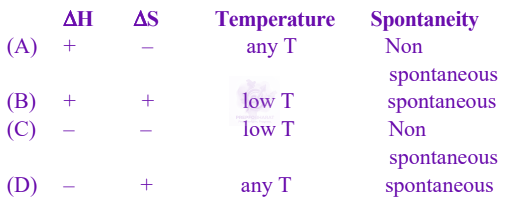
The correct statement amongst the following is :
The standard cell potential $\left(\mathrm{E}_{\text {cell }}^{\ominus}\right)$ of a fuel cell based on the oxidation of methanol in air that has been used to power television relay station is measured as 1.21 V. The standard half cell reduction potential for $\mathrm{O}_2\left(\mathrm{E}_{\mathrm{O}_2 / \mathrm{H}_2 \mathrm{O}}^{\mathrm{O}}\right)$ is 1.229 V. Choose the correct statement:
Standard entropies of $\mathrm{X}_2, \mathrm{Y}_2$ and $\mathrm{XY}_5$ are 70,50 and $110 \mathrm{~J} \mathrm{~K}^{-1} \mathrm{~mol}^{-1}$ respectively. The temperature in Kelvin at which the reaction $\frac{1}{2} \mathrm{X}_2+\frac{5}{2} \mathrm{Y}_2 \rightleftharpoons \mathrm{XY}_5 \Delta \mathrm{H}^{\Theta}=-35 \mathrm{~kJ} \mathrm{~mol}^{-1}$ will be at equilibrium is_______. (Nearest integer)
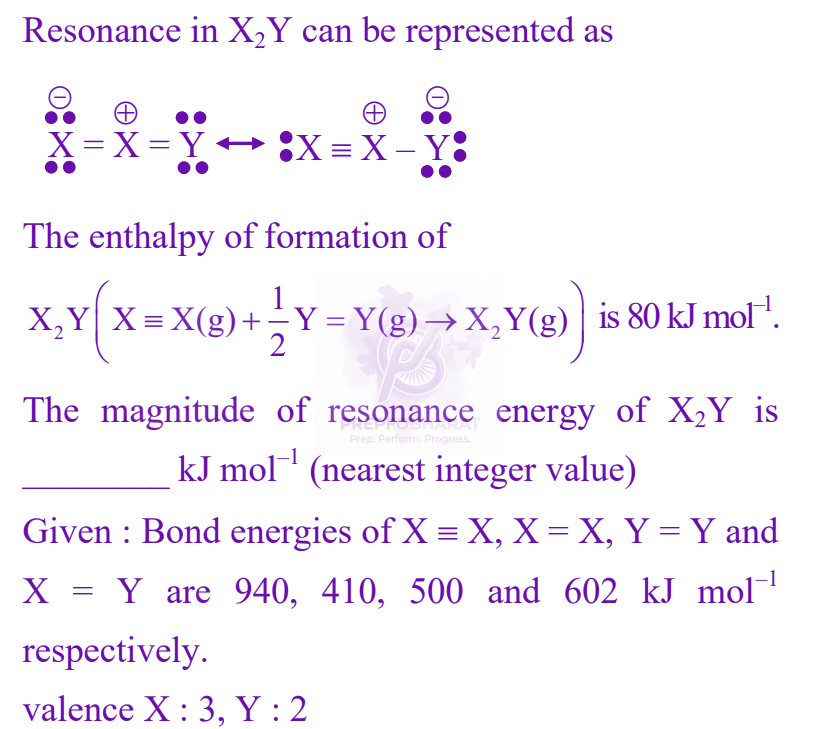
For the reaction \(\mathrm{A} \rightarrow\) products. 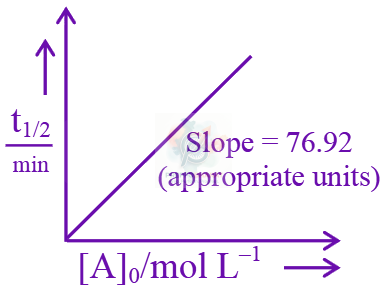 The concentration of A at 10 minutes is _______ \(\times 10^{-3} \mathrm{~mol} \mathrm{~L}^{-1}\) (nearest integer). The reaction was started with \(2.5 \mathrm{~mol} \mathrm{~L}^{-1}\) of A.
For a \(\mathrm{Mg}\left|\mathrm{Mg}^{2+}(\mathrm{aq})\right|\left|\mathrm{Ag}^{+}(\mathrm{aq})\right| \mathrm{Ag}\) the correct Nernst Equation is :
Which of the following statement is not true for radioactive decay?
The observed and normal molar masses of compound $\mathrm{MX}_2$ are 65.6 and 164 respectively. The percent degree of ionisation of $\mathrm{MX}_2$ is $\ldots\ldots$ %. (Nearest integer)
Given below are two statements : Statement I : Mohr's salt is composed of only three types of ions-ferrous, ammonium and sulphate. Statement II : If the molar conductance at infinite dilution of ferrous, ammonium and sulphate ions are $\mathrm{x}_1, \mathrm{x}_2$ and $\mathrm{x}_3 \mathrm{~S} \mathrm{~cm}^2 \mathrm{~mol}^{-1}$, respectively then the molar conductance for Mohr's salt solution at infinite dilution would be given by $\mathrm{x}_1+\mathrm{x}_2+2 \mathrm{x}_3$ In the light of the given statements, choose the correct answer from the options given below :
In a reaction $A+B \rightarrow C$, initial concentrations of $A$ and $B$ are related as $[A]_0=8[B]_0$. The half lives of $A$ and $B$ are 10 min and 40 min. respectively. If they start to disappear at the same time, both following first order kinetics, after how much time will the concentration of both the reactants be same?
Consider a binary solution of two volatile liquid components 1 and $2 . x_1$ and $y_1$ are the mole fractions of component 1 in liquid and vapour phase, respectively. The slope and intercept of the linear plot of $\frac{1}{x_1}$ vs $\frac{1}{y_1}$ are given respectively as:
Given below are two statements about X-ray spectra of elements : Statement (I) : A plot of $\sqrt{v}$ ( $v=$ frequency of $X$-rays emitted) vs atomic mass is a straight line. Statement (II) : A plot of $v(v=$ frequency of $X$-rays emitted) vs atomic number is a straight line. In the light of the above statements, choose the correct answer from the options given below :
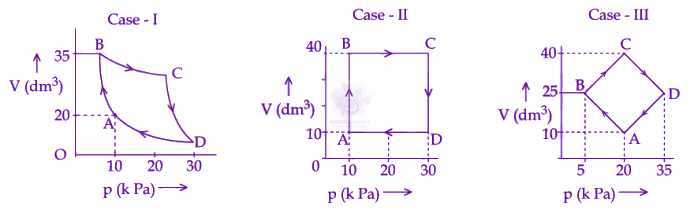 An ideal gas undergoes a cyclic transformation starting from the point $A$ and coming back to the same point by tracing the path $\mathrm{A} \rightarrow \mathrm{B} \rightarrow \mathrm{C} \rightarrow \mathrm{D} \rightarrow \mathrm{A}$ as shown in the three cases above. Choose the correct option regarding $\Delta \mathrm{U}$ :
Consider the following equilibrium, \(\mathrm{CO}(\mathrm{g})+2 \mathrm{H}_2(\mathrm{g}) \rightleftharpoons \mathrm{CH}_3 \mathrm{OH}(\mathrm{g})\) 0.1 mol of CO along with a catalyst is present in a \(2 \mathrm{dm}^3\) flask maintained at 500 K. Hydrogen is introduced into the flask until the pressure is 5 bar and 0.04 mol of \(\mathrm{CH}_3 \mathrm{OH}\) is formed. The \(\mathrm{K}_{\mathrm{p}}^0\) is ______ \(\times 10^{-3}\) (nearest integer). Given : \(\mathrm{R}=0.08 \mathrm{dm}^3\) bar \(\mathrm{K}^{-1} \mathrm{~mol}^{-1}\) Assume only methanol is formed as the product and the system follows ideal gas behaviour.
The percentage dissociation of a salt $\left(\mathrm{MX}_3\right)$ solution at given temperature (van't Hoff factor $\mathrm{i}=$ 2) is ______ % (Nearest integer)