Physical Chemistry PYQ — Page 14
JEE Main Chemistry — Physical Chemistry previous year questions with solutions.
All Physical Chemistry Questions (1826)
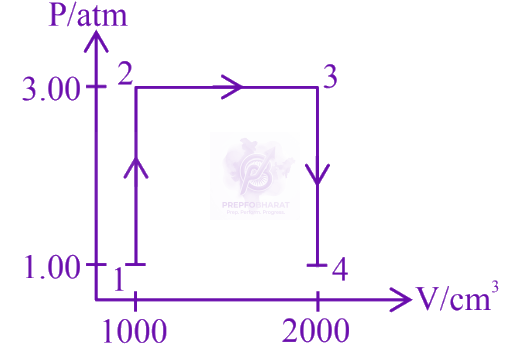 A perfect gas $(0.1 \mathrm{~mol})$ having $\overline{\mathrm{C}}_{\mathrm{v}}=1.50 \mathrm{R}$ (independent of temperature) undergoes the above transformation from point 1 to point 4. If each step is reversible, the total work done (w) while going from point 1 to point 4 is $(-)$ ________ J (nearest integer) $\left[\right.$ Given : $\left.\mathrm{R}=0.082 \mathrm{~L} \mathrm{~atm} \mathrm{~K}^{-1} \mathrm{~mol}^{-1}\right]$
Consider the reaction $\mathrm{X}_2 \mathrm{Y}(\mathrm{~g})=\mathrm{X}_2(\mathrm{~g})+\frac{1}{2} \mathrm{Y}_2(\mathrm{~g})$ The equation representing correct relationship between the degree of dissociation (x) of $\mathrm{X}_2 \mathrm{Y}(\mathrm{g})$ with its equilibrium constant Kp is ______ . Assume $x$ to be very very small.
The molarity of a $70 \%$ (mass $/$ mass) aqueous solution of a monobasic acid $(\mathrm{X})$ is __________ $\times 10^{-1}$ M(Nearest integer) [Given: Density of aqueous solution of (X) is $1.25 \mathrm{~g} \mathrm{~mL}^{-1}$ Molar mass of the acid is $70 \mathrm{~g} \mathrm{~mol}^{-1}$ ]
An organic compound weighing 500 mg , produced 220 mg of $\mathrm{CO}_2$. on complete combustion. The percentage composition of carbon in the compound is _____ \%. (nearest integer) (Given molar mass in $\mathrm{g} \mathrm{mol}^{-1}$ of $\mathrm{C}: 12, \mathrm{O}: 16$)
Correct statements for an element with atomic number 9 are A. There can be 5 electrons for which $\mathrm{m}_{\mathrm{s}}=+\frac{1}{2}$ and 4 electrons for which $\mathrm{m}_{\mathrm{s}}=-\frac{1}{2}$ B. There is only one electron in $p_z$ orbital C. The last electron goes to orbital with $\mathrm{n}=2$ and $l=1$ 4. The sum of angular nodes of all the atomic orbitals is 1. Choose the correct answer from the options given below:
Heat treatment of muscular pain involves radiation of wavelength of about 900 nm . Which spectral line of H atom is suitable for this? Given : Rydberg constant $\mathrm{R}_{\mathrm{H}}=10^5 \mathrm{~cm}^{-1}, \mathrm{~h}=6.6 \times 10^{-34} \mathrm{~J} \mathrm{~s}, \mathrm{c}=3 \times 10^8 \mathrm{~m} / \mathrm{s}$ )
Given below are two statements : 1 M aqueous solution of each of $\mathrm{Cu}\left(\mathrm{NO}_3\right)_2, \mathrm{AgNO}_3$, $\mathrm{Hg}_2\left(\mathrm{NO}_3\right)_2 ; \mathrm{Mg}\left(\mathrm{NO}_3\right)_2$ are electrolysed using inert electrodes, $\begin{aligned} & \text { Given : } \mathrm{E}_{\mathrm{Ag}^{+} / \mathrm{Ag}}^\theta=0.80 \mathrm{~V}, \mathrm{E}_{\mathrm{Hg}_2^{2+} / \mathrm{Hg}}^\theta=0.79 \mathrm{~V}, \\ & \mathrm{E}_{\mathrm{Cu}^{2+} / \mathrm{Cu}}^\theta=0.24 \mathrm{~V} \text { and } \mathrm{E}_{\mathrm{Mg}^{2+} / \mathrm{Mg}}^\theta=-2.37 \mathrm{~V}\end{aligned}$ Statement (I) : With increasing voltage, the sequence of deposition of metals on the cathode will be $\mathrm{Ag}, \mathrm{Hg}$ and Cu Statement (II) : Magnesium will not be deposited at cathode instead oxygen gas will be evolved at the cathode. In the light of the above statement, choose the most appropriate answer from the options given below
Liquid A and B form an ideal solution. The vapour pressure of pure liquids A and B are 350 and 750 mm Hg respectively at the same temperature. If $\mathrm{x}_{\mathrm{A}}$ and $x_B$ are the mole fraction of $A$ and $B$ in solution while $y_A$ and $y_B$ are the mole fraction of A and B in vapour phase then :
Let us consider a reversible reaction at temperature, T. In this reaction, both $\Delta \mathrm{H}$ and $\Delta \mathrm{S}$ were observed to have positive values. If the equilibrium temperature is Te , then the reaction becomes spontaneous at :
Radius of the first excited state of Helium ion is given as : $\mathrm{a}_0 \rightarrow$ radius of first stationary state of hydrogen atom.
Only litre buffer solution was prepared by adding 0.10 mol each of $\mathrm{NH}_3$ and $\mathrm{NH}_4 \mathrm{Cl}$ in deionised water. The change in pH on addition of 0.05 mol of HCl to the above solution is ________ $\times 10^{-2}$, (Nearest integer) (Given : $\mathrm{pK}_{\mathrm{b}}$ of $\mathrm{NH}_3=4.745$ and $\log _{10} 3=0.477$)
Which of the following graphs correctly represents the variation of thermodynamic properties of Haber's process?
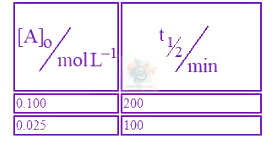 For a given reaction $\mathrm{R} \rightarrow \mathrm{P}, \mathrm{t}_{1 / 2}$ is related to $[\mathrm{A}]_0$ as given in table. Given: $\log 2=0.30$ Which of the following is true? A. The order of the reaction is $1 / 2$. B. If $[\mathrm{A}]_0$ is 1 M , then $\mathrm{t}_{1 / 2}$ is $200 \sqrt{10} \mathrm{~min}$ C. The order of the reaction changes to 1 if the concentration of reactant changes from 0.100 M to 0.500 M . D. $\mathrm{t}_{1 / 2}$ is 800 min for $[\mathrm{A}]_0=1.6 \mathrm{M}$ Choose the correct answer from the options given below: Options
20 mL of 2 M NaOH solution is added to 400 mL of 0.5 M NaOH solution. The final concentration of the solution is _______ $\times 10^{-2} \mathrm{M}$. (Nearest integer)
Sea water, which can be considered as a 6 molar $(6 \mathrm{M})$ solution of NaCl , has a density of $2 \mathrm{~g} \mathrm{~mL}^{-1}$. The concentration of dissolved oxygen $\left(\mathrm{O}_2\right)$ in sea water is 5.8 ppm. Then the concentration of dissolved oxygen $\left(\mathrm{O}_2\right)$ in sea water, is $\mathrm{x} \times 10^{-4} \mathrm{~m}$. $\mathrm{x}=$ _______. (Nearest integer) Given: Molar mass of NaCl is $58.5 \mathrm{~g} \mathrm{~mol}^{-1}$ Molar mass of $\mathrm{O}_2$ is $32 \mathrm{~g} \mathrm{~mol}^{-1}$
Given below are two statements: Statement I: In the oxalic acid vs $\mathrm{KMnO}_4$ (in the presence of dil $\mathrm{H}_2 \mathrm{SO}_4$ ) titration the solution needs to be heated initially to $60^{\circ} \mathrm{C}$, but no heating is required in Ferrous ammonium sulphate (FAS) vs $\mathrm{KMnO}_4$ titration (in the presence of dil $\mathrm{H}_2 \mathrm{SO}_4$ ) Statement II: In oxalic acid vs $\mathrm{KMnO}_4$ titration, the initial formation of $\mathrm{MnSO}_4$ takes place at high temperature, which then acts as catalyst for further reaction. In the case of FAS vs $\mathrm{KMnO}_4$, heating oxidizes $\mathrm{Fe}^{2+}$ into $\mathrm{Fe}^{3+}$ by oxygen of air and error may be introduced in the experiment. In the light of the above statements, choose the correct answer from the options given below
The effect of temperature on spontaneity of reactions are represented as : 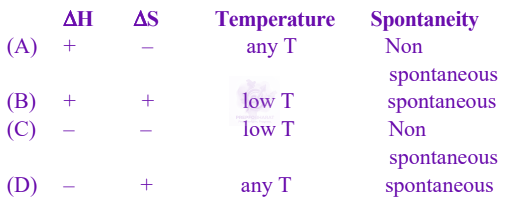
' x ' g of NaCl is added to water in a beaker with a lid. The temperature of the system is raised from $1^{\circ} \mathrm{C}$ to $25^{\circ} \mathrm{C}$. Which out of the following plots, is best suited for the change in the molarity (M) of the solution with respect to temperature? [Consider the solubility of NaCl remains unchanged over the temperature range]
The standard cell potential $\left(\mathrm{E}_{\text {cell }}^{\ominus}\right)$ of a fuel cell based on the oxidation of methanol in air that has been used to power television relay station is measured as 1.21 V. The standard half cell reduction potential for $\mathrm{O}_2\left(\mathrm{E}_{\mathrm{O}_2 / \mathrm{H}_2 \mathrm{O}}^{\mathrm{O}}\right)$ is 1.229 V. Choose the correct statement:
Let us consider an endothermic reaction which is non-spontaneous at the freezing point of water. However, the reaction is spontaneous at boiling point of water. Choose the correct option.
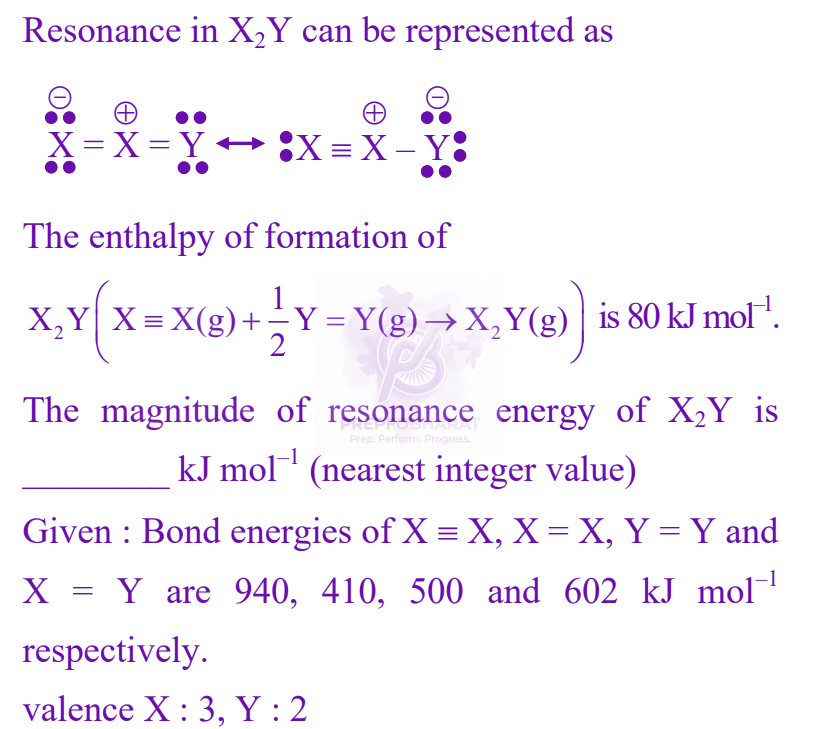
For the reaction \(\mathrm{A} \rightarrow\) products. 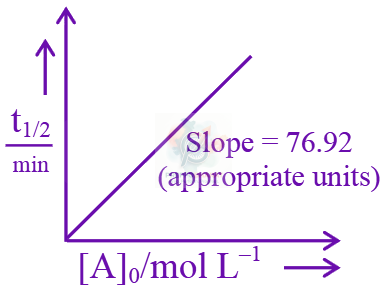 The concentration of A at 10 minutes is _______ \(\times 10^{-3} \mathrm{~mol} \mathrm{~L}^{-1}\) (nearest integer). The reaction was started with \(2.5 \mathrm{~mol} \mathrm{~L}^{-1}\) of A.
For a \(\mathrm{Mg}\left|\mathrm{Mg}^{2+}(\mathrm{aq})\right|\left|\mathrm{Ag}^{+}(\mathrm{aq})\right| \mathrm{Ag}\) the correct Nernst Equation is :
Given below is the plot of the molar conductivity vs $\sqrt{\text { concentration }}$ for KCl in aqueous solution. 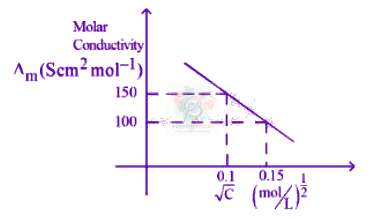 If, for the higher concentration of KCl solution, the resistance of the conductivity cell is $100 \Omega$, then the resistance of the same cell with the dilute solution is ' $x$ ' $\Omega$ The value of $x$ is __________ (Nearest integer)