Physical Chemistry PYQ — Page 13
JEE Main Chemistry — Physical Chemistry previous year questions with solutions.
All Physical Chemistry Questions (1826)
$\mathrm{FeO}_4^{2-} \xrightarrow{+2.0 \mathrm{v}} \mathrm{Fe}^{3+} \xrightarrow{0.8 \mathrm{v}} \mathrm{Fe}^{2+} \xrightarrow{-0.5 \mathrm{v}} \mathrm{Fe}^0$ In the above diagram, the standard electrode potentials are given in volts (over the arrow). The value of $\mathrm{E}_{\mathrm{FeO}_4^{2-} / \mathrm{Fe}^{2+}}^{\mathrm{O}}$ is
Choose the correct statements. (A) Weight of a substance is the amount of matter present in it. (B) Mass is the force exerted by gravity on an object. (C) Volume is the amount of space occupied by a substance. (D) Temperatures below \(0^{\circ} \mathrm{C}\) are possible in Celsius scale, but in Kelvin scale negative temperature is not possible. (E) Precision refers to the closeness of various measurements for the same quantity. Choose the correct answer from the options given below :
Fortification of food with iron is done using $\mathrm{FeSO}_4 \cdot 7 \mathrm{H}_2 \mathrm{O}$. The mass in grams of the $\mathrm{FeSO}_4 \cdot 7 \mathrm{H}_2 \mathrm{O}$ required to achieve 12 ppm of iron in 150 kg of wheat is ____ (Nearest integer) [Given : Molar mass of $\mathrm{Fe}, \mathrm{S}$ and O respectively are 56,32 and $16 \mathrm{~g} \mathrm{~mol}^{-1}$ ]
Consider the following statements related to temperature dependence of rate constants. Identify the correct statements, A. The Arrhenius equation holds true only for an elementary homogenous reaction. B. The unit of A is same as that of k in Arrhenius equation. C. At a given temperature, a low activation energy means a fast reaction. D. A and Ea as used in Arrhenius equation depend on temperature. E. When $\mathrm{Ea} \gg \mathrm{RT}$. A and Ea become interdependent. Choose the correct answer from the options given below :
Which of the following mixing of 1 M base and 1 M acid leads to the largest increase in temperature?
Drug $X$ becomes ineffective after $50 \%$ decomposition. The original concentration of drug in a bottle was $16 \mathrm{mg} / \mathrm{mL}$ which becomes $4 \mathrm{mg} / \mathrm{mL}$ in 12 months. The expiry time of the drug in months is __________$\qquad$ Assume that the decomposition of the drug follows first order kinetics.
Given below are two statements Statement I : A catalyst cannot alter the equilibrium constant $\left(\mathrm{K}_{\mathrm{c}}\right)$ of the reaction, temperature remaining constant Statement II : A homogenous catalyst can change the equilibrium composition of a system temperature remaining constant In the light of the above statements, choose the correct answer from the options given below
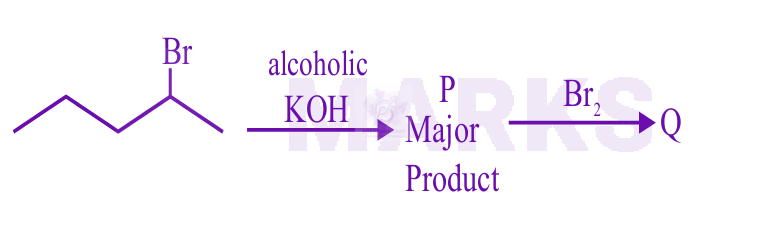 Consider the above sequence of reactions. 151 g of 2-bromopentane is made to react. Yield of major product P is $80 \%$ whereas Q is $100 \%$. Mass of product Q obtained is ____ g. (Given molar mass in $\mathrm{g} \mathrm{mol}^{-1} \mathrm{H}: 1, \mathrm{C}: 12, \mathrm{O}: 16$, $\mathrm{Br}: 80)$
$\mathrm{O}_2$ gas will be evolved as a product of electrolysis of : (A) an aqueous solution of $\mathrm{AgNO}_3$ using silver electrodes. (B) an aqueous solution of $\mathrm{AgNO}_3$ using platinum electrodes. (C) a dilute solution of $\mathrm{H}_2 \mathrm{SO}_4$ using platinum electrodes. (D) a high concentration solution of $\mathrm{H}_2 \mathrm{SO}_4$ using platinum electrodes. Choose the correct answer from the options given below :
Which of the following happens when $\mathrm{NH}_4 \mathrm{OH}$ is added gradually to the solution containing 1 M $\mathrm{A}^{2+}$ and $1 \mathrm{MB}^{3+}$ ions? Given : $\mathrm{K}_{\mathrm{sp}}\left[\mathrm{A}(\mathrm{OH})_2\right]=9 \times 10^{-10}$ and $\mathrm{K}_{\mathrm{sp}}\left[\mathrm{B}(\mathrm{OH})_3\right]=27 \times 10^{-18}$ at 298 K .
For electron in ' 2 s ' and ' 2 p ' orbitals, the orbital angular momentum values, respectively are :
For bacterial growth in a cell culture, growth law is very similar to the law of radioactive decay. Which of the following graphs is most suitable to represent bacterial colony growth ? Where N - Number of Bacteria at any time, $\mathrm{N}_0$ - Initial number of Bacteria.
Consider the given plots of vapour pressure (VP) vs temperature(T/K). Which amongst the following options is correct graphical representation showing $\Delta \mathrm{T}_{\mathrm{f}}$, depression in the freezing point of a solvent in a solution?
Consider a complex reaction taking place in three steps with rate constants $k_1, k_2$ and $k_3$ respectively. The overall rate constant $k$ is given by the expression $k=\sqrt{\frac{k_1 k_3}{k_2}}$. If the activation energies of the three steps are 60,30 and $10 \mathrm{~kJ} \mathrm{~mol}{ }^{-1}$ respectively, then the overall energy of activation in $\mathrm{kJ} \mathrm{mol}^{-1}$ is $\ldots\ldots$ . (Nearest integer)
On charging the lead storage battery, the oxidation state of lead changes from $x_1$ to $y_1$ at the anode and from $x_2$ to $y_2$ at the cathode. The values of $x_1, y_1, x_2, y_2$ are respectively :
If equal volumes of \(\mathrm{AB}_2\) and XY (both are salts) aqueous solutions are mixed, which of the following combination will give a precipitate of \(\mathrm{AY}_2\) at 300 K ? (Given \(\mathrm{K}_{\mathrm{sp}}\) (at 300 K) for \(\mathrm{AY}_2=5.2 \times 10^{-7}\))
Given below are two statements : 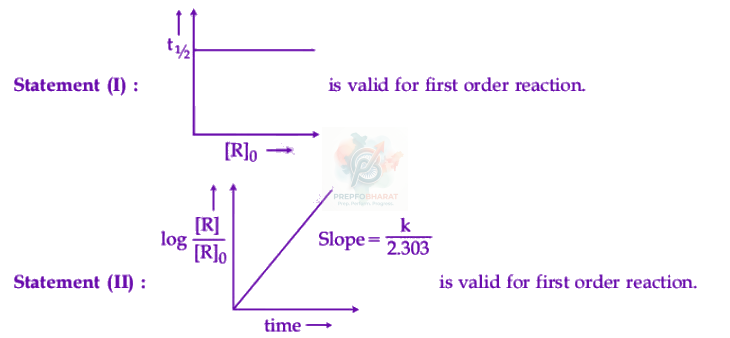 In the light of the above statements, choose the correct answer from the options given below :
The molar conductivity of a weak electrolyte when plotted against the square root of its concentration, which of the following is expected to be observed ?
Which of the following binary mixture does not show the behaviour of minimum boiling azeotropes?
pH of water is 7 at $25^{\circ} \mathrm{C}$. If water is heated to $80^{\circ} \mathrm{C}$., it's pH will :
The hydrocarbon $(X)$ with molar mass $80 \mathrm{~g} \mathrm{~mol}^{-1}$ and $90 \%$ carbon has $\ldots\ldots$ degree of unsaturation.
Given below are two statements : Statement (I) : Molal depression constant $\mathrm{K}_{\mathrm{f}}$ is given by $\frac{M_1 R T_f}{\Delta S_{f u s}}$, where symbols have their usual meaning. Statement (II) : $\mathrm{K}_{\mathrm{f}}$ for benzene is less than the $\mathrm{K}_{\mathrm{f}}$ for water. In the light of the above statements, choose the most appropriate answer from the options given below :
The formation enthalpies, $\Delta \mathrm{H}_{\mathrm{f}} \ominus$ for $\mathrm{H}_{(\mathrm{g})}$ and $\mathrm{O}_{(\mathrm{g})}$ are 220.0 and $250.0 \mathrm{~kJ} \mathrm{~mol}^{-1}$, respectively, at 298.15 K , and $\Delta \mathrm{H}_{\mathrm{f}}{ }^{\ominus}$ for $\mathrm{H}_2 \mathrm{O}_{(\mathrm{g})}$ is $-242.0 \mathrm{~kJ} \mathrm{~mol}^{-1}$ at the same temperature. The average bond enthalpy of the $\mathrm{O}-\mathrm{H}$ bond in water at 298.15 K is __________ $\mathrm{kJ} \mathrm{mol}^{-1}$ (nearest integer).
500 J of energy is transferred as heat to 0.5 mol of Argon gas at 298 K and 1.00 atm. The final temperature and the change in internal energy respectively are: Given : \(\mathrm{R}=8.3 \mathrm{~J} \mathrm{~K}^{-1} \mathrm{~mol}^{-1}\)