Physical Chemistry PYQ — Page 12
JEE Main Chemistry — Physical Chemistry previous year questions with solutions.
All Physical Chemistry Questions (1826)
At temperature T, compound \(\mathrm{AB}_{2(\mathrm{~g})}\) dissociates as \(\mathrm{AB}_{2(\mathrm{~g})} \rightleftharpoons \mathrm{AB}_{(\mathrm{g})}+\frac{1}{2} \mathrm{~B}_{2(\mathrm{~g})}\) having degree of dissociation \(x\) (small compared to unity). The correct expression for \(x\) in terms of \(\mathrm{K}_{\mathrm{p}}\) and p is
The equilibrium constant for decomposition of $\mathrm{H}_2 \mathrm{O}(\mathrm{g})$ $\mathrm{H}_2 \mathrm{O}(\mathrm{~g}) \rightleftharpoons \mathrm{H}_2(\mathrm{~g})+\frac{1}{2} \mathrm{O}_2(\mathrm{~g})\left(\Delta \mathrm{G}^{\circ}=92.34 \mathrm{~kJ} \mathrm{~mol}^{-1}\right)$ is $8.0 \times 10^{-3}$ at 2300 K and total pressure at equilibrium is 1 bar. Under this condition, the degree of dissociation $(\alpha)$ of water is ________ $\times 10^{-2}$ (nearest integer value). [Assume $\alpha$ is negligible with respect to 1 ]
The pH of a 0.01 M weak acid $\mathrm{HX}\left(\mathrm{K}_{\mathrm{a}}=4 \times 10^{-10}\right)$ is found to be 5. Now the acid solution is diluted with excess of water so that the pH of the solution changes to 6. The new concentration of the diluted weak acid is given as $x \times 10^{-4} \mathrm{M}$. The value of x is ________ (nearest integer)
$\begin{aligned} & \mathrm{S}(\mathrm{~g})+\frac{3}{2} \mathrm{O}_2(\mathrm{~g}) \rightarrow \mathrm{SO}_3(\mathrm{~g})+2 x \mathrm{kcal} \\ & \mathrm{SO}_2(\mathrm{~g})+\frac{1}{2} \mathrm{O}_2(\mathrm{~g}) \rightarrow \mathrm{SO}_3(\mathrm{~g})+y \mathrm{kcal} \end{aligned}$ The heat of formation of $\mathrm{SO}_2(\mathrm{~g})$ is given by :
Consider the following plots of log of rate constant $\mathrm{k}(\log \mathrm{k})$ vs $\frac{1}{\mathrm{~T}}$ for three different reactions. The correct order of activation energies of these reactions is 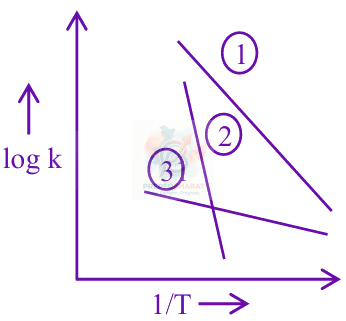
$\mathrm{A} \rightarrow \mathrm{~B}$ The molecule A changes into its isomeric form B by following a first order kinetics at a temperature of 1000 K . If the energy barrier with respect to reactant energy for such isomeric transformation is $191.48 \mathrm{~kJ} \mathrm{~mol}^{-1}$ and the frequency factor is $10^{20}$, the time required for $50 \%$ molecules of A to become $B$ is _________ picoseconds (nearest integer). $\left[\mathrm{R}=8.314 \mathrm{~J} \mathrm{~K}^{-1} \mathrm{~mol}^{-1}\right]$
Consider the following equilibrium, \(\mathrm{CO}(\mathrm{g})+2 \mathrm{H}_2(\mathrm{g}) \rightleftharpoons \mathrm{CH}_3 \mathrm{OH}(\mathrm{g})\) 0.1 mol of CO along with a catalyst is present in a \(2 \mathrm{dm}^3\) flask maintained at 500 K. Hydrogen is introduced into the flask until the pressure is 5 bar and 0.04 mol of \(\mathrm{CH}_3 \mathrm{OH}\) is formed. The \(\mathrm{K}_{\mathrm{p}}^0\) is ______ \(\times 10^{-3}\) (nearest integer). Given : \(\mathrm{R}=0.08 \mathrm{dm}^3\) bar \(\mathrm{K}^{-1} \mathrm{~mol}^{-1}\) Assume only methanol is formed as the product and the system follows ideal gas behaviour.
Match the LIST-I with LIST-II 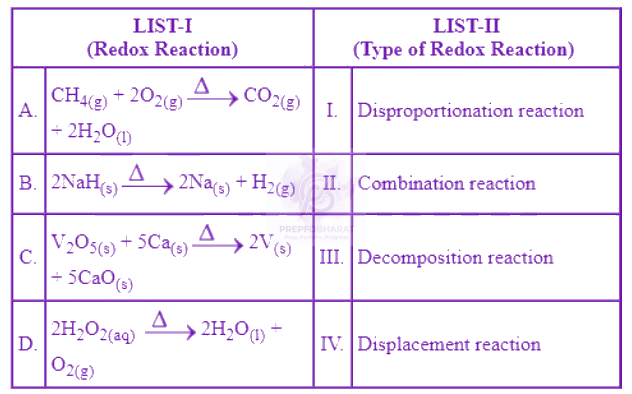 Choose the correct answer from the options given below:
The species which does not undergo disproportionation reaction is :
2 moles each of ethylene glycol and glucose are dissolved in 500 g of water. The boiling point of the resulting solution is : (Given : Ebullioscopic constant of water $\left.=0.52 \mathrm{~K} \mathrm{~kg} \mathrm{~mol}^{-1}\right)$
x mg of $\mathrm{Mg}(\mathrm{OH})_2($ molar mass $=58)$ is required to be dissolved in 1.0 L of water to produce a pH of 10.0 at 298 K. The value of x is ________ mg. (Nearest integer) (Given : $\mathrm{Mg}(\mathrm{OH})_2$ is assumed to dissociate completely in $\mathrm{H}_2 \mathrm{O}$)
If $\quad C$ (diamond $) \rightarrow C$ (graphite $)+\mathrm{X} \mathrm{kJ} \mathrm{mol}^{-1}$ $\mathrm{C}($ diamond $)+\mathrm{O}_2(\mathrm{~g}) \rightarrow \mathrm{CO}_2(\mathrm{~g})+\mathrm{Y} \mathrm{kJ} \mathrm{mol}^{-1}$ C (graphite) $+\mathrm{O}_2(\mathrm{~g}) \rightarrow \mathrm{CO}_2(\mathrm{~g})+\mathrm{Z} \mathrm{kJ} \mathrm{mol}^{-1}$ at constant temperature. Then
The energy of an electron in first Bohr orbit of H -atom is -13.6 eV. The magnitude of energy value of electron in the first excited state of $\mathrm{Be}^{3+}$ is ________ eV. (nearest integer value)
At the sea level, the dry air mass percentage composition is given as nitrogen gas : 70.0, oxygen gas : 27.0 and argon gas : 3.0. If total pressure is 1.15 atm , then calculate the ratio of followings respectively : (i) partial pressure of nitrogen gas to partial pressure of oxygen gas (ii) partial pressure of oxygen gas to partial pressure of argon gas (Given : Molar mass of $\mathrm{N}, \mathrm{O}$ and Ar are 14, 16, and $40 \mathrm{~g} \mathrm{~mol}^{-1}$ respectively)
Consider the following data : Heat of formation of $\mathrm{CO}_2(\mathrm{~g})=-393.5 \mathrm{~kJ} \mathrm{~mol}^{-1}$ Heat of formation of $\mathrm{H}_2 \mathrm{O}(\mathrm{l})=-286.0 \mathrm{~kJ} \mathrm{~mol}^{-1}$ Heat of combustion of benzene $=-3267.0 \mathrm{~kJ} \mathrm{~mol}^{-1}$ The heat of formation of benzene is _ $\mathrm{kJ} \mathrm{mol}{ }^{-1}$. (Nearest integer)
Consider the ground state of chromium atom $(\mathrm{Z}=24)$. How many electrons are with Azimuthal quantum number $l=1$ and $l=2$ respectively ?
40 mL of a mixture of $\mathrm{CH}_3 \mathrm{COOH}$ and HCl (aqueous solution) is titrated against 0.1 M NaOH solution conductometrically. Which of the following statement is correct? 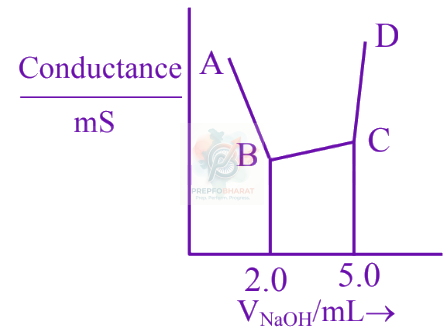
In the following system, $\mathrm{PCl}_5(\mathrm{~g}) \rightleftharpoons \mathrm{PCl}_3(\mathrm{~g})+\mathrm{Cl}_2(\mathrm{~g})$ at equilibrium, upon addition of xenon gas at constant $\mathrm{T} \& \mathrm{p}$, the concentration of
Electrolysis of 600 mL aqueous solution of NaCl for 5 min changes the pH of the solution to 12 . The current in Amperes used for the given electrolysis is ____. (Nearest integer).
Given below are two statements : Statement (I) : A spectral line will be observed for a $2 \mathrm{p}_x \rightarrow 2 \mathrm{p}_y$ transition. Statement (II) : $2 P_x$ and $2 p_y$ are degenerate orbitals. In the light of the above statements, choose the correct answer from the options given below :
Butane reacts with oxygen to produce carbon dioxide and water following the equation given below $\mathrm{C}_4 \mathrm{H}_{10}(\mathrm{~g})+\frac{13}{2} \mathrm{O}_2(\mathrm{~g}) \rightarrow 4 \mathrm{CO}_2(\mathrm{~g})+5 \mathrm{H}_2 \mathrm{O}(\mathrm{l})$ If 174.0 kg of butane is mixed with 320.0 kg of $\mathrm{O}_2$, the volume of water formed in litres is ________.(Nearest integer) [Given : (a) Molar mass of $\mathrm{C}, \mathrm{H}, \mathrm{O}$ are 12, 1, $16 \mathrm{~g} \mathrm{~mol}^{-1}$ respectively, (b) Density of water $\left.=1 \mathrm{~g} \mathrm{~mL}^{-1}\right]$
According to Bohr's model of hydrogen atom, which of the following statement is incorrect?
$37.8 \mathrm{~g} \mathrm{~N}_2 \mathrm{O}_5$ was taken in a 1 L reaction vessel and allowed to undergo the following reaction at 500 K $2 \mathrm{~N}_2 \mathrm{O}_{5(\mathrm{~g})} \rightleftharpoons 2 \mathrm{~N}_2 \mathrm{O}_{4(\mathrm{~g})}+\mathrm{O}_{2(\mathrm{~g})}$ The total pressure at equilibrium was found to be 18.65 bar. Then, $\mathrm{Kp}=$ ______ $\times 10^{-2}$ [nearest integer] Assume $\mathrm{N}_2 \mathrm{O}_5$ to behave ideally under these conditions. Given: $\mathrm{R}=0.082$ bar $\mathrm{L} \mathrm{mol}^{-1} \mathrm{~K}^{-1}$
The reaction \(\mathrm{A}_2+\mathrm{B}_2 \rightarrow 2 \mathrm{AB}\) follows the mechanism 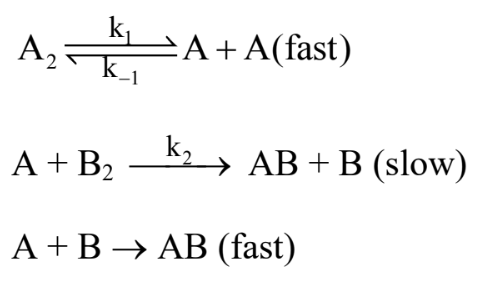 The overall order of the reaction is :