Physical Chemistry PYQ — Page 11
JEE Main Chemistry — Physical Chemistry previous year questions with solutions.
All Physical Chemistry Questions (1826)
Reactant A converts to product D through the given mechanism (with the net evolution of heat) : $\mathrm{A} \rightarrow \mathrm{B} \quad$ slow $; \Delta \mathrm{H}=+\mathrm{ve}$ $\mathrm{B} \rightarrow \mathrm{C}$ fast; $\Delta \mathrm{H}=-\mathrm{ve}$ $\mathrm{C} \rightarrow \mathrm{D} \quad$ fast ; $\Delta \mathrm{H}=-\mathrm{ve}$ Which of the following represents the above reaction mechanism?
$\mathrm{K}_{\text {sp }}$ for $\mathrm{Cr}(\mathrm{OH})_3$ is $1.6 \times 10^{-30}$. What is the molar solubility of this salt in water?
Among $10^{-9} \mathrm{~g}$ (each) of the following elements, which one will have the highest number of atoms? Element : $\mathrm{Pb}, \mathrm{Po}, \mathrm{Pr}$ and Pt
Given below are two statements : Statement (I) : Corrosion is an electrochemical phenomenon in which pure metal acts as an anode and impure metal as a cathode. Statement (II) : The rate of corrosion is more in alkaline medium than in acidic medium. In the light of the above statements, choose the correct answer from the options given below :
A liquid when kept inside a thermally insulated closed vessel at $25^{\circ} \mathrm{C}$ was mechanically stirred from outside. What will be the correct option for the following thermodynamic parameters ?
$X Y$ is the membrane / partition between two chambers 1 and 2 containing sugar solutions of concentration $c_1$ and $c_2\left(c_1 \gt c_2\right) \mathrm{mol} \mathrm{L}^{-1}$. For the reverse osmosis to take place identify the correct condition (Here $p_1$ and $p_2$ are pressures applied on chamber 1 and 2) 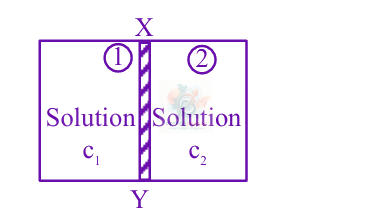 (A) Membrane/Partition; Cellophane, $\mathrm{p}_1 \gt \pi$ (B) Membrane/Partition ; Porous. $\mathrm{p}_2 \gt \pi$ (C) Membrane/Partition ; Parchment paper, $\mathrm{p}_1 \gt \pi$ (D) Membrane/Partition : Cellophane, $\mathrm{p}_2 \gt \pi$ Choose the correct answer from the option given below :
Given below are two statements : Statement (I) : NaCl is added to the ice at $0^{\circ} \mathrm{C}$, present in the ice cream box to prevent the melting of ice cream. Statement (II) : On addition of NaCl to ice at $0^{\circ} \mathrm{C}$, there is a depression in freezing point. In the light of the above statements, choose the correct answer from the options given below :
Assume a living cell with $0.9 \%(\omega / \omega)$ of glucose solution (aqueous). This cell is immersed in another solution having equal mole fraction of glucose and water. (Consider the data upto first decimal place only) The cell will :
Which of the following graph correctly represents the plots of \(\mathrm{K}_{\mathrm{H}}\) at 1 bar gases in water versus temperature?
The observed and normal molar masses of compound $\mathrm{MX}_2$ are 65.6 and 164 respectively. The percent degree of ionisation of $\mathrm{MX}_2$ is $\ldots\ldots$ %. (Nearest integer)
The standard reduction potential values of some of the p-block ions are given below. Predict the one with the strongest oxidising capacity.
Consider the given data : (a) $\mathrm{HCl}(\mathrm{g})+10 \mathrm{H}_2 \mathrm{O}(\mathrm{l}) \rightarrow \mathrm{HCl}.10 \mathrm{H}_2 \mathrm{O}$ $\Delta \mathrm{H}=-69.01 \mathrm{~kJ} \mathrm{~mol}^{-1}$ (b) $\mathrm{HCl}(\mathrm{g})+40 \mathrm{H}_2 \mathrm{O}(\mathrm{l}) \rightarrow \mathrm{HCl}.40 \mathrm{H}_2 \mathrm{O}$ $\Delta \mathrm{H}=-72.79 \mathrm{~kJ} \mathrm{~mol}^{-1}$ Choose the correct statement :
In a multielectron atom, which of the following orbitals described by three quantum numbers will have same energy in absence of electric and magnetic fields? A. $\mathrm{n}=1, \mathrm{l}=0, \mathrm{~m}_1=0$ B. $\mathrm{n}=2, \mathrm{l}=0, \mathrm{~m}_1=0$ C. $\mathrm{n}=2, \mathrm{l}=1, \mathrm{~m}_1=1$ D. $\mathrm{n}=3, \mathrm{l}=2, \mathrm{~m}_1=1$ E. $\mathrm{n}=3, \mathrm{l}=2, \mathrm{~m}_1=0$ Choose the correct answer from the options given below:
When 81.0 g of aluminium is allowed to react with 128.0 g of oxygen gas, the mass of aluminium oxide produced in grams is_______ - (Nearest integer) Given : Molar mass of Al is $27.0 \mathrm{~g} \mathrm{~mol}^{-1}$ Molar mass of O is $16.0 \mathrm{~g} \mathrm{~mol}^{-1}$
Given below are two statements : Statement I : When a system containing ice in equilibrium with water (liquid) is heated, heat is absorbed by the system and there is no change in the temperature of the system until whole ice gets melted. Statement II : At melting point of ice, there is absorption of heat in order to overcome intermolecular forces of attraction within the molecules of water in ice and kinetic energy of molecules is not increased at melting point. In the light of the above statements, choose the correct answer from the options given below:
Which one of the following about an electron occupying the 1 s orbital in a hydrogen atom is incorrect ? (Bohr's radius is represented by a $a_0$)
10 mL of 2 M NaOH solution is added to 20 mL of 1 M HCl solution kept in a beaker. Now, 10 mL of this mixture is poured into a volumetric flask of 100 mL containing 2 moles of HCl and made the volume upto the mark with distilled water. The solution in this flask is :
$0.2 \%(\mathrm{w} / \mathrm{v})$ solution of NaOH is measured to have resistivity $870.0 \mathrm{~m} \Omega \mathrm{~m}$. The molar conductivity of the solution will be ______ $\times 10^2 \mathrm{mS} \mathrm{dm}{ }^2 \mathrm{~mol}^{-1}$. (Nearest integer)
When 1 g each of compounds AB and $\mathrm{AB}_2$ are dissolved in 15 g of water separately, they increased the boiling point of water by 2.7 K and 1.5 K respectively. The atomic mass of A (in amu) is ____ $\times 10^{-1}$ (Nearest integer) (Given : Molal boiling point elevation constant is $\left.0.5 \mathrm{~K} \mathrm{~kg} \mathrm{~mol}^{-1}\right)$
In a reaction $A+B \rightarrow C$, initial concentrations of $A$ and $B$ are related as $[A]_0=8[B]_0$. The half lives of $A$ and $B$ are 10 min and 40 min. respectively. If they start to disappear at the same time, both following first order kinetics, after how much time will the concentration of both the reactants be same?
The elemental composition of a compound is $54.2 \% \mathrm{C}, 9.2 \% \mathrm{H}$ and $36.6 \% \mathrm{O}$. If the molar mass of the compound is $132 \mathrm{~g} \mathrm{~mol}^{-1}$, the molecular formula of the compound is : [Given : The relative atomic mass of $\mathrm{C}: \mathrm{H}: \mathrm{O}=12: 1: 16$ ]
Some $\mathrm{CO}_2$ gas was kept in a sealed container at a pressure of 1 atm and at 273 K . This entire amount of $\mathrm{CO}_2$ gas was later passed through an aqueous solution of $\mathrm{Ca}(\mathrm{OH})_2$. The excess unreacted $\mathrm{Ca}(\mathrm{OH})_2$ was later neutralized with 0.1 M of 40 mL HCl . If the volume of the sealed container of $\mathrm{CO}_2$ was $x$, then $x$ is ________ $\mathrm{cm}^3$ (nearest integer). [Given : The entire amount of $\mathrm{CO}_2(\mathrm{~g})$ reacted with exactly half the initial amount of $\mathrm{Ca}(\mathrm{OH})_2$ present in the aqueous solution.]
${ }^1$ The standard enthalpy and standard entropy of decomposition of $\mathrm{N}_2 \mathrm{O}_4$ to $\mathrm{NO}_2$ are $55.0 \mathrm{~kJ} \mathrm{~mol}^{-1}$ and $175.0 \mathrm{~J} / \mathrm{K} / \mathrm{mol}$ respectively. The standard free energy change for this reaction at $25^{\circ} \mathrm{C}$ in J $\mathrm{mol}^{-1}$ is ______ (Nearest integer)