Physical Chemistry PYQ — Page 10
JEE Main Chemistry — Physical Chemistry previous year questions with solutions.
All Physical Chemistry Questions (1826)
For a reaction, $\mathrm{N}_2 \mathrm{O}_{5(\mathrm{~g})} \rightarrow 2 \mathrm{NO}_{2(\mathrm{~g})}+\frac{1}{2} \mathrm{O}_{2(\mathrm{~g})}$ in a constant volume container, no products were present initially. The final pressure of the system when $50 \%$ of reaction gets completed is
A person's wound was exposed to some bacteria and then bacteria growth started to happen at the same place. The wound was later treated with some antibacterial medicine and the rate of bacterial decay (r) was found to be proportional with the square of the existing number of bacteria at any instance. Which of the following set of graphs correctly represents the 'before' and 'after' situation of the application of the medicine? [Given : $\mathrm{N}=$ No. of bacteria, $\mathrm{t}=$ time, bacterial growth follows $I^{\text {st }}$ order kinetics.]
The correct statement amongst the following is :
\(\mathrm{CaCO}_3(\mathrm{~s})+2 \mathrm{HCl}(\mathrm{aq}) \rightarrow \mathrm{CaCl}_2(\mathrm{aq})+\mathrm{CO}_2(\mathrm{~g}) \mathrm{H}_2 \mathrm{O}(\mathrm{l})\) Consider the above reaction, what mass of \(\mathrm{CaCl}_2\) will be formed if 250 mL of 0.76 M HCl reacts with 1000 g of \(\mathrm{CaCO}_3\) ? (Given : Molar mass of \(\mathrm{Ca}, \mathrm{C}, \mathrm{O}, \mathrm{H}\) and Cl are 40, \(12,16,1\) and \(35.5 \mathrm{~g} \mathrm{~mol}^{-1}\), respectively)
Correct order of limiting molar conductivity for cations in water at 298 K is :
A vessel at 1000 K contains $\mathrm{CO}_2$ with a pressure of 0.5 atm . Some of $\mathrm{CO}_2$ is converted into CO on addition of graphite. If total pressure at equilibrium is 0.8 atm , then Kp is :
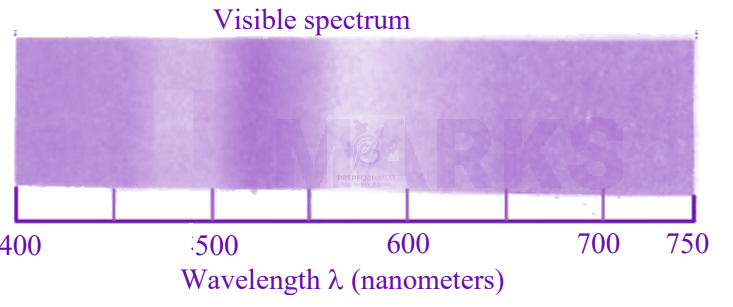 Which of the following statements are correct, if the threshold frequency of caesium is $5.16 \times 10^{14} \mathrm{~Hz}$ ? A. When Cs is placed inside a vacuum chamber with an ammeter connected to it and yellow light is focused on Cs the ammeter shows the presence of current. B. When the brightness of the yellow light is dimmed, the value of the current in the ammeter is reduced. C. When a red light is used instead to the yellow light, the current produced is higher with respect to the yellow light. D. When a blue light is used, the ammeter shows the formation of current. E. When a white light is used, the ammeter shows formation of current. Choose the correct answer from the options given below :
The hydration energies of $\mathrm{K}^{+}$and $\mathrm{Cl}^{-}$are -x and -y $\mathrm{kJ} / \mathrm{mol}$ respectively. If lattice energy of KCl is -z $\mathrm{kJ} / \mathrm{mol}$, then the heat of solution of KCl is :
A weak acid HA has degree of dissociation x . Which option gives the correct expression of ( pH $\mathrm{pK}_{\mathrm{a}}$ )?
Consider the given figure and choose the correct option : 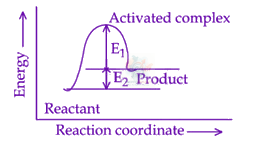
The molar solubility(s) of zirconium phosphate with molecular formula $\left(\mathrm{Zr}^{4+}\right)_3\left(\mathrm{PO}_4^{3-}\right)_4$ is given by relation :
Match List - I with List - II. 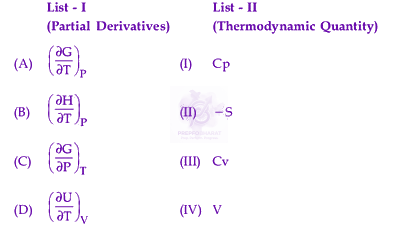 Choose the correct answer from the options given below :
The amount of calcium oxide produced on heating 150 kg limestone ( $75 \%$ pure) is ______ kg. (Nearest integer) Given : Molar mass (in $\mathrm{g} \mathrm{mol}^{-1}$) of Ca-40, O-16, C-12
Total enthalpy change for freezing of 1 mol of water at $10^{\circ} \mathrm{C}$ to ice at $-10^{\circ} \mathrm{C}$ is ____ (Given : $\Delta_{\text {fus }} H=x \mathrm{~kJ} / \mathrm{mol}$) $\begin{aligned} & \mathrm{C}_{\mathrm{p}}\left[\mathrm{H}_2 \mathrm{O}(\mathrm{l})\right]=\mathrm{y} \mathrm{J} \mathrm{mol}^{-1} \mathrm{~K}^{-1} \\ & \mathrm{C}_{\mathrm{p}}\left[\mathrm{H}_2 \mathrm{O}(\mathrm{s})\right]=\mathrm{z} \mathrm{J} \mathrm{mol}^{-1} \mathrm{~K}^{-1}\end{aligned}$
Standard entropies of $\mathrm{X}_2, \mathrm{Y}_2$ and $\mathrm{XY}_5$ are 70,50 and $110 \mathrm{~J} \mathrm{~K}^{-1} \mathrm{~mol}^{-1}$ respectively. The temperature in Kelvin at which the reaction $\frac{1}{2} \mathrm{X}_2+\frac{5}{2} \mathrm{Y}_2 \rightleftharpoons \mathrm{XY}_5 \Delta \mathrm{H}^{\Theta}=-35 \mathrm{~kJ} \mathrm{~mol}^{-1}$ will be at equilibrium is_______. (Nearest integer)
Match List - I with List - II : \(\begin{array}{llll} & \text { List - I } & \text { List - II } \\ & \text { Applications } & \text { Batteries } / \text { Cell } \\ \text { (A) } & \text { Transistors } & \text { (I) } \text { Anode }-\mathrm{Zn} / \mathrm{Hg} \text {; Cathode }-\mathrm{HgO}+\mathrm{C} \\ \text { (B) } & \text { Hearing aids } & \text { (II) } \text { Hydrogen fuel cell } \\ \text { (C) } & \text { Invertors } & \text { (III) Anode }-\mathrm{Zn} \text {; Cathode }- \text { Carbon } \\ \text { (D) } & \text { Apollo space ship } & \text { (IV) Anode }-\mathrm{Pb} \text {; Cathode }-\mathrm{Pb} \mid \mathrm{PbO}_2 \end{array}\) Choose the correct answer from the options given below :
Concentrated nitric acid is labelled as $75 \%$ by mass. The volume in mL of the solution which contains 30 g of nitric acid is ____. Given : Density of nitric acid solution is $1.25 \mathrm{~g} / \mathrm{mL}$.
Which of the following statements are true? (A) The subsidiary quantum number $l$ describes the shape of the orbital occupied by the electron. (B) 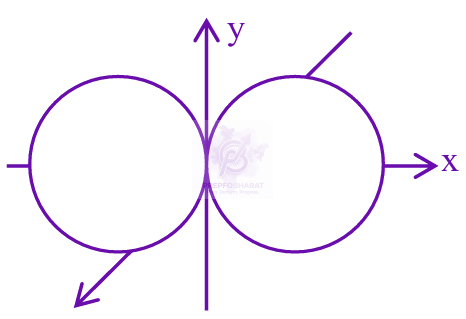 is the boundary surface diagram of the $2 p_x$ orbital. (C) The + and - signs in the wave function of the $2 \mathrm{p}_{\mathrm{x}}$ orbital refer to charge. (D) The wave function of $2 p_x$ orbital is zero everywhere in the xy plane.
Which of the following is/are not correct with respect to energy of atomic orbitals of hydrogen atom? (A)$1 \mathrm{~s} \lt 2 \mathrm{p} \lt 3 \mathrm{~d} \lt 4 \mathrm{~s}$ (B) $1 \mathrm{~s} \lt 2 \mathrm{~s}=2 \mathrm{p} \lt 3 \mathrm{~s}=3 \mathrm{p}$ (C) $1 \mathrm{~s} \lt 2 \mathrm{~s} \lt 2 \mathrm{p} \lt 3 \mathrm{~s} \lt 3 \mathrm{p}$ (D) $1 \mathrm{~s} \lt 2 \mathrm{~s} \lt 4 \mathrm{~s} \lt 3 \mathrm{~d}$ Choose the correct answer from the options given below :
The extra stability of half-filled subshell is due to (A) Symmetrical distribution of electrons (B) Smaller coulombic repulsion energy (C) The presence of electrons with the same spin in non-degenerate orbitals (D) Larger exchange energy (E) Relatively smaller shielding of electrons by one another Identify the correct statements
Given : $\begin{aligned}<br />& \Delta \mathrm{H}_{\text {sub }}^{\ominus}[\mathrm{C}(\text { graphite })]=710 \mathrm{~kJ} \mathrm{~mol}^{-1} \\ & \Delta_{\mathrm{C}-\mathrm{H}} \mathrm{H}^{\ominus}=414 \mathrm{~kJ} \mathrm{~mol}^{-1} \\ & \Delta_{\mathrm{H}-\mathrm{H}} \mathrm{H}^{\Theta}=436 \mathrm{~kJ} \mathrm{~mol}^{-1} \\ & \Delta_{\mathrm{C}=\mathrm{C}} \mathrm{H}^{\Theta}=611 \mathrm{~kJ} \mathrm{~mol}^{-1}<br />\end{aligned}$ The $\Delta \mathrm{H}_{\mathrm{f}}^{\ominus}$ for $\mathrm{CH}_2=\mathrm{CH}_2$ is _____ $\mathrm{kJ} \mathrm{mol}^{-1}$ (nearest integer value)
Consider the following reaction occurring in the blast furnace: $\mathrm{Fe}_3 \mathrm{O}_{4(\mathrm{~s})}+4 \mathrm{CO}_{(\mathrm{g})} \rightarrow 3 \mathrm{Fe}_{(\mathrm{l})}+4 \mathrm{CO}_{2(\mathrm{~g})}$ ' $x$ ' kg of iron is produced when $2.32 \times 10^3 \mathrm{~kg} \mathrm{Fe}_3 \mathrm{O}_4$ and $2.8 \times 10^2 \mathrm{~kg} \mathrm{CO}$ are brought together in the furnace. The value of ' $x$ ' is _____. (nearest integer) Given: molar mass of $\mathrm{Fe}_3 \mathrm{O}_4=232 \mathrm{~g} \mathrm{~mol}^{-1}$ molar mass of $\mathrm{CO}=28 \mathrm{~g} \mathrm{~mol}^{-1}$ molar mass of $\left.\mathrm{Fe}=56 \mathrm{~g} \mathrm{~mol}^{-1}\right\}$
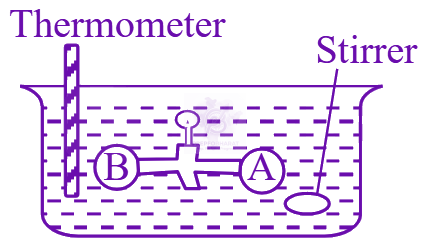 Two vessels A and B are connected via stopcock. The vessel A is filled with a gas at a certain pressure. The entire assembly is immersed in water and is allowed to come to thermal equilibrium with water. After opening the stopcock the gas from vessel A expands into vessel B and no change in temperature is observed in the thermometer. Which of the following statement is true?
Which of the following statement is not true for radioactive decay?