JEE Main Chemistry — Physical Chemistry previous year questions with solutions.
Ice at $-5^{\circ} \mathrm{C}$ is heated to become vapor with temperature of $110^{\circ} \mathrm{C}$ at atmospheric pressure. The entropy change associated with this process can be obtained from
Arrange the following in order of magnitude of work done by the system / on the system at constant temperature : (a) $\left|\mathrm{w}_{\text {reversible }}\right|$ for expansion in infinite stage. (b) $\left|w_{\text {irreversible }}\right|$ for expansion in single stage. (c) $\left|w_{\text {reversible }}\right|$ for compression in infinite stage. (d) $\left|w_{\text {irreversible }}\right|$ for compression in single stage. Choose the correct answer from the options given below:
Consider the equilibrium $\mathrm{CO}(\mathrm{~g})+3 \mathrm{H}_2(\mathrm{~g}) \rightleftharpoons \mathrm{CH}_4(\mathrm{~g})+\mathrm{H}_2 \mathrm{O}(\mathrm{~g})$ If the pressure applied over the system increases by two fold at constant temperature then (A) Concentration of reactants and products increases. (B) Equilibrium will shift in forward direction. (C) Equilibrium constant increases since concentration of products increases. (D) Equilibrium constant remains unchanged as concentration of reactants and products remain same. Choose the correct answer from the options given below :
If $\quad C$ (diamond $) \rightarrow C$ (graphite $)+\mathrm{X} \mathrm{kJ} \mathrm{mol}^{-1}$ $\mathrm{C}($ diamond $)+\mathrm{O}_2(\mathrm{~g}) \rightarrow \mathrm{CO}_2(\mathrm{~g})+\mathrm{Y} \mathrm{kJ} \mathrm{mol}^{-1}$ C (graphite) $+\mathrm{O}_2(\mathrm{~g}) \rightarrow \mathrm{CO}_2(\mathrm{~g})+\mathrm{Z} \mathrm{kJ} \mathrm{mol}^{-1}$ at constant temperature. Then
Consider the following data : Heat of formation of $\mathrm{CO}_2(\mathrm{~g})=-393.5 \mathrm{~kJ} \mathrm{~mol}^{-1}$ Heat of formation of $\mathrm{H}_2 \mathrm{O}(\mathrm{l})=-286.0 \mathrm{~kJ} \mathrm{~mol}^{-1}$ Heat of combustion of benzene $=-3267.0 \mathrm{~kJ} \mathrm{~mol}^{-1}$ The heat of formation of benzene is _ $\mathrm{kJ} \mathrm{mol}{ }^{-1}$. (Nearest integer)
The bond dissociation enthalpy of $\mathrm{X}_2 \Delta \mathrm{H}_{\text {bond }}$ calculated from the given data is $\qquad$ $\mathrm{kJ} \mathrm{mol}^{-1}$. (Nearest integer) $\begin{aligned} & \mathrm{M}^{+} \mathrm{X}^{-}(\mathrm{s}) \rightarrow \mathrm{M}^{+}(\mathrm{g})+\mathrm{X}^{-}(\mathrm{g}) \Delta \mathrm{H}_{\text {lattice }}^*=800 \mathrm{~kJ} \mathrm{~mol}^{-1} \\ & \mathrm{M}(\mathrm{~s}) \rightarrow \mathrm{M}(\mathrm{~g}) \Delta \mathrm{H}_{\text {sub }}^{\circ}=100 \mathrm{~kJ} \mathrm{~mol}^{-1} \end{aligned}$ $\mathrm{M}(\mathrm{~g}) \rightarrow \mathrm{M}^{+}(\mathrm{g})+\mathrm{e}^{-}(\mathrm{g}) \Delta \mathrm{H}_{\mathrm{i}}=500 \mathrm{~kJ} \mathrm{~mol}^{-1}$ $\mathrm{X}(\mathrm{~g})+\mathrm{e}^{-}(\mathrm{g}) \rightarrow \mathrm{X}^{-}(\mathrm{g}) \Delta \mathrm{H}_{\mathrm{eg}}^*=-300 \mathrm{~kJ} \mathrm{~mol}^{-1}$ $\mathrm{M}(\mathrm{~s})+\frac{1}{2} \mathrm{X}_2(\mathrm{~g}) \rightarrow \mathrm{M}^{+} \mathrm{X}^{-}(\mathrm{s}) \Delta \mathrm{H}_f^{\circ}=-400 \mathrm{~kJ} \mathrm{~mol}^{-1}$ [Given : $\mathrm{M}^{+} \mathrm{X}^{-}$is a pure ionic compound and X forms a diatomic molecule $\mathrm{X}_2$ in gaseous state]
If \(\mathrm{a}_0\) is denoted as the Bohr radius of hydrogen atom, then what is the de-Broglie wavelength \((\lambda)\) of the electron present in the second orbit of hydrogen atom? [n : any integer]
For the reaction, $\mathrm{H}_2(\mathrm{~g})+\mathrm{I}_2(\mathrm{~g}) \rightleftharpoons 2 \mathrm{HI}(\mathrm{~g})$ Attainment of equillibrium is predicted correctly by :
The metals that are employed in the battery industries are A. Fe, B. Mn, C. Ni, D. Cr, E. Cd Choose the correct answer from the options given below:
The following concentrations were observed at $500K$ for the formation of ${\mathrm{NH}}_{3}$ from ${N}_{2}$ and ${H}_{2}$. At equilibrium : $[{N}_{2}]=2\times {10}^{-2}M,[{H}_{2}]=3\times {10}^{-2}M$ and $[{\mathrm{NH}}_{3}]=1.5\times {10}^{-2}M$. Equilibrium constant for the reaction is ______.
The quantity which changes with temperature is:
Consider the following first order gas phase reaction at constant temperature \(\mathrm{A}(\mathrm{g}) \rightarrow 2 \mathrm{~B}(\mathrm{~g})+\mathrm{C}(\mathrm{g})\) If the total pressure of the gases is found to be 200 torr after \(23 \mathrm{sec}\). and 300 torr upon the complete decomposition of A after a very long time, then the rate constant of the given reaction is ______ \(\times 10^{-2} \mathrm{~s}^{-1}\) (nearest integer) [Given : \(\log _{10}(2)=0.301\)]
The reaction at cathode in the cells commonly used in clocks involves.
Molality of an aqueous solution of urea is \(4.44 \mathrm{~m}\). Mole fraction of urea in solution is \(x \times 10^{-3}\). Value of \(x\) is \(\qquad\) - (Integer answer)
The potential for the given half cell at $298K$ is $(-)$............ $\times {10}^{-2}V.$ $2{H}_{(\mathrm{aq})}^{+}+2{e}^{-}\rightarrow {H}_{2}(g)$ $[{H}^{+}]=1M,{P}_{{H}_{2}}=2\mathrm{atm}$ (Given$2.303\mathrm{RT}/F=0.06V,\mathrm{log}2=0.3$)
Match List I with List II 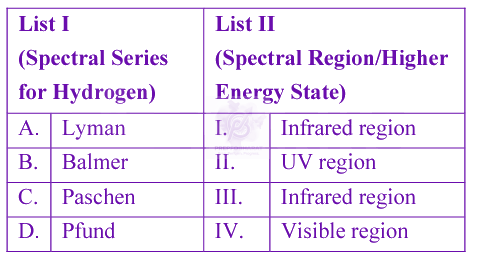 Choose the correct answer from the options given below :-
Molality of $0.8M{H}_{2}{\mathrm{SO}}_{4}$ solution (density $1.06g{\mathrm{cm}}^{-3}$ ) is _______$\times {10}^{-3}m$. Round off your answer to the nearest integer.
For a strong electrolyte, a plot of molar conductivity against (concentration) \({ }^{1 / 2}\) is a straight line, with a negative slope, the correct unit for the slope is
Volume of $3M\mathrm{NaOH}$ (formula weight $40g{\mathrm{mol}}^{-1}$ ) which can be prepared from $84g$ of $\mathrm{NaOH}$ is ____$\times {10}^{-1}{\mathrm{dm}}^{3}$.
A solution of ${H}_{2}{\mathrm{SO}}_{4}$ is $31.4%{H}_{2}{\mathrm{SO}}_{4}$ by mass and has a density of $1.25g/\mathrm{mL}$. The molarity of the ${H}_{2}{\mathrm{SO}}_{4}$ solution is $M$ (nearest integer) [Given molar mass of ${H}_{2}{\mathrm{SO}}_{4}=98g{\mathrm{mol}}^{-1}$]
Consider the following reactions \(\mathrm{NiS}+\mathrm{HNO}_3+\mathrm{HCl} \rightarrow \mathrm{A}+\mathrm{NO}+\mathrm{S}+\mathrm{H}_2 \mathrm{O}\) \(\begin{aligned} \mathrm{A}+\mathrm{NH}_4 \mathrm{OH}+\mathrm{H}_3 \mathrm{C}-\mathrm{C} & =\mathrm{N}-\mathrm{OH} \\ | ~\\ \mathrm{H}_3 \mathrm{C}-\mathrm{C} & =\mathrm{N}-\mathrm{OH}\end{aligned} \rightarrow \mathrm{B}+\mathrm{NH}_4 \mathrm{Cl}+\mathrm{H}_2 \mathrm{O}\) The number of protons that do not involve in hydrogen bonding in the product \(B\) is ______.
\(2.7 \mathrm{~kg}\) of each of water and acetic acid are mixed. The freezing point of the solution will be \(-x^{\circ} \mathrm{C}\). Consider the acetic acid does not dimerise in water, nor dissociates in water. \(x=\) ______ (nearest integer) [Given: Molar mass of water \(=18 \mathrm{~g} \mathrm{~mol}^{-1}\), acetic acid \(=60 \mathrm{~g} \mathrm{~mol}^{-1}\) \(\mathrm{K}_{\mathrm{f}} \mathrm{H}_2 \mathrm{O}: 1.86 \mathrm{~K} \mathrm{~kg} \mathrm{~mol}^{-1}\) \(\mathrm{K}_{\mathrm{f}}\) acetic acid: \(3.90 \mathrm{~K} \mathrm{~kg} \mathrm{~mol}^{-1}\) freezing point: \(\mathrm{H}_2 \mathrm{O}=273 \mathrm{~K}\), acetic acid \(=290 \mathrm{~K}\)]
When equal volume of \(1 \mathrm{M} \mathrm{HCl}\) and \(1 \mathrm{M} \mathrm{H}_2 \mathrm{SO}_4\) are separately neutralised by excess volume of \(1 \mathrm{M}\) \(\mathrm{NaOH}\) solution. \(x\) and \(y \mathrm{~kJ}\) of heat is liberated respectively. The value of \(y / x\) is _______
The mass of zinc produced by the electrolysis of zinc sulphate solution with a steady current of $0.015A$ for $15$ minutes is $____\times {10}^{-4}g$. (Atomic mass of zinc $=65.4\mathrm{amu})$