Cell junctions are especially abundant in epithelial tissues. They consist of protein complexes and provide contact between neighbouring cells, between a cell and the extracellular matrix, or they built up the paracellular barrier of epithelia and control the paracellular transport. The other three (thrombocytes, tendon and hyaline cartilage) belongs to connective tissue. Thrombocytes or platelets aid the formation of blood clots by releasing various protein substances. Tendon attaches a muscle to a bone and hyaline cartilage gives flexibility and support at the joints. Related Theory Ciliated epithelium is a region of epithelium consisting of columnar or cuboidal cells bearing hairlike appendages that are capable of beating rapidly. Ciliated epithelium performs the function of moving particles or fluid over the epithelial surface in such structures as the trachea, bronchial tubes, and nasal cavities. It ofien occurs in the vicinity of mucus-secreting goblet cells.
In which one of the following preparations are you likely to come across cell junctions most frequently?
NEET UG 2007 — Zoology Structural Organisation in Animals
In which one of the following preparations are you likely to come across cell junctions most frequently?
Held on 30 Apr 2007 · Verified 9 Jul 2026.
Options
- A
thrombocytes
- B
tendon
- C
hyaline cartilage
- D
ciliated epithelium.
Did you get this right?
Sign in to track your attempts and accuracy.
Your note
Sign in to keep a private note on this question. Nothing you write is ever public.
NEET UG Structural Organisation in Animals in other years
More NEET UG Structural Organisation in Animals questions
In frog, the Renal portal system is a special venous connection that acts to link :
What is the name of the blood vessel that carries deoxygenated blood from the body to the heart in a frog?
Which of the following statement is correct about location of the male frog copulatory pad?
Three types of muscles are given as $\mathrm{a}, \mathrm{b}$ and c . Identify the correct matching pair along with their location in human body: 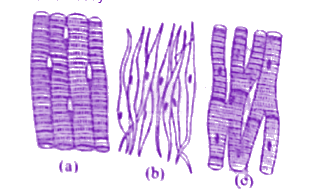 Name of muscle/location
Match List I with List II: $\begin{array}{|l|l|r|l|}\hline & \text{List I} & & \text{List II} \\ \hline A. & \begin{array}{l} \text{Unicellular glandular} \\ \text{epithelium} \end{array} & I. & \text{Salivary glands} \\ \hline B. & \text{Compound epithelium} & II. & \text{Pancreas} \\ \hline C. & \begin{array}{l} \text{Multicellular glandular} \\ \text{epithelium} \end{array} & III. & \text{Goblet cells of alimentary canal} \\ \hline D. & \begin{array}{l} \text{Endocrine glandular} \\ \text{epithelium} \end{array} & IV. & \text{Moist surface of buccal cavity} \\ \hline \end{array}$ Choose the correct answer from the options given below:
Other Zoology topics for NEET UG
Keep practicing Structural Organisation in Animals
Work through every NEET UG Structural Organisation in Animals PYQ, year by year.