Sickle cell anaemia in which RBCs become sickle-shaped and stiff is a genetic disorder which is autosomal and linked to a recessive allele. It has not been eliminated from the African population because it provides immunity against malaria. People who are heterozygous for the sickle cell allele are much less susceptible to falciparum malariaone of the main causes of illness and death. Since sickle-shaped RBC effectively kills the malaria parasite, the individuals heterozygous for this variant are able to cope with malaria infections much better than normal persons. The natural selection thus maintains this variant form of haemoglobin along with the normal haemoglobin in malaria prone areas.
Sickle cell anaemia has not been eliminated from the African population because:
NEET UG 2006 — Zoology Principles of Inheritance and Variation
2006mcqeasy
Sickle cell anaemia has not been eliminated from the African population because:
Official previous-year question
Held on 30 Apr 2006 · Verified 9 Jul 2026.
Options
- A
it is controlled by dominant genes
- B
it is controlled by recessive genes
- C
it is not a fatal disease
- D
it provides immunity against malaria
Did you get this right?
Sign in to track your attempts and accuracy.
Your note
Sign in to keep a private note on this question. Nothing you write is ever public.
NEET UG Principles of Inheritance and Variation in other years
Principles of Inheritance and Variation 2025Principles of Inheritance and Variation 2024Principles of Inheritance and Variation 2023Principles of Inheritance and Variation 2022Principles of Inheritance and Variation 2021Principles of Inheritance and Variation 2020Principles of Inheritance and Variation 2019Principles of Inheritance and Variation 2018Principles of Inheritance and Variation 2017Principles of Inheritance and Variation 2016Principles of Inheritance and Variation 2015Principles of Inheritance and Variation 2014
More NEET UG Principles of Inheritance and Variation questions
What is the pattern of inheritance for polygenic trait?
2025easy
With the help of given pedigree, find out the probability for the birth of a child having no disease and being a carrier (has the disease mutation in one allele of the gene) in $F_3$ generation. 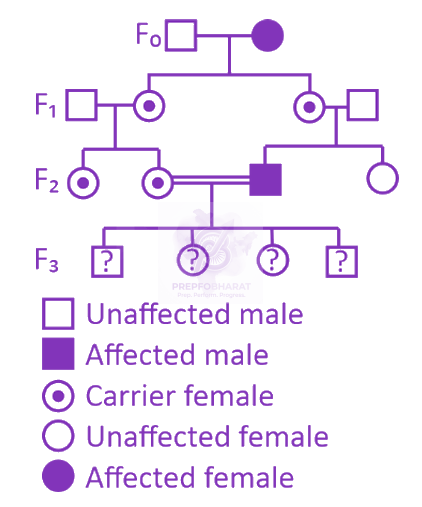
2025hard
Genes $R$ and $Y$ follow independent assortment. If RRYY produce round yellow seeds and rryy produce wrinkled green seeds, what will be the phenotypic ratio of the F2 generation?
2025medium
When a tall pea plant with round seeds was selfed, it produced the progeny of : (a) Tall plants with round seeds and (b) Tall plants with wrinkled seeds. Identify the genotype of the parent plant.
2024hard
Given below are two statements: Statement I: Failure of segregation of chromatids during cell cycle resulting in the gain or loss of whole set of chromosome in an organism is known as aneuploidy. Statement II: Failure of cytokinesis after anaphase stage of cell division results in the gain or loss of a chromosome is called polyploidy. In the light of the above statements, choose the correct answer from the options given below:
2024medium
Other Zoology topics for NEET UG
Keep practicing Principles of Inheritance and Variation
Work through every NEET UG Principles of Inheritance and Variation PYQ, year by year.