According to biological species concept, a species is a natural inbreeding group which may have essentially similar morphological traits but they are genetically distinct and reproductively isolated from others. As under laboratory conditions, N. tabacum and N. sylvestris cannot produce selffertile offspring, so they are not reproductively isolated. They are considered as separate species because since their flowering periods are different so cross pollination is not possible between them naturally. This makes them different species. Caution Students are generally intimidated by such long questions. However, in most cases. such type of questions are framed to test the presence of mind and witty nature. These questions are easy to answer and the actual question is asked in last 2 lines only, rest form the story around it. As in this case, 'What is the best reason for considering N. sylvestris and N. tabacum to be separate species' is the question in focus and the options given defines the universal term 'species.'
Nicotiana sylvestris flowers only during long days and N.tabacum flowers only during short days. If raised in the laboratory under different…
NEET UG 2003 — Zoology Principles of Inheritance and Variation
Nicotiana sylvestris flowers only during long days and N.tabacum flowers only during short days. If raised in the laboratory under different photoperiods, they can be indued to flower at the same time and can be cross-fertilized to produce self-fertile offspring. What is the best reason considering N. sylvestris and N.tabocum to be separate species ?
Held on 30 Apr 2003 · Verified 9 Jul 2026.
Options
- A
they cannot interbreed in nature
- B
they are reproductively distinct
- C
they are physiologically distinct
- D
they arc morphologically distinct
Did you get this right?
Sign in to track your attempts and accuracy.
Your note
Sign in to keep a private note on this question. Nothing you write is ever public.
NEET UG Principles of Inheritance and Variation in other years
More NEET UG Principles of Inheritance and Variation questions
What is the pattern of inheritance for polygenic trait?
With the help of given pedigree, find out the probability for the birth of a child having no disease and being a carrier (has the disease mutation in one allele of the gene) in $F_3$ generation. 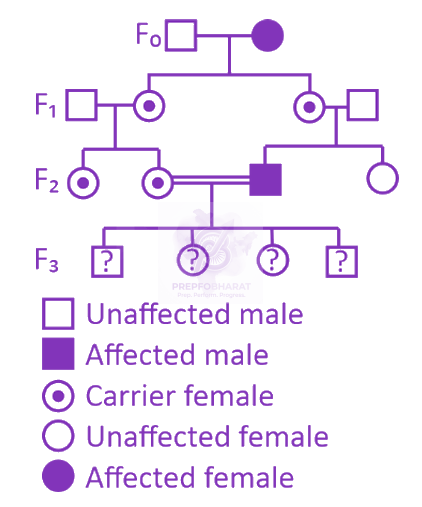
Genes $R$ and $Y$ follow independent assortment. If RRYY produce round yellow seeds and rryy produce wrinkled green seeds, what will be the phenotypic ratio of the F2 generation?
When a tall pea plant with round seeds was selfed, it produced the progeny of : (a) Tall plants with round seeds and (b) Tall plants with wrinkled seeds. Identify the genotype of the parent plant.
Given below are two statements: Statement I: Failure of segregation of chromatids during cell cycle resulting in the gain or loss of whole set of chromosome in an organism is known as aneuploidy. Statement II: Failure of cytokinesis after anaphase stage of cell division results in the gain or loss of a chromosome is called polyploidy. In the light of the above statements, choose the correct answer from the options given below:
Other Zoology topics for NEET UG
Keep practicing Principles of Inheritance and Variation
Work through every NEET UG Principles of Inheritance and Variation PYQ, year by year.