The autonomic nervous system regulates involuntary physiologic processes including heart rate, blood pressure, respiration, digestion, and sexual arousal. It contains three anatomically distinct divisions: sympathetic, parasympathetic and enteric. A reflex action, also known as a reflex, is an involuntary and nearly instantaneous movement in response to a stimulus. A reflex does not require any thought input. Peristalsis of intestine is related with autonomous nervous system whereas knee-jerk response, pupillary reflex and swallowing of food are reflex action. Related Theory The path taken by the nerve impulses in a reflex is called a reflex arc. In higher animals, most sensory neurons do not pass directly into the brain, but synapse in the spinal cord. This characteristic allows reflex actions to occur relatively quickly by activating spinal motor neurons without the delay of routing signals through the brain, although the brain will receive sensory input while the reflex action occurs. A Caution Autonomic nervous system is regulated by CNS while reflex action is controlled by spinal nerves
One of the examples of the action of the autonomous nervous system is:
NEET UG 2005 — Zoology Neural Control and Coordination
One of the examples of the action of the autonomous nervous system is:
Held on 30 Apr 2005 · Verified 9 Jul 2026.
Options
- A
swallowing of food
- B
pupillary reflex
- C
peristalsis of the intestines
- D
knee-jerk response.
Did you get this right?
Sign in to track your attempts and accuracy.
Your note
Sign in to keep a private note on this question. Nothing you write is ever public.
NEET UG Neural Control and Coordination in other years
More NEET UG Neural Control and Coordination questions
Match List-I with List -II \begin{array}{|l|l|l|l|}\hline & List-I & & List-II \\\hline A. & Schwann cells & I. & Neurotransmitter \\\hline B. & Synaptic knob & II. & Cerebral cortex \\\hline C. & Bipolar neurons & III. & Myelin sheath \\\hline D. & Multipolar neurons & IV. & Retina \\\hline\end{array} Choose the correct answer from the options given below:
Given below are two statements: Statement I: The cerebral hemispheres are connected by nerve tract known as corpus callosum. Statement II: The brain stem consists of the medulla oblongata, pons and cerebrum. In the light of the above statements, choose the most appropriate answer from the options given below:
Match List I with List II : 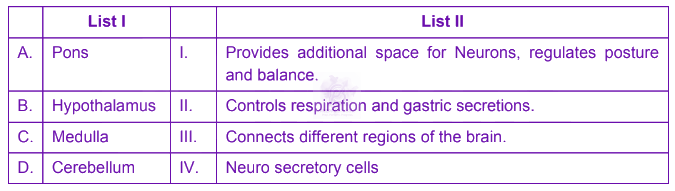 Choose the correct answer from the options given below :
The parts of human brain that helps in regulation of sexual behaviour, expression of excitement, pleaseure, rage, fear, etc. are:
Brainstem of human brain consists of:
Other Zoology topics for NEET UG
Keep practicing Neural Control and Coordination
Work through every NEET UG Neural Control and Coordination PYQ, year by year.