Calcium plays a key regulatory role in muscle contraction. Ca2+ ions bind to troponin and change their shape and position. This, in turn, alters the shape and position of tropomyosin and hence, the active sites on F-actin are exposed. Due to this, myosin cross-bridges are able to bind to these active sites and muscle contraction occurs.
Calcium important in skeletal muscle contraction because
NEET UG 2018 — Zoology Locomotion and Movement
2018mcqmedium
Calcium important in skeletal muscle contraction because
Official previous-year question
Held on 30 Apr 2018 · Verified 9 Jul 2026.
Options
- A
Detaches the myosin head from the actin filament
- B
Activates the myosin ATPase by binding to it
- C
Binds to troponin to remove the masking of active sites on actin for myosin
- D
Prevents the formation of bonds between the myosin cross bridges and actin filament
Did you get this right?
Sign in to track your attempts and accuracy.
Your note
Sign in to keep a private note on this question. Nothing you write is ever public.
NEET UG Locomotion and Movement in other years
Locomotion and Movement 2024Locomotion and Movement 2023Locomotion and Movement 2022Locomotion and Movement 2021Locomotion and Movement 2020Locomotion and Movement 2019Locomotion and Movement 2017Locomotion and Movement 2016Locomotion and Movement 2015Locomotion and Movement 2014Locomotion and Movement 2013Locomotion and Movement 2012
More NEET UG Locomotion and Movement questions
Match List-I with List-II: $\begin{array}{|l|l|r|l|}\hline & \begin{array}{l} \text{List I} \\ \text{Location of Joint} \end{array} & & \begin{array}{l} \text{List II} \\ \text{Type of Joint} \end{array} \\ \hline A. & \begin{array}{l} \text{Joint between humerus and} \\ \text{pectoral girdle} \end{array} & I. & \text{Gliding joint} \\ \hline B. & \text{Knee joint} & II. & \text{Ball and Socket joint} \\ \hline C. & \text{Joint between atlas and axis} & III. & \text{Hinge joint} \\ \hline D & \text{Joint between carpals} & IV. & \text{Pivot joint} \\ \hline \end{array}$ Chose the correct answer from the option given below:
2024medium
Match List I with List II :  Choose the correct answer from the options given below :
2024medium
Select the correct statements regarding mechanism of muscle contraction. A. It is initiated by a signal sent by CNS via sensory neuron. B. Neurotransmitter generates action potential in the sarcolemma. C. Increased $\mathrm{Ca}^{++}$level leads to the binding of calcium with troponin on action filaments. D. Masking of active site for actin is activated. E. Utilising the energy from ATP hydrolysis to form cross bridge. Choose the most appropriate answer from the options given below:
2024hard
Which of the following statements are correct regarding the skeletal muscle? A. Muscle bundles are held together by collagenous tissue layer called fascicle. B. Sarcoplasmic reticulum of muscle fibre is a store house of calcium ions. C. Striated appearance of skeletal muscle fibre is due to distribution pattern of actin and myosin proteins. D. M line is considered as functional unit of contraction called sarcomere. Choose the most appropriate answer from the options given below:
2023medium
Match List-I with List-II. 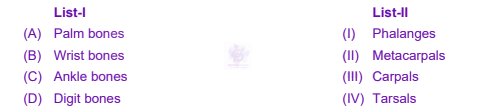 Choose the correct answer from the options given below:
2023easy
Other Zoology topics for NEET UG
Keep practicing Locomotion and Movement
Work through every NEET UG Locomotion and Movement PYQ, year by year.