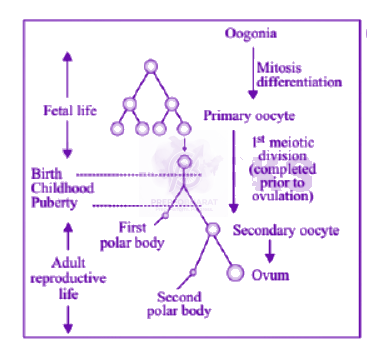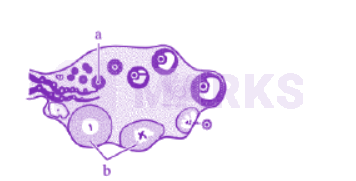
The zona pellucida and thecal cells of Graafian follicle in the ovary after ovulation forms corpus luteum, which produce progesterone. The tertiary follicle changes into the mature follicle or Graafian follicle and forms a new membrane called zona pellucida surrounding it. The Graafian follicle now ruptures to release the secondary oocyte (ovum) from the ovary. During oogenesis in embryonic development, oogonia start division and enter into prophase-I of the meiotic division and get temporarily arrested at that stage, called primary oocytes. Each primary oocyte then gets surrounded by a layer of granulosa cells and is called the primary follicle 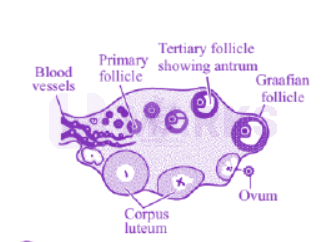
Related Theory The secondary follicle transforms into a tertiary follicle characterized by a fluid filled cavity called antrum. The theca layer organize into an inner theca interna and an outer theca externa. At this stage (puberty) the primary oocyte within the tertiary follicle grows in size and completes its first meiotic division. It is an unequal division resulting in the formation of a large haploid secondary oocyte and a tiny first polar body.