The pituitary gland is located in a bony cavity called sella tursica and is attached to hypothalamus by a stalk. It is divided anatomically into an adenohypophysis and a neurohypophysis. The latter is also called pars nervosa or posterior pituitary. It stores and releases two hormone called oxytocin and vasopressin, which are actually synthesized by the hypothalamus and are transported axonally to neurohypophysis. Vasopressin acts mainly at the kidney and stimulates resorption of water and electrolytes by the distal tubules in the nephron and therby reduces loss of water through urine (divereses). Hence, it is also called as anti-diuretic hormone (ADH) .
Match the source gland with its respective hormone as well as the function. NEET 2011 Zoology, Chemical Coordination and Integration — question figure
NEET UG 2011 — Zoology Chemical Coordination and Integration
2011mcqeasy
Match the source gland with its respective hormone as well as the function. 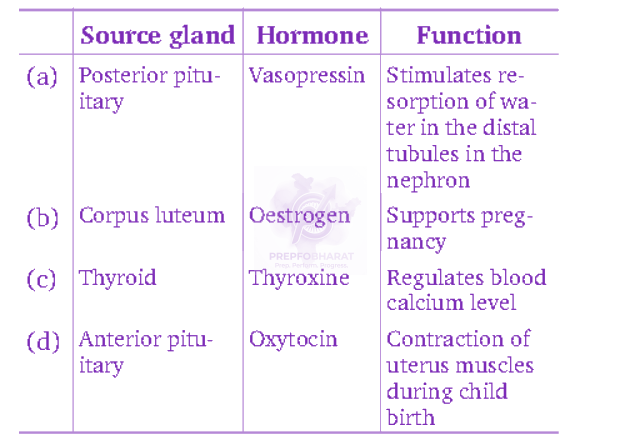
Official previous-year question
Held on 30 Apr 2011 · Verified 9 Jul 2026.
Options
- A
(a)
- B
(b)
- C
(c)
- D
(d)
Did you get this right?
Sign in to track your attempts and accuracy.
Your note
Sign in to keep a private note on this question. Nothing you write is ever public.
NEET UG Chemical Coordination and Integration in other years
Chemical Coordination and Integration 2025Chemical Coordination and Integration 2024Chemical Coordination and Integration 2023Chemical Coordination and Integration 2022Chemical Coordination and Integration 2020Chemical Coordination and Integration 2019Chemical Coordination and Integration 2018Chemical Coordination and Integration 2017Chemical Coordination and Integration 2016Chemical Coordination and Integration 2015Chemical Coordination and Integration 2014Chemical Coordination and Integration 2013
More NEET UG Chemical Coordination and Integration questions
Consider the following statements regarding function of adrenal medullary hormones : (A) It causes pupilary constriction. (B) It is a hyperglycemic hormone. (C) It causes piloerection. (D) It increases strength of heart contraction. Choose the correct answer from the options given below :
2025medium
Which of the following hormones released from the pituitary is actually synthesized in the hypothalamus?
2025easy
Match List-I with List-II. $\begin{array}{|l|l|l|l|}\hline & \text{List - I} & & \text{List - II} \\\hline \text{A}. & \text{Progesterone} & \text{(i)} & \text{Pars intermedia} \\\hline \text{B.} & \text{Relaxin} & \text{(ii)} & \text{Ovary} \\\hline \text{C.} & \text{Melanocyte stimulating hormone} & \text{(iii)} & \text{Adrenal Medulla} \\\hline \text{D.} & \text{Catecholamines} & \text{(iv)} & \text{Corpus luteum} \\\hline\end{array}$ Choose the correct answer from the options given below :
2025medium
Match List-I with List-II. $\begin{array}{|l|l|l|l|}\hline & \text{List - I} & & \text{List - II} \\\hline \text{A}. & \text{Heart} & \text{(i)} & \text{Erythropoietin} \\\hline \text{B.} & \text{Kidney} & \text{(ii)} & \text{Aldosterone} \\\hline \text{C.} & \text{Gastro-intestinal tract} & \text{(iii)} & \text{Atrial natriuretic factor} \\\hline \text{D.} & \text{Adrenal Cortex} & \text{(iv)} & \text{Secretin} \\\hline\end{array}$ Choose the correct answer from the options given below :
2025medium
Match List I with List II : \begin{array}{|l|l|l|l|}\hline & List I & & List II \\\hline A. & Exophthalmic goiter & I. & Excess secretion of cortisol, moon face \& hypergylcemia. \\\hline B. & Acromegaly & II. & Hypo-secretion of thyroid hormone and stunted growth. \\\hline C. & Cushing's syndrome & III. & Hyper secretion of thyroid hormone \& protruding eye balls. \\\hline D. & Cretinism & IV. & Excessive secretion of growth hormone. \\\hline\end{array} Choose the correct answer from the options given below :
2024medium
Other Zoology topics for NEET UG
Keep practicing Chemical Coordination and Integration
Work through every NEET UG Chemical Coordination and Integration PYQ, year by year.