When CO2 concentration in blood increases breathing becomes faster and deeper. The effect of increased CO2 is to decrease the affinity of haemoglobin for O2. Thus, due to Bohr's effect the CO2 released in respiring tissue accelerates the delivery of oxygen by faster and deeper breathing. Related Theory Bohr and Haldane's effect are two properties of haemoglobin. They help the dissociation of respiratory gases from the haemoglobin molecule based on the physiological conditions of their final destination. Bohr effect is the decrease of the oxygen binding capacity of haemoglobin with the increase of the concentration of carbon dioxide or decrease in pH whereas Haldane effect is the decrease of the carbon dioxide binding capacity of haemoglobin with the rise in the concentration of oxygen. Furthermore, Bohr effect aids in the release of oxygen from oxyhaemoglobin at the metabolizing tissues while Haldane effect aids in the release of carbon dioxide from carboxyhaemoglobin in the lungs.
When CO_2 concentration in blood increases breathing becomes:
NEET UG 2004 — Zoology Breathing and Exchange of Gases
When CO2 concentration in blood increases breathing becomes:
Held on 30 Apr 2004 · Verified 9 Jul 2026.
Options
- A
shallower and slow
- B
there is no effect on breathing
- C
slow and deep
- D
faster and deeper.
Did you get this right?
Sign in to track your attempts and accuracy.
Your note
Sign in to keep a private note on this question. Nothing you write is ever public.
NEET UG Breathing and Exchange of Gases in other years
More NEET UG Breathing and Exchange of Gases questions
Frogs respire in water by skin and buccal cavity and on land by skin, buccal cavity and lungs. Choose the correct answer from the following :
Match List-I with List-II. $\begin{array}{|l|l|l|l|}\hline & \text{List - I} & & \text{List - II} \\\hline \text{A}. & \text{Emphysema} & \text{(i)} & \text{Rapid spasms in muscle due to low } \mathrm{Ca}^{++} \text{ in body fluid} \\\hline \text{B.} & \text{Angina pectoris} & \text{(ii)} & \text{Damaged alveolar walls and decreased respiratory surface} \\\hline \text{C.} & \text{Glomerulonephritis} & \text{(iii)} & \text{Acute chest pain when not enough oxygen is reaching to heart muscle} \\\hline \text{D.} & \text{Tetany} & \text{(iv)} & \text{Inflammation of glomeruli of kidney} \\\hline\end{array}$ Choose the correct answer from the options given below :
Match List-I with List-II: $\begin{array}{|l|l|r|l|}\hline & \text{List-I} & & \text{List-II} \\ \hline A. & \text{Residual Volume} & I. & \begin{array}{l} \text{Maximum volume of air that can be breathed in after forced} \\ \text{expiration} \end{array} \\ \hline B. & \text{Vital Capacity} & II. & \text{Volume of air inspired or expired during normal respiration} \\ \hline C. & \text{Expiratory Capacity} & III. & \text{Volume of air remaining in lungs after forcible expiration} \\ \hline D. & \text{Tidal Volume} & IV. & \text{Total volume of air expired after normal inspiration} \\ \hline \end{array}$ Choose the correct answer from the options given below:
Given below are two statements: One is labelled as Assertion A and the other is labelled as Reason R. Assertion A: During the transportation of gases, about $20-25$ percent of $\mathrm{CO}_2$ is carried by Haemoglobin as carbamino-haemoglobin. Reason R: This binding is related to high $\mathrm{pCO}_2$ and low $\mathrm{pO}_2$ in tissues. In the light of the above statements, choose the correct answer from the options given below.
Match List I with List II : 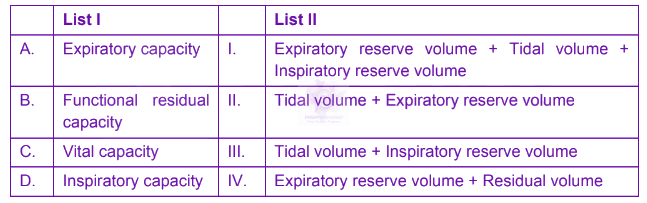 Choose the correct answer from the options given below :
Other Zoology topics for NEET UG
Keep practicing Breathing and Exchange of Gases
Work through every NEET UG Breathing and Exchange of Gases PYQ, year by year.