Option (2) is the answer because, the P-wave represents the electrical excitation (depolarisation) of the atria which leads to the contraction of both the atria. The QRS complex represents the depolarisation of the ventricles. The T-wave represents the return of the ventricles from excited to normal state (Repolarisation). The end of the T-wave marks the end of systole.
Match List-I with List-II NEET 2023 Zoology, Body Fluids and Circulation — question figure Choose the correct answer from the options given below :
NEET UG 2023 — Zoology Body Fluids and Circulation
2023mcqeasy
Match List-I with List-II 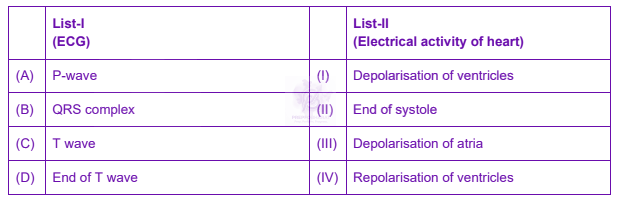
Choose the correct answer from the options given below :
Official previous-year question
Held on 30 Apr 2023 · Verified 9 Jul 2026.
Options
- A
(A)−(IV),(B)−(III),(C)−(I),(D)−(II)
- B
(A)−(III),(B)−(I),(C)−(IV),(D)−(II)
- C
(A)−(IV),(B)−(I),(C)−(III),(D)−(II)
- D
(A)−(I),(B)−(IV),(C)−(III),(D)−(II)
Did you get this right?
Sign in to track your attempts and accuracy.
Your note
Sign in to keep a private note on this question. Nothing you write is ever public.
NEET UG Body Fluids and Circulation in other years
Body Fluids and Circulation 2025Body Fluids and Circulation 2024Body Fluids and Circulation 2022Body Fluids and Circulation 2021Body Fluids and Circulation 2020Body Fluids and Circulation 2019Body Fluids and Circulation 2018Body Fluids and Circulation 2017Body Fluids and Circulation 2016Body Fluids and Circulation 2015Body Fluids and Circulation 2014Body Fluids and Circulation 2013
More NEET UG Body Fluids and Circulation questions
Cardiac activities of the heart are regulated by: A. Nodal tissue B. A special neural centre in the medulla oblongata C. Adrenal medullary hormones D. Adrenal cortical hormones Choose the correct answer from the options given below :
2025medium
A person with blood group $\mathrm{ARh}^{-}$can receive the blood transfusion from which of the following types? A. $\mathrm{BRh}^{-}$ B. $\mathrm{ABRh}^{-}$ C. $\mathrm{ORh}^{-}$ D. $\mathrm{ARh}^{-}$ E. $\mathrm{ARh}^{*}$ Choose the correct answer from the options given below :
2024medium
The mother has $\mathrm{A}+$ blood group the father has $\mathrm{B}+$ and the child is $\mathrm{A}+$. What can be the possibility of genotypes of all three, respectively? A. $\quad I^A I^A\left|I^B i\right| I^B i$ B. $\quad I^A I^A\left|I^B i\right| I^A i$ C. $\quad I^B i\left|I^A I^A\right| I^A I^B$ D. $\quad I^A I^A\left|I^B I^B\right| I^A i$ E. $\quad I^A i\left|I^B i\right| I^{A_i}$ Choose the correct answer from the option given below:
2024hard
Match List I with List II : \begin{array}{|l|l|l|l|}\hline & List I & & List II \\\hline A. & P wave & I. & Heart muscles are electrically silent. \\\hline B. & QRS complex & II. & Depolarisation of ventricles. \\\hline C. & T wave & III. & Depolarisation of atria. \\\hline D. & T-P gap & IV. & Repolarisation of ventricles. \\\hline\end{array} Choose the correct answer from the options given below :
2024easy
Given below are two statements : Statement I : Bone marrow is the main lymphoid organ where all blood cells including lymphocytes are produced. Statement II : Both bone marrow and thymus provide micro environments for the development and maturation of T-lymphocytes. In the light of above statements, choose the most appropriate answer from the options given below :
2024medium
Other Zoology topics for NEET UG
Keep practicing Body Fluids and Circulation
Work through every NEET UG Body Fluids and Circulation PYQ, year by year.