Modern Physics PYQ — Page 10
NEET UG Physics — Modern Physics previous year questions with solutions.
All Modern Physics Questions (300)
Two radioactive materials $X_1$ and $X_2$ have decay constants $5 \lambda$ and $\lambda$ respectively. If initially they have the same number of nuclei, then the ratio of the number of nuclei of $X_1$ to that of $X_2$ will be $\frac{1}{e}$ after a time
The circuit is equivalent to 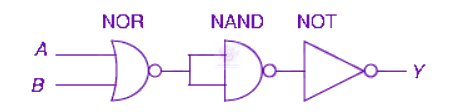
A p-n photodiode is made of a material with a band gap of $2.0 \mathrm{eV}$. The minimum frequency of the radiation that can be absorbed by the material is nearly
The ground state energy of hydrogen atom is $-13.6 \mathrm{eV}$. When its electron is in the first excited state, its excitation energy is
The work function of a surface of a photosensitive material is $6.2 \mathrm{eV}$. The wavelength of the incident radiation for which the stopping potential is $5 \mathrm{~V}$ lies in the
The ground state energy of hydrogen atom is $-13.6 \mathrm{eV}$. When its electron is in the first excited state, its excitation energy is
In the phenomenon of electric discharge through gases at low pressure, the coloured glow in the tube appears as a result of
Two nuclei have their mass numbers in the ratio of $1: 3$. The ratio of their nuclear densities would be
The work function of a surface of a photosensitive material is $6.2 \mathrm{eV}$. The wavelength of the incident radiation for which the stopping potential is $5 \mathrm{~V}$ lies in the
In the phenomenon of electric discharge through gases at low pressure, the coloured glow in the tube appears as a result of
Two nuclei have their mass numbers in the ratio of $1: 3$. The ratio of their nuclear densities would be
Two radioactive materials $X_1$ and $X_2$ have decay constants $5 \lambda$ and $\lambda$ respectively. If initially they have the same number of nuclei, then the ratio of the number of nuclei of $\mathrm{X}_1$ to that of $X_2$ will be $\frac{1}{e}$ after a time
A p-n photodiode is made of a material with a band gap of $2.0 \mathrm{eV}$. The minimum frequency of the radiation that can be absorbed by the material is nearly
A particle of mass $1 \mathrm{mg}$ has the same wavelength as an electron moving with a velocity of $3 \times 10^6 \mathrm{~ms}^{-1}$. The velocity of the particle is (mass of electron $=9.1 \times 10^{-31} \mathrm{~kg}$ )
The circuit 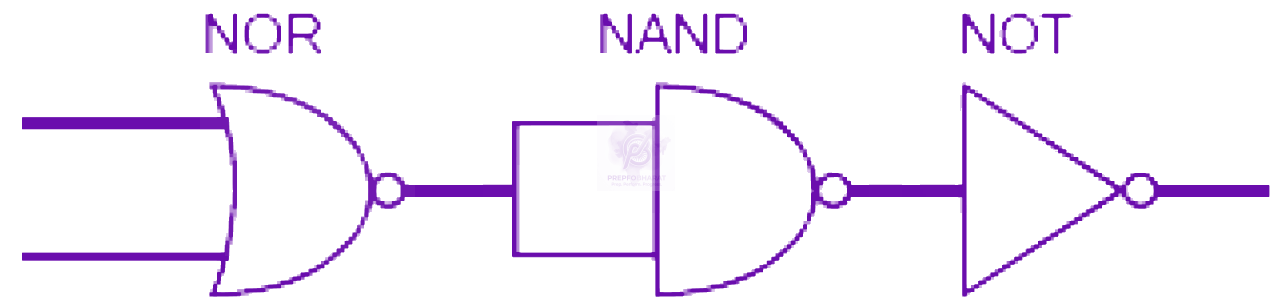 is equivalent to
A particle of mass 1 mg has the same wavelength as an electron moving with a velocity of $3 \times 10^6 \mathrm{~ms}^{-1}$. The velocity of the particle is (Mass of electron $=9.1 \times 10^{-31} \mathrm{~kg}$ )
If $M(A, Z), M_P$ and $M_n$ denote the masses of the nucleus ${ }_Z^A X$, proton and neutron respectively in units of $u\left(1 \mathrm{u}=931.5 \mathrm{MeV} / c^2\right)$ and $\mathrm{BE}$ represents its binding energy in $\mathrm{MeV}$, then
A nucleus ${ }^A_Z X$ has mass represented by $M(A, Z)$. If $M_p$ and $M_n$ denote the mass of proton and neutron respectively and B.E. the binding energy in $\mathrm{MeV}$, then
In a radioactive decay process, the negatively charged emitted $\beta$-particles are:
The total energy of electron in the ground state of hydrogen atom is $-13.6 \mathrm{eV}$. The kinetic energy of an electron in the first excited state is:
A 5 watt source emits monochromatic light of wavelength $5000 Å$. When placed $0.5 \mathrm{~m}$ away, it liberates photoclectrons from a photosensitive metallic surface. When the source is moved to a distance of $1.0 \mathrm{~m}$, the number of photoelectrons liberated will be reduced by a factor of :
In the following circuit, the output $\mathrm{Y}$ for all possible inputs $\mathrm{A}$ and $\mathrm{B}$ is expressed by the truth table. 
In the energy band diagram of a material shown below, the open circles and filled circles denote holes and electrons respectively. The material is 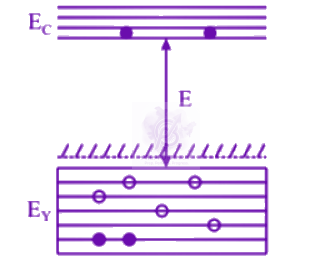
If the nucleus ${ }_{13}^{27} \mathrm{Al}$ has a nuclear radius of about $3.6 \mathrm{fm}$, then ${ }_{32}^{125} \mathrm{Te}$ would have its radius approximately as: