Modern Physics PYQ — Page 9
NEET UG Physics — Modern Physics previous year questions with solutions.
All Modern Physics Questions (300)
The electron in the hydrogen atom jumps from excited state $(n=3)$ to its ground state $(n=1)$ and the photons thus emitted irradiate a photosensitive material. If the work function of the material is $5.1 \mathrm{eV}$, the stopping potential is estimated to be (the energy of the electron in $n$th state $\mathrm{E}_{\mathrm{n}}=-\frac{13.6}{\mathrm{n}^2} \mathrm{eV}$ )
The activity of a radioactive sample is measured as $\mathrm{N}_0$ counts per minute at $\mathrm{t}=0$ and $\mathrm{N}_0 / \mathrm{e}$ counts per minute at $\mathrm{t}=5 \mathrm{~min}$. The time (in minute) at which the activity reduces to half its value is
The binding energy per nucleon in deuterium and helium nuclei are $1.1 \mathrm{MeV}$ and $7.0 \mathrm{MeV}$, respectively. When two deuterium nuclei fuse to form a helium nucleus the energy released in the fusion is
The decay constant of a radio isotope is $\lambda$. If $A_1$ and $\mathrm{A}_2$ are its activities at times $\mathrm{t}_1$ and $\mathrm{t}_2$ respectively, the number of nuclei which have decayed during the time $\left(\mathrm{t}_1-\mathrm{t}_2\right)$
A beam of cathode rays is subjected to crossed Electric ( $E$ ) and Magnetic fields $(B)$. The fields are adjusted such that the beam is not deflected. The specific charge of the cathode rays is given by (where $V$ is the potential difference between cathod and anode)
In the nuclear decay given below $$ { }_{\mathrm{Z}}^{\mathrm{A}} \mathrm{X} \longrightarrow{ }_{\mathrm{Z}+1}^{\mathrm{A}} \mathrm{Y} \longrightarrow{ }_{\mathrm{Z}-1}^{\mathrm{A}-4} \mathrm{~B}^* \longrightarrow{ }_{\mathrm{Z}-1}^{\mathrm{A}-4} \mathrm{~B} \text {, } $$ the particles emitted in the sequence are
Which of the following hormones contains iodine?
In the nuclear decay given below : $$ { }_{\mathrm{A}}^{\mathrm{A}} \mathrm{X} \longrightarrow \stackrel{\mathrm{A}}{\mathrm{A}+1} \mathrm{Y} \longrightarrow \mathrm{A}_{\mathrm{A}-4} \mathrm{~B}^* \longrightarrow \stackrel{\mathrm{A}-4}{\mathrm{Z}-1} \mathrm{~B} $$ The particles emitted in the sequence are :
The number of photoelectrons emitted for light of a frequency $\mathrm{v}$ (higher than the threshold frequency $\mathrm{v}_0$ ) is proportional to :
Monochromatic light of wavelength $667 \mathrm{~nm}$ is produced by a helium neon laser. The power emitted is $9 \mathrm{~mW}$. The number of photons arriving per second on the average at a target irradiated by this beam is :
A $p-n$ photodiode is fabricated from a semiconductor with a band gap of $2.5 \mathrm{eV}$. It can detect a signal of wavelength
The figure shows a plot of photo current versus anode potential for a photo sensitive surface for three different radiations. Which one of the following is a correct statement ? 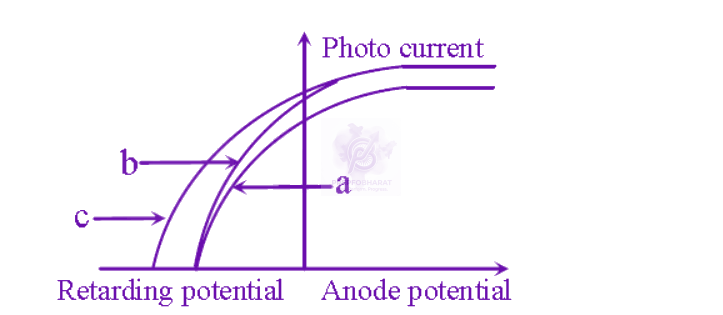
In a Rutherford scattering experiment when a projectile of charge $Z_1$ and mass $M_1$ approaches a target nucleus of charge $Z_2$ and mass $M_2$, the distance of closest approach is $r_0$. The energy of the projectile is :
A p-n photodiode is fabricated from a semiconductor with a band gap of $2.5 \mathrm{eV}$. It can detect a signal of wavelength :
Monochromatic light of wavelength $667 \mathrm{~nm}$ is produced by a helium neon laser. The power emitted is $9 \mathrm{~mW}$. The number of photons arriving per second on the average at a target irradiated by this beam is
The ionization energy of the electron in the hydrogen atom in its grounds state is $13.6 \mathrm{eV}$. The atoms are excited to higher energy levels to emit radiations of 6 wavelengths. Maximum wavelength of emitted radiation corresponds to the transition between :
In a Rutherford scattering experiment when a projectile of charge $Z_1$ and mass $M_1$ approaches a target nucleus of charge $Z_2$ and mass $\mathrm{M}_2$, the distance of closest approach is $\mathrm{r}_0$. The energy of the projectile is
The number of beta particles emitted by a radioactive substance is twice the number of alpha particles emitted by it. The resulting daughter is an :
A transistor is operated in common-emitter configuration at $\mathrm{V}_{\mathrm{C}}=2 \mathrm{~V}$ such that a change in the base current from $100 \mu \mathrm{A}$ to $200 \mu \mathrm{A}$ produces a change in the collector current from $5 \mathrm{~mA}$ to $10 \mathrm{~mA}$. The current gain is :
The figure shows a plot of photo current versus anode potential for a photo sensitive surface for three different radiations. Which one of the following is a correct statement? 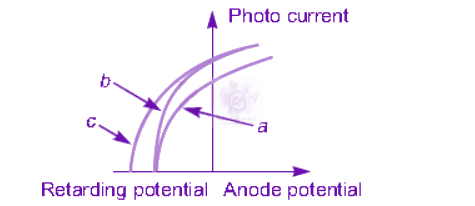
The ionization energy of the electron in the hydrogen atom in its ground state is $13.6 \mathrm{eV}$. The atoms are excited to higher energy levels to emit radiations of 6 wavelengths. Maximum wavelength of emitted radiation corresponds to the transition between
The number of beta particles emitted by a radioactive substance is twice the number of alpha particles emitted by it. The resulting daughter is an
The number of photoelectrons emitted for light of a frequency $v$ (higher than the threshold frequency $v_0$ ) is proportional to
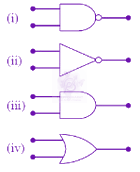
The symbolic representation of four logic gates The logic symbols for OR, NOT and NAND gates are respectively