Modern Physics PYQ — Page 11
NEET UG Physics — Modern Physics previous year questions with solutions.
All Modern Physics Questions (300)
Two radioactive substances $\mathrm{A}$ and $\mathrm{B}$ have decay constants $5 \lambda$ and $\lambda$ respectively. At $t=0$ they have the same number of nuclei. The ratio of number of nuclei of A to those of $\mathrm{B}$ will be $(1 / e)^2$ after a time interval.
Monochromatic light of frequency $6.0 \times$ $10^{14} \mathrm{~Hz}$ is produced by a laser. The power emitted is $2 \times 10^{-3} \mathrm{~W}$. The number of photons emitted, on the average, by the source per second is:
The binding energy of deuteron is 2.2 $\mathrm{MeV}$ and that of ${ }_2^4 \mathrm{He}$ is $28 \mathrm{MeV}$. If two deuterons are fused to form one ${ }_2^4 \mathrm{He}$ then the energy released is:
The radius of germanium (Ge) nuclide is measured to be twice the radius of ${ }_4^9 \mathrm{Be}$. The number of nucleons in Ge are:
A photocell employs photoelectric effect to convert:
The momentum of a photon of energy 1 $\mathrm{MeV}$ in $\mathrm{kg} \mathrm{m} / \mathrm{s}$ will be:
In a radioactive material the activity at time $t_1$ is $R_1$ and at a later time $t_2$, it is $R_2$. If the decay constant of the material is $\lambda$, then:
When photons of energy $h v$ fall on an aluminium plate (of work function $E_0$ ), photoelectrons of maximum kinetic energy $K$ are ejected. If the frequency of radiation is doubled, the maximum kinetic energy of the ejected photoelectrons will be:
A forward biased diode is:
Ionization potential of hydrogen atom is $13.6 \mathrm{eV}$. Hydrogen atoms in the ground state are excited by monochromatic radiation of photon energy $12.1 \mathrm{eV}$. According to Bohr's theory, the spectral lines emitted by hydrogen will be:
In a discharge tube ionization of enclosed gas is produced due to collisions between:
The following figure shows a logic gate circuit with two inputs $\mathrm{A}$ and $\mathrm{B}$ and the output $\mathrm{C}$. The voltage waveforms of $\mathrm{A}$, $\mathrm{B}$ and $\mathrm{C}$ are as shown below: 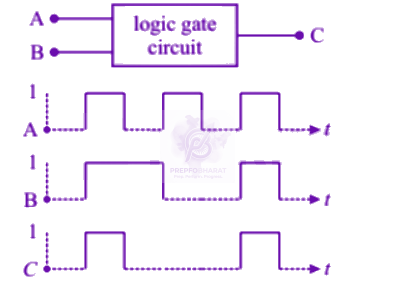 The logic circuit gate is:
The photosensitive metallic surface has work function $h v_0$ fall on this surface, the electrons come out with a maximum velocity of $4 \times 10^6 \mathrm{~m} / \mathrm{s}$. When the photon energy is increased $5 h v_0$. Then maximum velocity of photoelectrons will be:
In any fission process the ratio: mass of fission products mass of parent nucleus is:
Carbon, silicon and germanium atoms have four valence electrons each. Their valence and conduction bands are separated energy band gaps represented $\left(E_g\right)_C,\left(E_g\right)_{S i}$, and $\left(E_g\right)_{G e}$ respectively. Which one of the following relationship is true in their case?
The work functions for metal $\mathrm{a}, \mathrm{b}$ and c are respectively $1.92 \mathrm{eV}, 2.0 \mathrm{eV}$ and 5 eV. According to Einstein's equation the metals which will emit photoelectrons for a radiation of wavelength $4100 Å$ is a/are:
Zener diode is used for:
The total energy of an electron in the first excited state of hydrogen atom is about $-3.4 \mathrm{eV}$. Its kinetic energy in this state is:
Choose the only false statement from the following:
The nuclei of which one of the following pairs of nuclei are isotones?
Energy levels $\mathrm{A}, \mathrm{B}$ and $\mathrm{C}$ of a certain action corresponding to increasing values of energy i.e. $E_A < E_B < E_C$. If $\lambda_1$, $\lambda_2$ and $\lambda_3$ are wavelength of radiations corresponding to transitions $\mathrm{C}$ to $\mathrm{B}, \mathrm{B}$ to $\mathrm{A}$ and $\mathrm{C}$ to $\mathrm{A}$ respectively, which of the following relations is correct?
In the reaction ${ }_1^2 \mathrm{H}+{ }_1^3 \mathrm{H} \rightarrow{ }_2^4 \mathrm{He}+{ }_0^1 n$, if the binding energies of ${ }_1^2 \mathrm{H},{ }_1^3 \mathrm{H}$ and ${ }_2^4 \mathrm{He}$ are respectively $a, b$ and $c$ (in Me V), then the energy (in $\mathrm{MeV}$ ) released in this reaction is:
Fission of nuclei is possible because the binding energy per nucleon in them:
Application of a forward bias to a $p-n$ junction: