NEET UG 2010 — Modern Physics
Physics Modern Physics questions from NEET UG 2010.
Other Years
14 Modern Physics Questions from 2010
The potential difference that must be applied to stop the fastest photoelectrons emitted by a nickel surface, having work function $5.01 \mathrm{eV}$, when ultraviolet light of $200 \mathrm{~nm}$ falls on it, must be
The mass of a ${ }_3 \mathrm{Li}^7$ nucleus is $0.042 \mathrm{u}$ less than the sum of the masses of all its nucleons. The binding energy per nucleon of ${ }_3 \mathrm{Li}^7$ nucleus is nearly
The energy of a hydrogen atom in the ground state is $-13.6 \mathrm{eV}$. The energy of a $\mathrm{He}^{+}$ion in the first excited state will be
A source $\mathrm{S}_1$ is producing, $10^{15}$ photons/s of wavelength $5000 Å$. Another source $S_2$ is producing $1.02 \times 10^{15}$ photons per second of wavelength $5100 Å$. Then, (power of $\left.S_2\right) /\left(\right.$ power of $S_1$ ) is equal to
To get an output $Y=1$ from the circuit shown below, the input must be 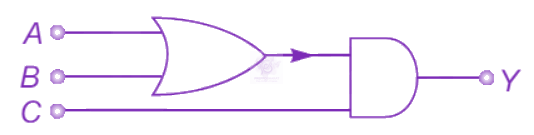 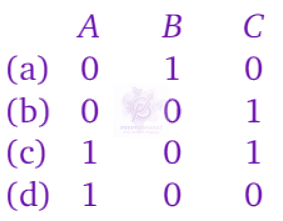
When monochromatic radiation of intensity $I$ falls on a metal surface, the number of photoelectron and their maximum kinetic energy are $N$ and $T$ respectively. If the intensity of radiation is 2I, the number of emitted electrons and their maximum kinetic energy are respectively
The following figure shows a logic gate circuit with two inputs $A$ and $B$ and the output $Y$. The voltage waveforms of $A, B$ and $Y$ are as given  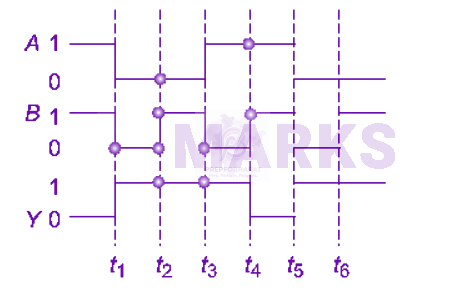 The logic gate is
Which one of the following statement is false?
The device that can act as a complete electronic circuit is
The electron in the hydrogen atom jumps from excited state $(n=3)$ to its ground state $(n=1)$ and the photons thus emitted irradiate a photosensitive material. If the work function of the material is $5.1 \mathrm{eV}$, the stopping potential is estimated to be (the energy of the electron in $n$th state $\mathrm{E}_{\mathrm{n}}=-\frac{13.6}{\mathrm{n}^2} \mathrm{eV}$ )
The activity of a radioactive sample is measured as $\mathrm{N}_0$ counts per minute at $\mathrm{t}=0$ and $\mathrm{N}_0 / \mathrm{e}$ counts per minute at $\mathrm{t}=5 \mathrm{~min}$. The time (in minute) at which the activity reduces to half its value is
The binding energy per nucleon in deuterium and helium nuclei are $1.1 \mathrm{MeV}$ and $7.0 \mathrm{MeV}$, respectively. When two deuterium nuclei fuse to form a helium nucleus the energy released in the fusion is
The decay constant of a radio isotope is $\lambda$. If $A_1$ and $\mathrm{A}_2$ are its activities at times $\mathrm{t}_1$ and $\mathrm{t}_2$ respectively, the number of nuclei which have decayed during the time $\left(\mathrm{t}_1-\mathrm{t}_2\right)$
A beam of cathode rays is subjected to crossed Electric ( $E$ ) and Magnetic fields $(B)$. The fields are adjusted such that the beam is not deflected. The specific charge of the cathode rays is given by (where $V$ is the potential difference between cathod and anode)