Mechanics PYQ — Page 19
NEET UG Physics — Mechanics previous year questions with solutions.
All Mechanics Questions (512)
A wheel has angular acceleration of 3.0 $\mathrm{rad} / \mathrm{sec}^2$ and an initial angular speed of $2~ \mathrm{rad}/ \mathrm{sec}$. In a time of $2 \mathrm{sec}$ it has rotated through an angle (in radian) of:
A uniform rod $\mathrm{AB}$ of length $I$ and mass $m$ is free to rotate about point $A$. The rod is released from rest in the horizontal position. Given that the moment of inertia of the rod about $\mathrm{A}$ is $m l^2 / 3$, the initial angular acceleration of the rod will be 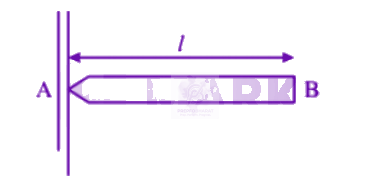
A particle starting from the origin $(0,0)$ moves in a straight line in the $(x, y)$ plane. Its coordinates at a later time are $(\sqrt{3}, 3)$. The path of the particle makes with the $x$-axis an angle of:
A block $B$ is pushed momentarily along a horizontal surface with an initial velocity $V$. If $\mu$ is the coefficient of sliding friction between B and the surface, block B will come to rest after a time. 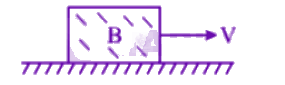
Dimensions of resistance in an electrical circuit, in terms of dimension of mass $M$, of length $L$, of time $T$ and of current $I$, would be
A particle moving along $x$-axis has acceleration $f$, at time $t$, given by $f=$ $f_0\left(1-\frac{t}{T}\right)$, where $f_0$ and $T$ are constants. The particle at $t=0$ has zero velocity. In the time interval between $t=0$ and the instant when $f=0$, the particle's velocity $\left(v_x\right)$ is:
A vertical spring with force constant $k$ is fixed on a table. A ball of mass $m$ at a height $h$ above the free upper end of the spring falls vertically on the spring so that the spring is compressed by a distance $d$. The net work done in the process is
A particle of mass $m$ moves in the $X Y$ plane with a velocity $v$ along the straight line $\mathrm{AB}$. If the angular momentum of the particle with respect to origin $\mathrm{O}$ is $L_A$ when it is at A and $L_B$ when it is at B, then: 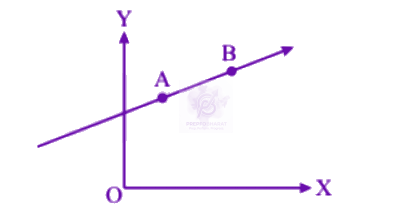
A car moves from $\mathrm{X}$ to $\mathrm{Y}$ with a uniform speed $v_u$. The average speed for this round trip is :
$\vec{A}$ and $\overline{\mathrm{B}}$ are two vectors and $\theta$ is the angle between them, if $|\overrightarrow{\mathrm{A}} \times \overline{\mathrm{B}}|=$ $\sqrt{3}(\overrightarrow{\mathrm{A}} \cdot \overline{\mathrm{B}})$, the value of $\theta$ is.
Two bodies $\mathrm{A}$ (of mass $1 \mathrm{~kg}$ ) and $\mathrm{B}$ (of mass $3 \mathrm{~kg}$ ) are dropped from heights of $16 \mathrm{~m}$ and $25 \mathrm{~m}$, respectively. The ratio of the time taken by them to reach the ground is:
The Earth is assumed to be a sphere of radius $R$. A platform is arranged at a height $R$ from the surface of the Earth. The escape velocity of a body from this platform is $f v$, where $v$ is its escape velocity from the surface of the Earth. The value of $f$ is:
The moment of inertia of a uniform circular disc of radius $R$ and mass $M$ about an axis touching the disc at its diameter and normal to the disc:
The potential energy of a long spring when stretched by $2 \mathrm{~cm}$ is $U$. If the spring is stretched by $8 \mathrm{~cm}$ the potential energy stored in it is:
A tube of length $L$ is filled completely with an incompressible liquid of mass $M$ and closed at both the ends. The tube is then rotated in a horizontal plane about one of its ends with a uniform angular velocity $\omega$. The force exerted by the liquid at the other end is:
A body of mass $3 \mathrm{~kg}$ is under a constant force which causes a displacement $s$ in metres in it, given by the relation $s=\frac{1}{3} t^2$, where $t$ is in seconds. Work done by the force in 2 seconds is:
$300 \mathrm{~J}$ of work is done in sliding a $2 \mathrm{~kg}$ block up an inclined plane of height 10 $\mathrm{m}$. Taking $g=10 \mathrm{~m} / \mathrm{s}^2$, work done against friction is:
A rectangular block of mass $m$ and area of cross-section A floats in a liquid of density $\rho$. If it is given a small vertical displacement from equilibrium it undergoes with a time period $T$, Then:
A particle moves along a straight line $\mathrm{OX}$. At a time $t$ (in seconds) the distance $x$ (in metres) of the particle from $\mathrm{O}$ is given by $x=40+12 t-t^3$. How long would the particle travel before coming to rest ?
A $0.5 \mathrm{~kg}$ ball moving with a speed of 12 $\mathrm{m} / \mathrm{s}$ strikes a hard wall at an angle of $30^{\circ}$ with the wall. It is reflected with the same speed at the same angle. If the ball is in contact with the wall for 0.25 seconds, the average force acting on the wall is: 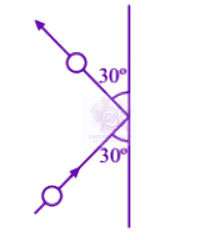
For angles of projection of projectile at angle $\left(45^{\circ}-\theta\right)$ and $\left(45^{\circ}+\theta\right)$, the horizontal range described by the projectile are in the ratio of:
The velocity $v$ of a particle at time $t$ is given by $v=a t+\frac{b}{t+c}$, where $a, b$ and $c$ are constants. The dimensions of $a, b$ and $c$ are:
The vectors $\vec{A}$ and $\vec{B}$ are such that $|\vec{A}+\vec{B}|=|\vec{A}-\vec{B}|$. The angle between the two vectors is:
A car runs at a constant speed on a circular track of radius $100 \mathrm{~m}$, taking 62.8 seconds for every circular lap. The average velocity and average speed for each circular lap respectively is: