Mechanics PYQ — Page 20
NEET UG Physics — Mechanics previous year questions with solutions.
All Mechanics Questions (512)
A uniform rod of length $l$ and mass $m$ is free to rotate in a vertical plane about $\mathrm{A}$. The rod initially in horizontal position is released. The initial angular acceleration of the rod is (moment of inertia of the rod about $\mathrm{A}$ is $\frac{m l^2}{3}$ ). 
A drum of radius $R$ and mass $M$ rolls down without slipping along an inclined plane of angle $\theta$. The frictional force:
Imagine a new planet having the same density as that of earth but it is 3 times bigger than the earth in size. If the acceleration due to gravity on the surface of earth is $g$ and that on the surface of the new planet is $\mathrm{g}^{\prime}$ then:
A bomb of mass $30 \mathrm{~kg}$ at rest explodes into two pieces of masses $18 \mathrm{~kg}$ and 12 $\mathrm{kg}$. The velocity of $18 \mathrm{~kg}$ mass is $6 \mathrm{~ms}^{-1}$. The kinetic energy of the other mass is:
Two boys are standing at the ends $\mathrm{A}$ and $\mathrm{B}$ of a ground where $\mathrm{AB}=a$. The boy at $\mathrm{B}$ starts running in a direction perpendicular to $\mathrm{AB}$ with velocity $v_1$. The boy at A starts running simultaneously with velocity $v$ and catches the other in time $t$, where $t$ is:
The moment of inertia of a uniform circular disc of radius $R$ and mass $M$ about an axis passing from the edge of the disc and normal to the disc is:
The ratio of the dimension Planck's constant and that of moment of inertia is the dimension of:
If a vector $2 \hat{i}+3 \hat{j}+8 \hat{k}$ is perpendicular to the vector $4 \hat{j}-4 \hat{i}+\alpha \hat{k}$ then the value of $\alpha$ is:
For a satellite in an orbit around the earth, the ratio of kinetic energy to potential energy is:
The circular motion of a particle with constant speed is:
A ball is thrown vertically. It has a speed of $10 \mathrm{~m} / \mathrm{sec}$ when it has reached one half of its maximum height. How high does the ball rise? Take $\mathrm{g}=10 \mathrm{~m} / \mathrm{s}^2$.
The displacement $x$ of a particle varies with time $t$ as $x=a e^{-a t}+B^{\beta x}$, where $a, b, \alpha$ and $\beta$ are positive constants. The velocity of the particle will:
A stone tied to the end of a string of 1 $\mathrm{m}$ long is whirled in a horizontal circle with a constant speed. If the stone makes 22 revolutions in 44 seconds, what is the magnitude and direction of acceleration of the stone?
Two bodies have their moments of inertia $l$ and $2 l$ respectively about their axis of rotation. If their kinetic energies of rotation are equal, their angular momenta will be in the ratio:
A force $F$ acting on an object varies with distance $x$ as shown here. The force is in $N$ and $x$ in $\mathrm{m}$. The work done by the force in moving the object $x=0$ to $x=6 \mathrm{~m}$ is: 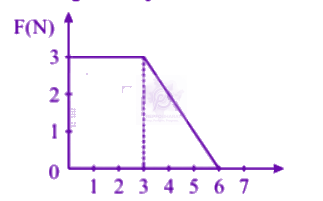
If the angle between the vector $\vec{A}$ and $(\vec{B} \times \vec{A}) \cdot \vec{A}$ is $\theta$, the value of the product $(\vec{B} \times \vec{A}) \cdot \vec{A}$ is equal to:
A particle of mass $m_1$ is moving with a velocity $v_1$ and another particle of mass $m_2$ is moving with a velocity $v_2$. Both of them have the same momentum but their different kinetic energies are $E_1$ and $E_2$ respectively. If $m_1>m_2$ then:
A mass of $0.5 \mathrm{~kg}$ moving with a speed of $1.5 \mathrm{~m} / \mathrm{s}$ on a horizontal smooth surface, collides with a nearly weightless spring of force constant $k=50 \mathrm{~N} / \mathrm{m}$. The maximum compression of the spring would be: 
A block mass $m$ is placed on a smooth wedge of inclination $\theta$. The whole system is accelerated horizontally so that the block does not slip on the wedge. The force exerted by the wedge on the block ( $g$ is acceleration due to gravity) will be:
The coefficient of static friction $\mu_8$, between block $A$ of mass $2 \mathrm{~kg}$ and the table as shown in the figure is 0.2 . What would be the maximum mass value of block B so that the two blocks do not move? The string and the pulley are assumed to be smooth and massless $(g$ $\left.=10 \mathrm{~m} / \mathrm{s}^2\right)$ 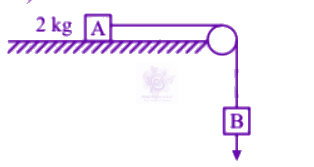
Two springs of spring constant $k_1$ and $k_2$ are joined in series. The effective spring constant of the combination is given by:
The ratio of the radii of gyration of a circular disc about a tangential axis in the plane of the disc and of a circular ring of the same radius about a tangential axis in the plane of the ring is:
A ball of mass $2 \mathrm{~kg}$ and another of mass $4 \mathrm{~kg}$ are dropped together from a 60 feet tall building. After a fall of 30 feet each towards earth, their respective kinetic energies will be in the ratio of:
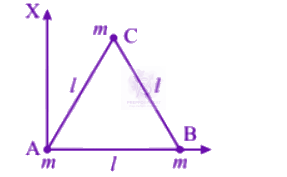
Three particles, each of mass $m$ gram, are situated at the vertices of an equilateral triangle $\mathrm{ABC}$ side $l \mathrm{~cm}$ (as shown in the figure). The moment of inertia of the system about a line $\mathrm{AX}$ perpendicular to $A B$ and in the plane of $A B C$, in gram $\mathrm{cm}^2$ units will be: