NEET UG 2012 — Mechanics
Physics Mechanics questions from NEET UG 2012.
Other Years
23 Mechanics Questions from 2012
A circular platform is mounted on a frictionless vertical axle. Its radius $R=2 \mathrm{~m}$ and its moment of inertia about the axle is $200 \mathrm{~kg} \mathrm{~m}^2$. It is initially at rest. A $50 \mathrm{~kg}$ man stands on the edge of the platform and begins to walk along the edge at the speed of $1 \mathrm{~ms}^{-1}$ relative to the ground. Time taken by the man to complete one revolution is
A solid cylinder of mass $3 \mathrm{~kg}$ is rolling on a horizontal surface with velocity $4 \mathrm{~ms}^{-1}$. It collides with a horizontal spring of force constant $200 \mathrm{Nm}^{-1}$. The maximum compression produced in the spring will be
When a mass is rotating in a plane about a fixed point, its angular momentum is directed along
$A B C$ is an equilateral triangle with $O$ as its centre. $\mathrm{F}_1, \mathrm{~F}_2$ and $\mathrm{F}_3$ represent three forces acting along the sides $A B, B C$ and $A C$ respectively. If the total torque about $O$ is zero then the magnitude of $\mathrm{F}_3$ is 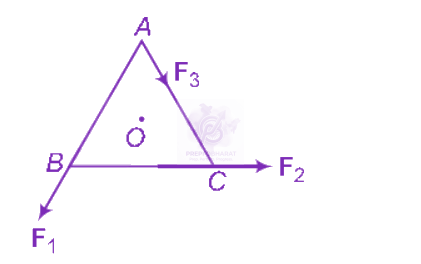
Two spheres $A$ and $B$ of masses $m_1$ and $m_2$ respectively collide. $A$ is at rest initially and $B$ is moving with velocity $y$ along $x$-axis. After collision $B$ has a velocity $\frac{v}{2}$ in a direction perpendicular to the original direction. The mass $A$ moves after collision in the direction
The dimensions of $\left(\mu_0 \varepsilon_0\right)^{-1 / 2}$ are
A car of mass $1000 \mathrm{~kg}$ negotiates a banked curve of radius $90 \mathrm{~m}$ on a frictionless road. If the banking angle is $45^{\circ}$, the speed of the car is
A geostationary satellite is orbiting the earth at a height of $5 R$ above that surface of the earth, $R$ being the radius of the earth. The time period of another satellite in hours at a height of $2 R$ from the surface of the earth is
Which one of the following plots represents the variation of gravitational field on a particle with distance $r$ due to a thin spherical shell of radius $R$ ? ( $r$ is measured from the centre of the spherical shell).
If $v_e$ is escape velocity and $v_o$ is orbital velocity of a satellite for orbit close to the Earth's surface, then these are related by
A car of mass $m$ is moving on a level circular track of radius $R$. If $\mu_s$ represents the static friction between the road and tyres of the car, the maximum speed of the car in circular motion is given by
The horizontal range and the maximum height of a projectile are equal. The angle of projection of the projectile is
Two persons of masses $55 \mathrm{~kg}$ and $65 \mathrm{~kg}$ respectively, are at the opposite ends of a boat. The length of the boat is $3.0 \mathrm{~m}$ and weighs $100 \mathrm{~kg}$. The $55 \mathrm{~kg}$ man walks up to the $65 \mathrm{~kg}$ man and sits with him. If the boat is in still water the centre of mass of the system shifts by
The height at which the weight of a body becomes $1 / 16$ th, its weight on the surface of earth (radius $R$ ), is
A car of mass $m$ starts from rest and accelerates so that the instantaneous power delivered to the car has a constant magnitude $P_0$. The instantaneous velocity of this car is proportional to
Three masses are placed on the $x$-axis : $300 \mathrm{~g}$ at origin, $500 \mathrm{~g}$ at $x=40 \mathrm{~cm}$ and $400 \mathrm{~g}$ at $x=70 \mathrm{~cm}$. The distance of the centre of mass from the origin is
A spherical planet has a mass $M_p$ and diameter $D_p$. A particle of mass $m$ falling freely near the surface of this planet will experience an acceleration due to gravity, equal to
A stone is dropped from a height $h$. It hits the ground with a certain momentum $p$. If the same stone is dropped from a height $100 \%$ more than the previous height, the momentum when it hits the ground will change by
The potential energy of a particle in a force field is $U=\frac{A}{r^2}-\frac{B}{r}$, where $A$ and $B$ are positive constants and $r$ is the distance of particle from the centre of the field. For stable equilibrium, the distance of the particle is
The damping force on an oscillator is directly proportional to the velocity. The units of the constant of proportionality are
A particle has initial velocity $(2 \mathbf{i}+3 \mathbf{j})$ and acceleration $(0.3 \mathbf{i}+0.2 \mathbf{j})$. The magnitude of velocity after $10 \mathrm{~s}$ will be
The motion of a particle along a straight line is described by equation $x=8+12 t-t^3$ where, $x$ is in metre and $t$ in second. The retardation of the particle when its velocity becomes zero, is
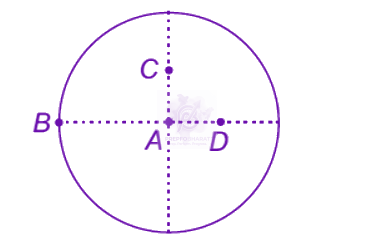
The moment of inertia of a uniform circular disc is maximum about an axis perpendicular to the disc and passing through