Electromagnetism PYQ — Page 19
NEET UG Physics — Electromagnetism previous year questions with solutions.
All Electromagnetism Questions (503)
Charges $+q$ and $-q$ are placed at points $\mathrm{A}$ and $\mathrm{B}$ respectively which are a distance $2 L$ apart, $\mathrm{C}$ is the midpoint between $\mathrm{A}$ and $\mathrm{B}$. The work done in moving a charge $+\mathrm{Q}$ along the semicircle CRD is 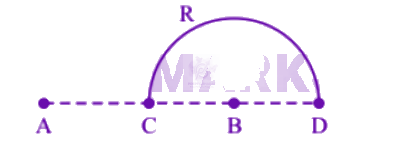
Two condensers, one of capacity $C$ and other of capacity $C / 2$ are connected to a $V$-volt battery, as shown. The work done in charging fully both the condensers is 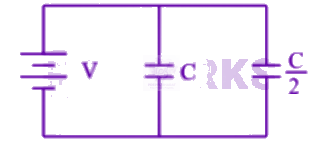
A charged particle (charge $q$) is moving in a circle of radius $R$ with uniform speed $v$. The associated magnetic moment $\mu$ is given by:
The primary and secondary coils of a transformer have 50 and 1500 turns respectively. If the magnetic flux $\phi$ linked with the primary coil is given by $\phi=\phi_v+4 t$, where $\phi$ is in webers, $t$ is time in seconds and $\phi_v$ is a constant, the output voltage across the output voltage across the secondary coil is:
When a charged particle moving with velocity $\vec{v}$ is subjected to a magnetic field of induction $\vec{B}$, the force on it is non-zero. This implies that:
Above curie temperature:
The core of a transformer is laminated because:
An electric dipole of moment $\vec{p}$ is lying along a uniform electric field $\vec{E}$. The work done in rotating the dipole by rotating the dipole by 90 degrees:
Kirchhoff's first and second laws of electrical circuits are consequences of:
A parallel plate air capacitor is charged to a potential difference of $V$ volts. After disconnecting the charging battery the distance between the plates of the capacitor is increased using an insulating handle. As a result the potential difference between the plates:
Two coils of self inductance $2 \mathrm{mH}$ and 8 $\mathrm{mH}$ are placed so close together that the effective flux in one coil is completely linked with the other. The mutual inductance between these coils is:
A square surface of side $L$ metres is in the plane of the paper. A uniform electric field $\vec{E}$ (volt $/ \mathrm{m})$, also in the plane of the paper, is limited only to the lower half of the square surface (see figure). The electric flux in SI units associated with the surface is: 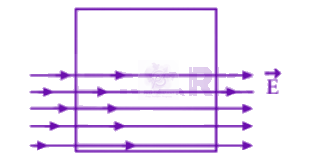
In producing chlorine through electrolysis 100 watt power at $125 \mathrm{~V}$ is being consumed. How much chlorine per minute is liberated ? E. C. E. of chlorine is $0.367 \times 10^{-6} \mathrm{~kg} /$ coulomb:
Two cells, having the same e.m.f. are connected in series through an external resistance $R$. Cells have internal resistances $r_1$ and $r_2\left(r_1>r_2\right)$ respectively. When the circuit is closed, the potential difference across the first cell is zero. The value of $R$ is:
Two circular coils 1 and 2 are made from the same wire but the radius of the $1^{\text {st }}$ coil is twice that of the $2^{\text {nd }}$ coil. What potential difference in volts should be applied across them so that the magnetic field at their centres is the same?
Power dissipated across the $8 \Omega$ resistor in the circuit shown here is 2 watt. The power dissipated in watt units across the $3 \Omega$ resistor is: 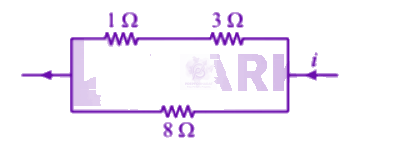
A coil of inductive reactance $31 \Omega$ has a resistance of $8 \Omega$. It is placed in series with a condenser of capacitative reactance $25 \Omega$. The combination is connected to an a.c. source of $110 \mathrm{~V}$. The power factor of the circuit is:
In the circuit shown, if a conducting wire is connected between points $\mathrm{A}$ and $\mathrm{B}$, the current in this wire will: 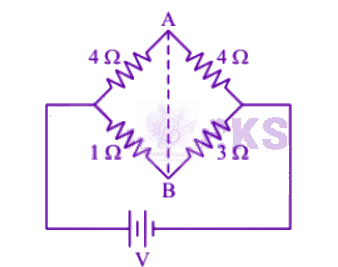
If the magnetic dipole of an atom of diamagnetic material, paramagnetic material are denoted by $\mu_d, \mu_p$ and $\mu_f$ respectively, then:
When a wire of uniform cross section $a$, length $l$ and resistance $R$ is into a complete circle, resistance between any two of diametrically opposite point will be:
In a circuit $\mathrm{L}, \mathrm{C}$ and $\mathrm{R}$ are connected in series with an alternating voltage source of frequency $f$. The current leads the voltage by $45^{\circ}$. The value of $\mathrm{C}$ is:
A 5-ampere fuse wire can withstand a maximum power of 1 watt in the circuit. The resistance of the fuse wire is :
As per the diagram a point charge $+q$ is placed at the origin $\mathrm{O}$. Work done in taking another point charge $-\mathrm{Q}$ from the point $\mathrm{A}$ [coordinate $(0, a)$ ] to another point $\mathrm{B}$ [coordinates $(a, 0)$ ] along the straight path $\mathrm{AB}$ is: 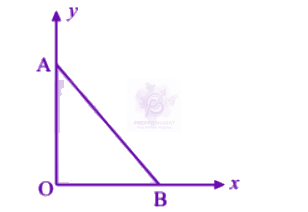
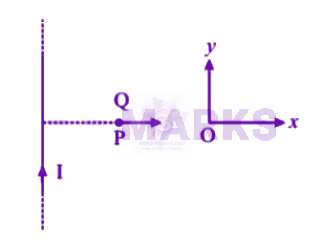
A very long straight wire carries a current I. At the instant when a charge $+Q$ at point $\mathrm{P}$ has velocity $\bar{v}$ as shown the force on the charge is: