Electromagnetism PYQ — Page 20
NEET UG Physics — Electromagnetism previous year questions with solutions.
All Electromagnetism Questions (503)
A coil in the shape of an equilateral triangle of side $l$ is suspended between the pole of a permanent magnet such that $B$ is in plane of the coil. If due to current $i$ in the triangle a torque $\tau$ acts on it, the side $l$ of the triangle is:
If $\lambda_v, \lambda_x$ and $\lambda_m$ represent the wavelength of visible light, X-rays and microwaves respectively, then:
Two charge $q_1$ and $q_2$ are placed $30 \mathrm{~cm}$ apart, as shown in the figure. A third charge $q_3$ is moved along the are of a circle of radius $40 \mathrm{~cm}$ from $\mathrm{C}$ to $\mathrm{D}$. The change in the potential energy of the system is \(\frac{q_3 k}{4 \pi \in_0}\), where $k$ is: 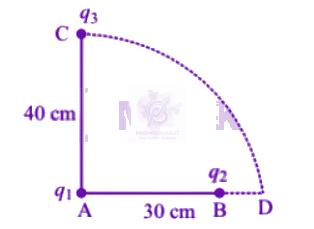
An electron moves in a circular orbit with a uniform speed $v$. It produces a magnetic field $B$ at the centre of the circle. The radius of the circle is proportional to:
Two batteries, one of emf 18 volts and internal resistance $2 \Omega$ and the other of emf 12 volts and internal resistance $1 \Omega$, are connected as shown. The voltmeter $V$ will record a reading of: 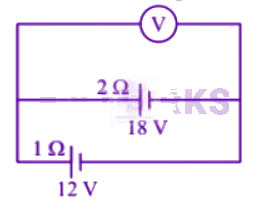
As a result of change in the magnetic flux linked to the closed loop as shown in the figure, an e.m.f. $V$ volt is induced in the loop. The work done (joules) in taking a charge $Q$ coulomb once along the loop is: 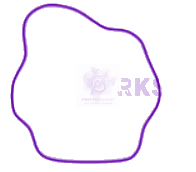
For the network shown in the figure the value of the current $i$ is: 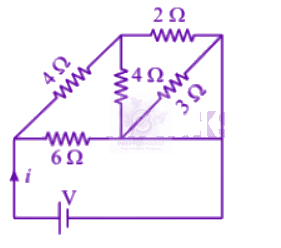
A network of four capacitors capacity equal $C_1=C, C_2=2 C, C_3=3 C$ and $C_4=$ $4 C$ are conducted to a battery as shown in the figure. The ratio of the change on $C_2$ and $C_4$ is: 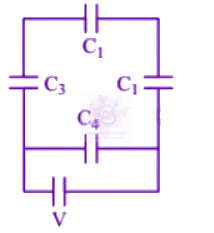
The electric resistance of a certain wire of iron is $R$. If its length and radius are both doubled, then:
A electric dipole has the magnitude of its charge as $q$ and its dipole moment is $p$. It is placed in a uniform electric field $E$. If its dipole moment is along the direction of the field, the force on it and it and its potential energy are respectively:
A galvanometer of $50 \mathrm{ohm}$ resistance has 25 divisions. A current $4 \times 10^{-4}$ ampere gives a deflection of one division. To convert this galvanometer into a voltmeter having a range of 25 volts, it should be connected with a resistance of:
When three identical bulbs of 60 watt, 200 volt rating are connected in series to a 200 volt supply, the power drawn by them will be:
Resistance $n$, each of $r$ ohm, when connected in parallel give an equivalent resistance $R \mathrm{~ohm}$. If these resistances were connected in series, the combination would have a resistance in ohms, equal to :
Five equal resistance each of resistance $R$ are connected as shown in the figure. A battery of $V$ volts is connected between $\mathrm{A}$ and $\mathrm{B}$. The current flowing in AFCEF will be: 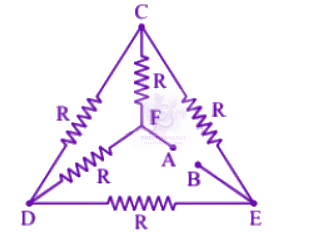
In India electricity is supplied for domestic use at $220 \mathrm{~V}$. It is supplied at $110 \mathrm{~V}$ in USA. If the resistance of a $60 \mathrm{~W}$ bulb for use in India is $R$, the resistance of a $60 \mathrm{~W}$ bulb for use in USA will be:
A bullet of mass $2 \mathrm{~g}$ is having of $2 \mu \mathrm{C}$. Through what potential difference must it be accelerated, starting from rest, to acquire a speed of of $10 \mathrm{~m} / \mathrm{s}$ ?
A galvanometer acting as a voltmeter will have:
A battery is charged at a potential of 15 $\mathrm{V}$ for 8 hours when the current flowing is $10 \mathrm{~A}$. The battery on discharge supplies a current of $5 \mathrm{~A}$ for 15 hours. The mean terminal voltage during discharge is $14 \mathrm{~V}$. The "Watt-hour" efficiency of the battery is:
The magnetic flux through a circuit of resistance $R$ changes by an amount $\Delta \phi$ in a time $\Delta t$. Then the total quantity of electric charge $Q$ that passes any point in the circuit during the time $\Delta \mathrm{t}$ is represented by:
A coil of 40 henry inductance is connected in series with a resistance of $8 \mathrm{ohm}$ and the combination is joined to the terminals of a 2 volt battery. The time constant of the circuit is:
A 6 volt battery is connected to the terminal of a three metre long wire of uniform thickness and resistance of 100 $\mathrm{ohm}$. The difference of potential between two points on the wire separated by a distance of $50 \mathrm{~cm}$ will be:
A diamagnetic material in a magnetic field moves:
Three capacitors each of capacity $4 \mu \mathrm{F}$ are to be connected in such a way that the effective capacitance is $6 \mu \mathrm{F}$. This can be done by:
A charge $q$ is located at the centre of a cube. The electric flux through any face is: