Electromagnetism PYQ — Page 18
NEET UG Physics — Electromagnetism previous year questions with solutions.
All Electromagnetism Questions (503)
A current of 3 A flows through the $2 \Omega$ resistor shown in the circuit. The power dissipated in the $5 \Omega$ resistor is 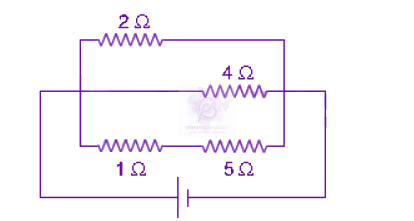
In an $A C$ circuit the emf (e) and the current (i) at any instant are given respectively by $e=E_0 \sin \omega t$ $i=I_0 \sin (\omega t-\phi)$ The average power in the circuit over one cycle of AC is
In the circuit shown, the current through the $4 \Omega$ resistor is $1 \mathrm{~A}$ when the points $P$ and $M$ are connected to a DC voltage source. The potential difference between the points $M$ and $N$ is 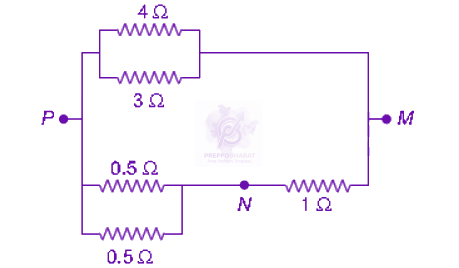
A wire of a certain material is stretched slowly by ten per cent. Its new resistance and specific resistance become respectively
The electric potential at a point in free space due to a charge $Q$ coulomb is $Q \times 10^{11} \mathrm{~V}$. The electric field at that point is
Curie temperature is the temperature above which
A wire of a certain material is stretched slowly by ten percent new resistance and specific resistance become respectively
The velocity of electromagnetic radiation in a medium of permittivity $\in_0$ and permeability $\mu_0$ is given by
The velocity of electromagnetic radiation in a medium of permittivity $\varepsilon_0$ and permeability $\mu_0$ is given by
A long solenoid has 500 turns. When a current of $2 \mathrm{~A}$ is passed through it, the resulting magnetic flux linked with each turn of the solenoid is $4 \times 10^{-3} \mathrm{~Wb}$. The self-inductance of the solenoid is
A circular disc of radius 0.2 meter is placed in a uniform magnetic field of induction linked with the disc is
A current of $3 \mathrm{amp}$. flows through the $2 \Omega$ resistor shown in the circuit. The power dissipated in the $5 \Omega$ resistor is 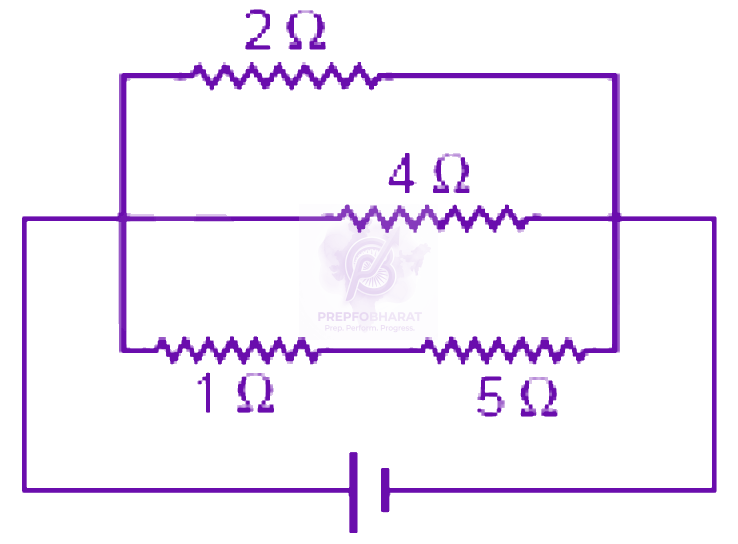
The electric and magnetic field of an electromagnetic wave are:
A transformer is used to light a $100 \mathrm{~W}$ and $110 \mathrm{~V}$ lamp from a $220 \mathrm{~V}$ mains. If the main current is $0.5 \mathrm{amp}$, the efficiency of the transformer is approximately.
Nickel shows ferromagnetic property at room temperature. If the temperature is increased beyond Curie temperature, then it will show:
The resistance of an ammeter is $13 \Omega$ and its scale is graduated for a current upto 100 amps. After an additional shunt has been connected to this ammeter it becomes possible to measure currents upto 750 amperes by this meter. The value of shunt-resistance is:
Under the influence of a uniform magnetic field a charged particle is moving in a circle of radius $R$ with constant speed $v$. The time period of the motion:
The total power dissipated in watt in the circuit shown here is: 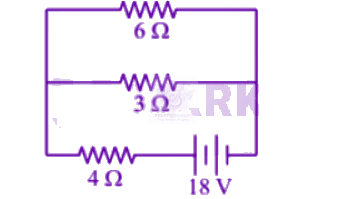
A beam of clectron passes undeflected through mutually perpendicular electric and magnetic fields. If the electric field is switched off, and the same magnetic field is maintained, the electrons move:
What is the value of inductance $L$ for which the current is maximum in a series LCR circuit with $C=10 \mu \mathrm{F}$ and $\omega=1000$ $\mathrm{s}^{-1}$ ?
Three resistances $P, Q, R$ each of $2 \Omega$ and an unknown resistances $\mathrm{S}$ form the four arms of a Wheatstone bridge circuit. When a resistance of $6 \Omega$ is connected in parallel ot $\mathrm{S}$ the bridge gets balanced. What is the value of $\mathrm{S}$ ?
A hollow cylinder has a charge $q$ coulomb within it. If $\phi$ is the electric flux in units of voltmeter associated with the curved surface B, the flux linked with the plane surface $\mathrm{A}$ in units of voltmeter will be 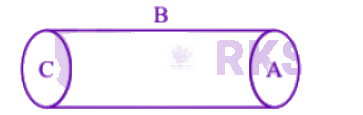
In a mass spectrometer for measuring the masses of ions, the ions are initially accelerated by an electric potential V and then made to describe semicircular paths of radius $R$ using a magnetic field $B$. If $V$ and $B$ are kept constant, the ratio $\left(\frac{\text { charge on the ion }}{\text { mass of the ion }}\right)$ will be proportional to:
Three point charges $+q,-2 q$ are placed at points $(x=0, y=a, z=0),(x=0, y=0, z$ $=0)$ and $(x=a, y=0, z=0)$ respectively. The magnitude and direction of the electric dipole moment vector of this charge assembly are: