NEET UG 2013 — Organic Chemistry
Chemistry Organic Chemistry questions from NEET UG 2013.
Other Years
22 Organic Chemistry Questions from 2013
Which of the following chemical system is non aromatic?
Homolytic fission of the following alkanes forms free radicals $\mathrm{CH}_3-\mathrm{CH}_3$, $\mathrm{CH}_3-\mathrm{CH}_2-\mathrm{CH}_3,\left(\mathrm{CH}_3\right)_2 \mathrm{CH}-\mathrm{CH}_3$, $\mathrm{CH}_3-\mathrm{CH}_2-\mathrm{CH}\left(\mathrm{CH}_3\right)_2$. Increasing orders of stability of the radicals is:
Some reaction of amines are given. Which one is not correct?
In DNA the linkages between different nitrogenous bases are:
In a particular isomer of $\left[\mathrm{Co}\left(\mathrm{NH}_3\right)_4 \mathrm{Cl}_2\right]^0$, the $\mathrm{Cl}-\mathrm{Co}-\mathrm{Cl}$ angle is $90^{\circ}$, the isomer is known as:
The order of stability of the following tatutomeric compound is 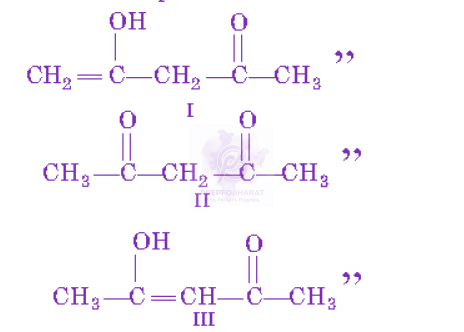
Arrange the following in increasing order of stability: (A) \(\left(\mathrm{CH}_3\right)_2 \stackrel{\oplus}{\mathrm{C}}-\mathrm{CH}_2 \mathrm{CH}_3\) (B) \(\left(\mathrm{CH}_3\right)_3-\stackrel{\oplus}{\mathrm{C}}\) (C) \(\left(\mathrm{CH}_3\right)_2-\stackrel{\oplus}{\mathrm{C}} \mathrm{H}\) (D) \(\mathrm{CH}_3-\stackrel{\oplus}{\mathrm{C}} \mathrm{H}_2\) (E) \(\stackrel{\oplus}{\mathrm{C}} \mathrm{H}_3\)
In the following reaction:  Product ' $\mathrm{P}$ ' will not give
Structure of the compound whose IUPAC name is 3-ethyl-2-hydroxy4-methylhex-3-en-5-ynoic acid is
Nitrogen detection in an organic compound is carried out by Lassaigne's test. The blue colour formed corresponds to which of the following formulae?
Nitrobenzene on reaction with conc. $\mathrm{HNO}_3 / \mathrm{H}_2 \mathrm{SO}_4$ at $80-100^{\circ} \mathrm{C}$ forms which one of the following products?
Given: 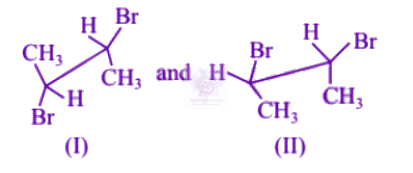 (I) and (II) are
The structure of isobutyl group in an organic compound is
Number of isomeric alcohols of molecular formula $\mathrm{C}_6 \mathrm{H}_{14} \mathrm{O}$ which give positive iodoform test is:
Among the following ethers, which one will produce methyl alcohol on treatment with hot concentrated HI?
In the reaction, 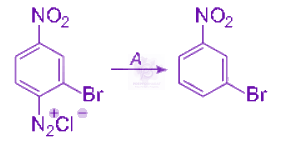 $A$ is
On hydrolysis of a "compound", two compounds are obtained, One of which on treatment with sodium nitrite and hydrochloric acid gives a product which does not respond to iodoform test. The second one reduces Tollen's reagent and Fehling's solution. The "compound" is:
Reaction by which benzaldehyde cannot be prepared?
Some meta-directing substituents in aromatic substitution are given. Which one is most deactivating?
$$ \text { The radical }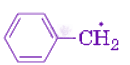 because it has $$
Phenol is distilled with $\mathrm{Zn}$ dust followed by Friedel-Crafts alkylation with propyl chloride in the presence of $\mathrm{AlCl}_3$ to give a compound (b). (b) is oxidised in the presence of air to form the compound (c). The structural formula of (c) is:
Which of the following compounds will not undergo Friedal-Craft's reaction easily?