NEET UG 2012 — Organic Chemistry
Chemistry Organic Chemistry questions from NEET UG 2012.
Other Years
16 Organic Chemistry Questions from 2012
$\mathrm{CH}_3 \mathrm{CHO}$ and $\mathrm{C}_6 \mathrm{H}_5 \mathrm{CH}_2 \mathrm{CHO}$ can be distinguished chemically by
Predict the products in the given reaction, 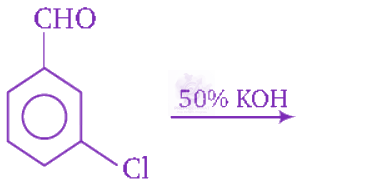
Which one of the following sets of monosaccharides forms sucrose?
Which of the following compounds will give a yellow precipitate with iodine and alkali?
Deficiency of vitamin $B_1$ causes the disease
In the following reaction, 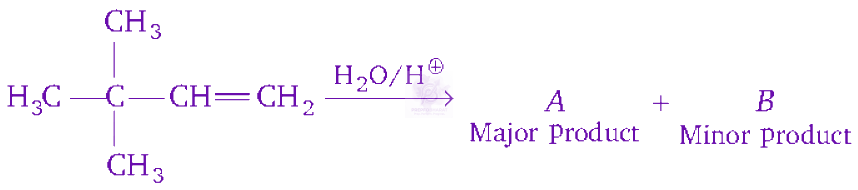
The correct order of decreasing acid strength of trichloroacetic acid $(A)$, trifluoroacetic acid $(B)$, acetic acid $(C)$ and formic acid $(D)$ is
Among the following compounds the one that is most reactive towards electrophilic nitration is
Consider the following reaction 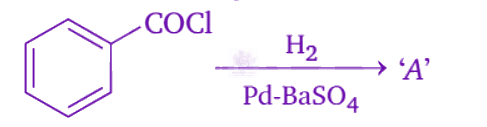 The product ' $A$ ' is
Which nomenclature is not according to IUPAC system?
Which of the following reagents will be able to distinguish between 1-butyne and 2-butyne?
Which of the following acids does not exhibit optical isomerism?
Acetone is treated with excess of ethanol in the presence of hydrochloric acid. The product obtained is
An organic compound $\left(\mathrm{C}_3 \mathrm{H}_9 \mathrm{~N}\right)(A)$, when treated with nitrous acid, gave an alcohol and $\mathrm{N}_2$ gas was evolved. $(A)$ on warming with $\mathrm{CHCl}_3$ and caustic potash gave (C) which on reduction gave iso-propylmethylamine. Predict the structure of $(A)$.
In the following sequence of reactions, $\mathrm{CH}_3-\mathrm{Br} \stackrel{\mathrm{KCN}}{\longrightarrow} A \stackrel{\mathrm{H}_3 \mathrm{O}^{+}}{\longrightarrow} B \xrightarrow[\mathrm{LiAlH}_4]{\text { ether }} C$ the end product $(C)$ is
Consider the reaction, $$ R \mathrm{CHO}+\mathrm{NH}_2 \mathrm{NH}_2 \longrightarrow \mathrm{RCH}=\mathrm{N}-\mathrm{NH}_2 $$ What sort of reaction is it?