Morphology of Flowering Plants PYQ — Page 2
NEET UG Botany — Morphology of Flowering Plants previous year questions with solutions.
All Morphology of Flowering Plants Questions (133)
Match Column - I with Column - II. <table class="pyq-table"><tbody><tr><td colspan="2" rowspan="1">Column-I</td><td colspan="2" rowspan="1">Column-II</td></tr><tr><td>(a)</td><td><img src="https://prepforbharat.s3.ap-south-1.amazonaws.com/exam/616059730283de43c87e3e22/Botany/images/Morphology_of_Flowering_Plants/66bcc025ae81d148616b26f9/question_1__q_66bcc025ae81d148616b26f9__cdn-question-pool.getmarks.app__85bdc250-d561-4bec-9173-0bab4e215c9b-image__aee7a4b785_final_ppt_sync.png" alt="NEET 2021 Botany, Morphology of Flowering Plants — question figure 1"></td><td>(i)</td><td>Brassicaceae</td></tr><tr><td>(b)</td><td><img src="https://prepforbharat.s3.ap-south-1.amazonaws.com/exam/616059730283de43c87e3e22/Botany/images/Morphology_of_Flowering_Plants/66bcc025ae81d148616b26f9/question_2__q_66bcc025ae81d148616b26f9__cdn-question-pool.getmarks.app__a42889c5-e995-4fd6-a119-7bd6e37cb010-image__4afb29214b_final_ppt_sync.png" alt="NEET 2021 Botany, Morphology of Flowering Plants — question figure 2"></td><td>(ii)</td><td>Liliaceae</td></tr><tr><td>(c)</td><td><img src="https://prepforbharat.s3.ap-south-1.amazonaws.com/exam/616059730283de43c87e3e22/Botany/images/Morphology_of_Flowering_Plants/66bcc025ae81d148616b26f9/question_3__q_66bcc025ae81d148616b26f9__cdn-question-pool.getmarks.app__9cb7e319-5465-42eb-b5af-ca967964c35c-image__0aa347f2a7_final_ppt_sync.png" alt="NEET 2021 Botany, Morphology of Flowering Plants — question figure 3"></td><td>(iii)</td><td>Fabaceae</td></tr><tr><td>(d)</td><td><img src="https://prepforbharat.s3.ap-south-1.amazonaws.com/exam/616059730283de43c87e3e22/Botany/images/Morphology_of_Flowering_Plants/66bcc025ae81d148616b26f9/question_4__q_66bcc025ae81d148616b26f9__cdn-question-pool.getmarks.app__399a6122-8905-45d2-b719-303386ef759d-image__d4151bc558_final_ppt_sync.png" alt="NEET 2021 Botany, Morphology of Flowering Plants — question figure 4"></td><td>(iv)</td><td>Solanaceae</td></tr></tbody></table>Choose the correct answer from the options given below.
Diadelphous stamens are found in:
The roots that originate from the base of the stem are
Ray florets have
Identify the correct features of mango and coconut fruits. (i) In both fruit is a drupe. (ii) Endocarp is edible in both. (iii) Mesocarp in coconut is fibrous, and in mango it is fleshy. (iv) In both, fruit develops from monocarpellary ovary. Select the correct option from below:
Correct position of floral parts over thalamus in mustard plant is:
The ovary is half inferior in:
Which of the following is the correct floral formula of Liliaceae?
Match the placental types (Column I) with their examples (Column II) 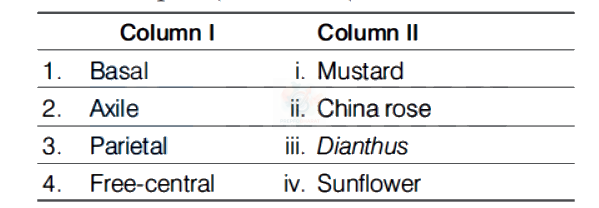 Select the correct option from the following
Bicarpellary ovary with obliquely placed septum is seen in
Placentation, in which ovules develop on the inner wall of the ovary or in peripheral part, is :
Which of the following shows whorled phyllotaxy?
Pneumatophores occur in:
Sweet potato is a modified
Coconut fruit is a
In Bougainvillea, thorns are the modifications of:
Root hairs develop from the region of
The term 'polyadelphous' is related to ------------
Radial symmetry is found in the flowers of
Proximal end of the filament of stamen is attached to the:
The coconut water from tender coconut represents:
Which of the following is not a stem modification?
Stems modified into flat green organs performing the functions of leaves are known as:
How many plants among Indigofera, Sesbania, Salvia, Allium, Aloe, mustard, groundnut, radish, gram and turnip have stamens with different lengths in their flowers?