Floral formula of Fabaceae: 
Floral formula of Solanaceae: 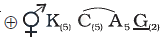
Floral formula of Liliaceae: 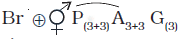
Floral formula of Brassicaceae: 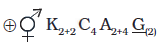
NEET UG 2021 — Botany Morphology of Flowering Plants
Match Column - I with Column - II.
| Column-I | Column-II | ||
| (a) |  | (i) | Brassicaceae |
| (b) | 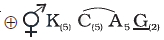 | (ii) | Liliaceae |
| (c) | 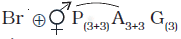 | (iii) | Fabaceae |
| (d) | 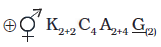 | (iv) | Solanaceae |
Held on 30 Apr 2021 · Verified 9 Jul 2026.
(a)−(iii);(b)−(iv);(c)−(ii);(d)−(i)
(a)−(i);(b)−(ii);(c)−(iii);(d)−(iv)
(a)−(ii);(b)−(iii);(c)−(iv);(d)−(i)
(a)−(iv);(b)−(ii);(c)−(i);(d)−(iii)
Sign in to track your attempts and accuracy.
Sign in to keep a private note on this question. Nothing you write is ever public.
Which of the following is an example of a zygomorphic flower?
Match List I with List II : $\begin{array}{|l|l|l|l|}\hline & \text{List - I} & & \text{List - II} \\\hline \text{A}. & \text{Scutellum} & \text{(i)} & \text{Persistent nucellus} \\\hline \text{B.} & \text{Non-albuminous seed} & \text{(ii)} & \text{Cotyledon of Monocot seed} \\\hline \text{C.} & \text{Epiblast} & \text{(iii)} & \text{Groundnut} \\\hline \text{D.} & \text{Perisperm} & \text{(iv)} & \text{Rudimentary cotyledon} \\\hline\end{array}$ Choose the option with all correct matches.
Given below are two statements: Statement I: In a floral formula $\oplus$ stands for zygomorphic nature of the flower, and $\underline{G}$ stands for inferior ovary. Statement II: In a floral formula $\oplus$ stands for actinomorphic nature of the flower and $\underline{G}$ stands for superior ovary. In the light of the above statements, choose the correct answer from the options given below:
In the seeds of cereals, the outer covering of endosperm separates the embryo by a protein-rich layer called :
Match List I with List II 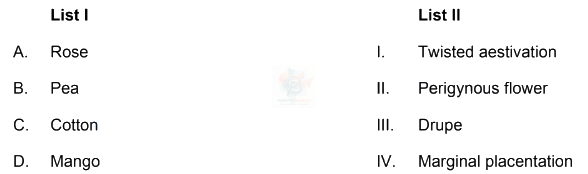 Choose the correct answer from the options given below :
Work through every NEET UG Morphology of Flowering Plants PYQ, year by year.