NEET UG 2024 — Morphology of Flowering Plants
Botany Morphology of Flowering Plants questions from NEET UG 2024.
Other Years
9 Morphology of Flowering Plants Questions from 2024
Match List-I with List-II : \begin{array}{llll} & List-I & & List-II \\A. & China rose & I. & Free central \\B. & Mustard & II. & Basal \\C. & Primrose & III. & Axile \\D. & Marigold & IV. & Parietal\end{array} Choose the correct answer from the options given below :
Match List I with List II 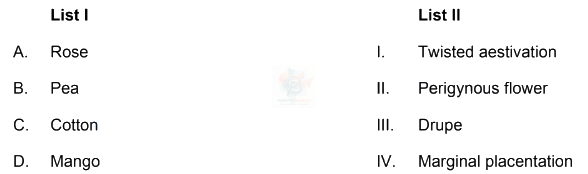 Choose the correct answer from the options given below :
Match List I with List II 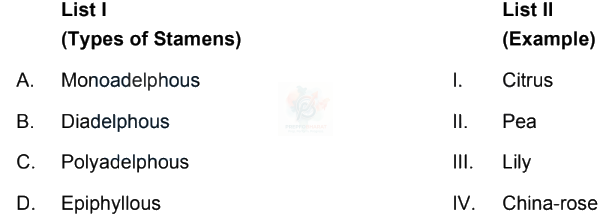 Choose the correct answer from the options given below:
Match List-I with List-II : \begin{array}{llll} & List-I & & List-II \\A. & Vexillary aestivation & I.&Brinjal \\B. & Epipetalous stamens & II. & Peach \\C. & Epiphyllous stamens & III. & Pea \\D. & Perigynous flower & IV. & Lily\end{array} Choose the correct answer from the options given below :
The part marked as ' $x$ ' in the given figure is 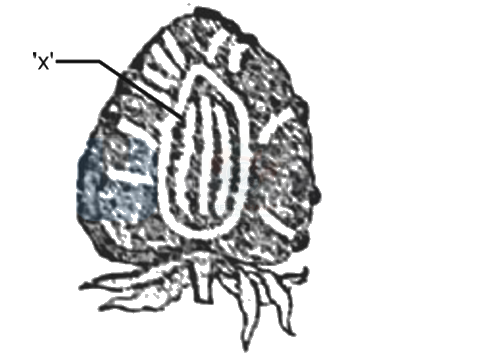
Identify the part of the seed from the given figure which is destined to form root when the seed germinates. 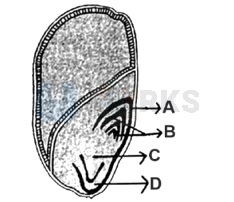
Which of the following examples show monocarpellary, unilocular ovary with many ovules? A. Sesbania B. Brinjal C. Indigofera D. Tobacco E. Asparagus Choose the correct answer from the options given below :
Which of the following is an example of actinomorphic flower?
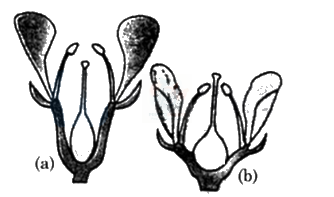
Identify the type of flowers based on the position of calyx, corolla and androecium with respect to the ovary from the given figures (a) and (b)