If gynoecium is situated in the centre and other parts of the flower are located on the rim of the thalamus almost at the same level, it is called perigynous. Both diagram shows perigynous condition.
Identify the type of flowers based on the position of calyx, corolla and androecium with respect to the ovary from the given figures (a) and (b) NEET…
NEET UG 2024 — Botany Morphology of Flowering Plants
2024mcqmedium
Identify the type of flowers based on the position of calyx, corolla and androecium with respect to the ovary from the given figures (a) and (b) 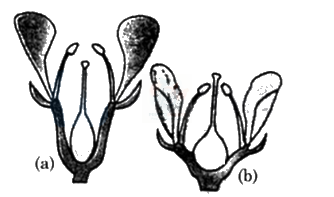
Official previous-year question
Held on 30 Apr 2024 · Verified 9 Jul 2026.
Options
- A
(a) Hypogynous; (b) Epigynous
- B
(a) Perigynous; (b) Epigynous
- C
(a) Perigynous; (b) Perigynous
- D
(a) Epigynous; (b) Hypogynous
Did you get this right?
Sign in to track your attempts and accuracy.
Your note
Sign in to keep a private note on this question. Nothing you write is ever public.
NEET UG Morphology of Flowering Plants in other years
Morphology of Flowering Plants 2025Morphology of Flowering Plants 2023Morphology of Flowering Plants 2022Morphology of Flowering Plants 2021Morphology of Flowering Plants 2020Morphology of Flowering Plants 2019Morphology of Flowering Plants 2018Morphology of Flowering Plants 2017Morphology of Flowering Plants 2016Morphology of Flowering Plants 2015Morphology of Flowering Plants 2014Morphology of Flowering Plants 2013
More NEET UG Morphology of Flowering Plants questions
Which of the following is an example of a zygomorphic flower?
2025easy
Match List I with List II : $\begin{array}{|l|l|l|l|}\hline & \text{List - I} & & \text{List - II} \\\hline \text{A}. & \text{Scutellum} & \text{(i)} & \text{Persistent nucellus} \\\hline \text{B.} & \text{Non-albuminous seed} & \text{(ii)} & \text{Cotyledon of Monocot seed} \\\hline \text{C.} & \text{Epiblast} & \text{(iii)} & \text{Groundnut} \\\hline \text{D.} & \text{Perisperm} & \text{(iv)} & \text{Rudimentary cotyledon} \\\hline\end{array}$ Choose the option with all correct matches.
2025medium
Given below are two statements: Statement I: In a floral formula $\oplus$ stands for zygomorphic nature of the flower, and $\underline{G}$ stands for inferior ovary. Statement II: In a floral formula $\oplus$ stands for actinomorphic nature of the flower and $\underline{G}$ stands for superior ovary. In the light of the above statements, choose the correct answer from the options given below:
2025easy
In the seeds of cereals, the outer covering of endosperm separates the embryo by a protein-rich layer called :
2025easy
Match List I with List II 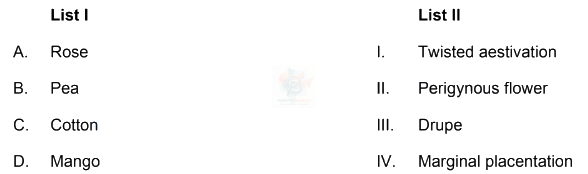 Choose the correct answer from the options given below :
2024medium
Other Botany topics for NEET UG
Keep practicing Morphology of Flowering Plants
Work through every NEET UG Morphology of Flowering Plants PYQ, year by year.