Morphology of Flowering Plants PYQ
NEET UG Botany — Morphology of Flowering Plants previous year questions with solutions.
Browse by Year
Morphology of Flowering Plants at a glance
Questions per year
133 across 23 yearsDifficulty mix
133 total- easy80 · 60%
- medium48 · 36%
- hard5 · 4%
All Morphology of Flowering Plants Questions (133)
Match List I with List II : $\begin{array}{|l|l|l|l|}\hline & \text{List - I} & & \text{List - II} \\\hline \text{A}. & \text{Scutellum} & \text{(i)} & \text{Persistent nucellus} \\\hline \text{B.} & \text{Non-albuminous seed} & \text{(ii)} & \text{Cotyledon of Monocot seed} \\\hline \text{C.} & \text{Epiblast} & \text{(iii)} & \text{Groundnut} \\\hline \text{D.} & \text{Perisperm} & \text{(iv)} & \text{Rudimentary cotyledon} \\\hline\end{array}$ Choose the option with all correct matches.
Given below are two statements: Statement I: In a floral formula $\oplus$ stands for zygomorphic nature of the flower, and $\underline{G}$ stands for inferior ovary. Statement II: In a floral formula $\oplus$ stands for actinomorphic nature of the flower and $\underline{G}$ stands for superior ovary. In the light of the above statements, choose the correct answer from the options given below:
Which of the following is an example of a zygomorphic flower?
In the seeds of cereals, the outer covering of endosperm separates the embryo by a protein-rich layer called :
Match List-I with List-II : \begin{array}{llll} & List-I & & List-II \\A. & China rose & I. & Free central \\B. & Mustard & II. & Basal \\C. & Primrose & III. & Axile \\D. & Marigold & IV. & Parietal\end{array} Choose the correct answer from the options given below :
Match List I with List II 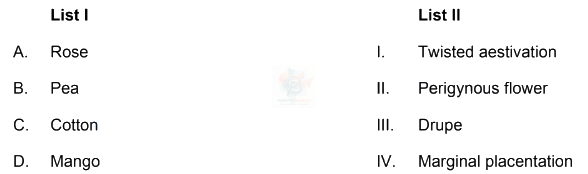 Choose the correct answer from the options given below :
Match List I with List II 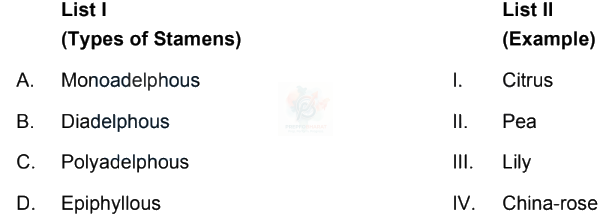 Choose the correct answer from the options given below:
Match List-I with List-II : \begin{array}{llll} & List-I & & List-II \\A. & Vexillary aestivation & I.&Brinjal \\B. & Epipetalous stamens & II. & Peach \\C. & Epiphyllous stamens & III. & Pea \\D. & Perigynous flower & IV. & Lily\end{array} Choose the correct answer from the options given below :
The part marked as ' $x$ ' in the given figure is 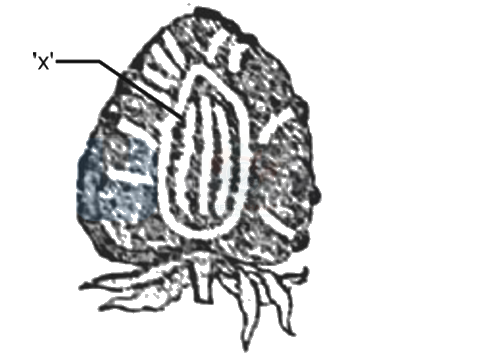
Identify the part of the seed from the given figure which is destined to form root when the seed germinates. 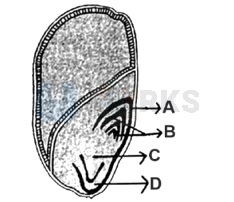
Which of the following examples show monocarpellary, unilocular ovary with many ovules? A. Sesbania B. Brinjal C. Indigofera D. Tobacco E. Asparagus Choose the correct answer from the options given below :
Which of the following is an example of actinomorphic flower?
Identify the type of flowers based on the position of calyx, corolla and androecium with respect to the ovary from the given figures (a) and (b) 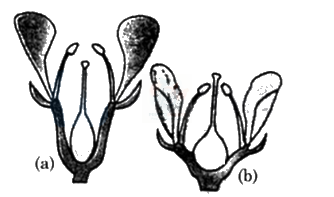
Family Fabaceae differs from Solanaceae and Liliaceae. With respect to the stamens, pick out the characteristics specific to family Fabaceae but not found in Solanaceae or Liliaceae.
In Calotropis, aestivation is :
Axial placentation is observed in:
Match the following : 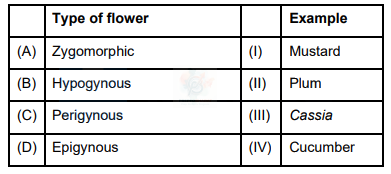 Select the correct option :
In a pea flower, five petals are arranged in a specialized manner with one posterior, two lateral and two anterior. These are named as ___________, ___________ and ___________ respectively.
Match List - I with List - II : 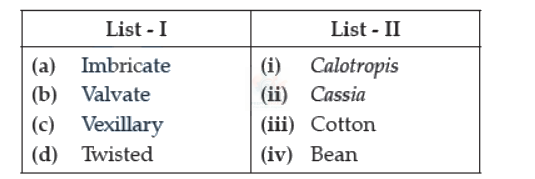 Choose the correct answer from the options given below :
Which one of the following plants shows vexillary aestivation and diadelphous stamens?
Which of the following statement is not correct?
Identify the correct set of statements : (a) The leaflets are modified into pointed hard thorns in Citrus and Bougainvillea (b) Axillary buds form slender and spirally coiled tendrils in cucumber and pumpkin (c) Stem is flattened and fleshy in Opuntia and modified to perform the function of leaves (d) Rhizophora shows vertically upward growing roots that help to get oxygen for respiration (e) Subaerially growing stems in grasses and strawberry help in vegetative propagation Choose the correct answer from the options given below:
The Floral Diagram represents which one of the following families ? 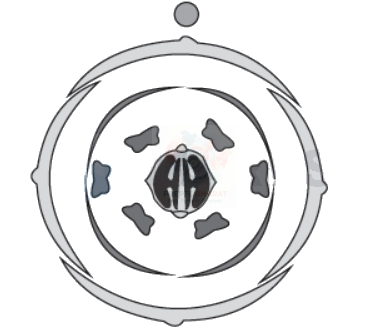
The flowers are Zygomorphic in : (a) Mustard (b) Gulmohar (c) Cassia (d) Datura (e) Chilly Choose the correct answer from the options given below: