JEE Main 2012 — Thermodynamics
Physics Thermodynamics questions from JEE Main 2012.
Other Years
10 Thermodynamics Questions from 2012
The heat radiated per unit area in 1 hour by a furnace whose temperature is $3000 \mathrm{~K}$ is $(\sigma=5.7 \times$ $10^{-8} \mathrm{~W} \mathrm{~m}^{-2} \mathrm{~K}^{-4}$ )
An ideal monatomic gas with pressure $P$, volume $V$ and temperature $T$ is expanded isothermally to a volume $2 V$ and a final pressure $P_i$. If the same gas is expanded adiabatically to a volume $2 \mathrm{~V}$, the final pressure is $P_a$. The ratio $\frac{P_a}{P_i}$ is
This question has Statement 1 and Statement 2. Of the four choices given after the Statements, choose the one that best describes the two Statements. Statement 1: In an adiabatic process, change in internal energy of a gas is equal to work done on/ by the gas in the process. Statement 2: The temperature of a gas remains constant in an adiabatic process.
A wooden wheel of radius $\mathrm{R}$ is made of two semicircular parts (see figure); The two parts are held together by a ring made of a metal strip of cross sectional area S and length $L$. $L$ is slightly less than $2 \pi R$. To fit the ring on the wheel, it is heated so that its temperature rises by $\Delta \mathrm{T}$ and it just steps over the wheel. As it cools down to surrounding temperature, it presses the semicircular parts together. If the coefficient of linear expansion of the metal is $\alpha$, and its Youngs' modulus is $Y$, the force that one part of the wheel applies on the other part is : 
A given ideal gas with $\gamma=\frac{C_p}{C_v}=1.5$ at a temperature $T$. If the gas is compressed adiabatically to one-fourth of its initial volume, the final temperature will be
$n$ moles of an ideal gas undergo a process $A \rightarrow B$ as shown in the figure. Maximum temperature of the gas during the process is 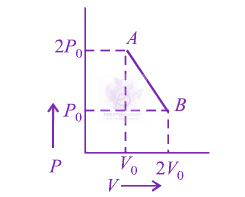
Helium gas goes through a cycle $\mathrm{ABCDA}$ (consisting of two isochoric and two isobaric lines) as shown in figure. Efficiency of this cycle is nearly: (Assume the gas to be close to ideal gas) 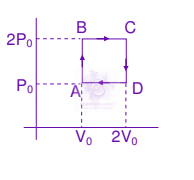
The pressure of an ideal gas varies with volume as $P=\alpha V$, where $\alpha$ is a constant. One mole of the gas is allowed to undergo expansion such that its volume becomes ' $m$ ' times its initial volume. The work done by the gas in the process is
A large cylindrical rod of length $L$ is made by joining two identical rods of copper and steel of length $\left(\frac{L}{2}\right)$ each. The rods are completely insulated from the surroundings. If the free end of copper rod is maintained at $100^{\circ} \mathrm{C}$ and that of steel at $0^{\circ} \mathrm{C}$ then the temperature of junction is (Thermal conductivity of copper is 9 times that of steel)
A perfect gas at $27^{\circ} \mathrm{C}$ is heated at constant pressure so as to double its volume. The final temperature of the gas will be, close to