Mechanics PYQ — Page 9
JEE Main Physics — Mechanics previous year questions with solutions.
All Mechanics Questions (2069)
The maximum percentage error in the measurment of density of a wire is [Given, mass of wire $=(0.60 \pm 0.003) \mathrm{g}$ radius of wire $=(0.50 \pm 0.01) \mathrm{cm}$ length of wire $=(10.00 \pm 0.05) \mathrm{cm}]$
A 400 g solid cube having an edge of length 10 cm floats in water. How much volume of the cube is outside the water ? (Given : density of water $=1000 \mathrm{~kg} \mathrm{~m}^{-3}$ )
Given below are two statements: one is labelled as Assertion (A) and the other is labelled as Reason (R). Assertion (A) : The radius vector from the Sun to a planet sweeps out equal areas in equal intervals of time and thus areal velocity of planet is constant. Reason (R) : For a central force field the angular momentum is a constant. In the light of the above statements, choose the most appropriate answer from the options given below :
A cord of negligible mass is wound around the rim of a wheel supported by spokes with negligible mass. The mass of wheel is 10 kg and radius is 10 cm and it can freely rotate without any friction. Initially the wheel is at rest. If a steady pull of 20 N is applied on the cord, the angular velocity of the wheel, after the cord is unwound by 1 m , would be : 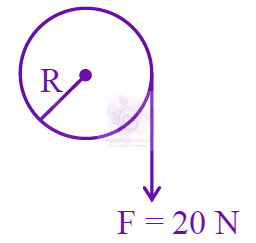
Two soap bubbles of radius 2 cm and 4 cm , respectively, are in contact with each other. The radius of curvature of the common surface, in cm , is ______ .
For an experimental expression $y=\frac{32.3 \times 1125}{27.4}$, where all the digits are significant. Then to report the value of $y$ we should write
Given below are two statements: one is labelled as Assertion $\mathrm{A}$ and the other is labelled as Reason $\mathrm{R}$ Assertion A : The kinetic energy needed to project a body of mass m from earth surface to infinity is $\frac{1}{2} \mathrm{mgR}$, where R is the radius of earth. Reason $\mathrm{R}$ : The maximum potential energy of a body is zero when it is projected to infinity from earth surface. In the light of the above statements, choose the correct answer from the option given below
A satellite of mass $\frac{M}{2}$ is revolving around earth in a circular orbit at a height of $\frac{R}{3}$ from earth surface. The angular momentum of the satellite is $M \sqrt{\frac{G M R}{x}}$. The value of $x$ is ______ , where $M$ and $R$ are the mass and radius of earth, respectively. ( G is the gravitational constant)
Match List-I with List-II. $\begin{array}{ll} \text{List-I} & \text{List-II} \\ \text{(A) Heat capacity of body} & \text{(I) } \mathrm{J} \mathrm{kg}^{-1} \\ \text{(B) Specific heat capacity of body} & \text{(II) } \mathrm{JK}^{-1} \\ \text{(C) Latent heat} & \text{(III) } \mathrm{J} \mathrm{kg}^{-1} \mathrm{~K}^{-1} \\ \text{(D) Thermal conductivity} & \text{(IV) } \mathrm{Jm}^{-1} \mathrm{~K}^{-1} \mathrm{~s}^{-1} \end{array}$ Choose the correct answer from the options given below :
A uniform rod of mass 250 g having length 100 cm is balanced on a sharp edge at 40 cm mark. A mass of 400 g is suspended at 10 cm mark. To maintain the balance of the rod, the mass to be suspended at 90 cm mark, is
The excess pressure inside a soap bubble A in air is half the excess pressure inside another soap bubble B in air. If the volume of the bubble A is $n$ times the volume of the bubble $B$, then, the value of $n$ is ___.
Match List - I with List - II. 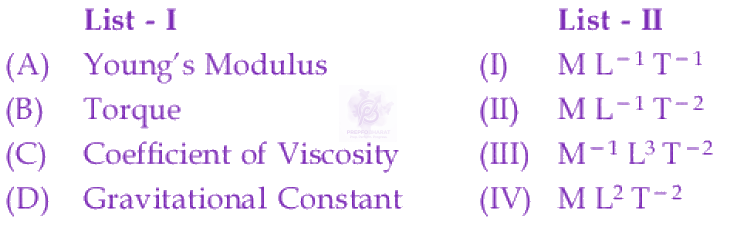 Choose the correct answer from the options given below :
A solid sphere of mass ' $m$ ' and radius ' $r$ ' is allowed to roll without slipping from the highest point of an inclined plane of length ' $L$ ' and makes an angle $30^{\circ}$ with the horizontal. The speed of the particle at the bottom of the plane is $v_1$. If the angle of inclination is increased to $45^{\circ}$ while keeping $L$ constant. Then the new speed of the sphere at the bottom of the plane is $v_2$. The ratio $v_1^2: v_2^2$ is
As shown below, bob \(A\) of a pendulum having massless string of length ' \(R\) ' is released from \(60^{\circ}\) to the vertical. It hits another bob \(B\) of half the mass that is at rest on a friction less table in the center. Assuming elastic collision, the magnitude of the velocity of bob A after the collision will be (take g as acceleration due to gravity.) 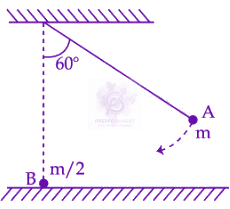
The maximum percentage error in the measurment of density of a wire is [Given, mass of wire $=(0.60 \pm 0.003) \mathrm{g}$ radius of wire $=(0.50 \pm 0.01) \mathrm{cm}$ length of wire $=(10.00 \pm 0.05) \mathrm{cm}]$
Two particles are located at equal distance from origin. The position vectors of those are represented by $\bar{A}=2 \hat{i}+3 n \hat{j}+2 \hat{k}$ and $\bar{B}=2 \hat{i}-2 \hat{j}+4 p \hat{k}$, respectively. If both the vectors are at right angle to each other, the value of $\mathrm{n}^{-1}$ is _____ .
Two particles are located at equal distance from origin. The position vectors of those are represented by $\bar{A}=2 \hat{i}+3 n \hat{j}+2 \hat{k}$ and $\bar{B}=2 \hat{i}-2 \hat{j}+4 p \hat{k}$, respectively. If both the vectors are at right angle to each other, the value of $\mathrm{n}^{-1}$ is _____ .
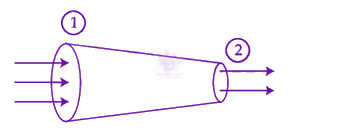 A tube of length $L$ is shown in the figure. The radius of cross section at the point (1) is 2 cm and at the point (2) is 1 cm , respectively. If the velocity of water entering at point (1) is $2 \mathrm{~m} / \mathrm{s}$, then velocity of water leaving the point (2) will be
A small point of mass $m$ is placed at a distance $2 R$ from the centre ' $O^{\prime}$ of a big uniform solid sphere of mass M and radius R . The gravitational force on ' m ' due to M is $\mathrm{F}_1$. A spherical part of radius $\mathrm{R} / 3$ is removed from the big sphere as shown in the figure and the gravitational force on m due to remaining part of M is found to be $\mathrm{F}_2$. The value of ratio $\mathrm{F}_1: \mathrm{F}_2$ is 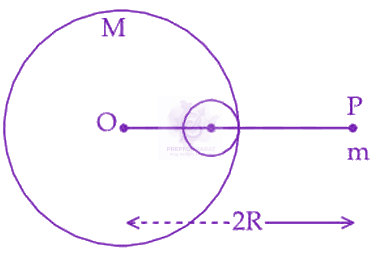
Which of the following are correct expression for torque acting on a body? B. $\vec{\tau}=\frac{\mathrm{d}}{\mathrm{dt}}(\overrightarrow{\mathrm{r}} \times \overrightarrow{\mathrm{p}})$ C. $\vec{\tau}=\overrightarrow{\mathrm{r}} \times \frac{\mathrm{d} \mathrm{p}}{\mathrm{dt}}$ D. $\vec{\tau}=\mathrm{I} \vec{\alpha}$ E. $\vec{\tau}=\overrightarrow{\mathrm{r}} \times \overrightarrow{\mathrm{F}}$ ( $\overrightarrow{\mathrm{r}}=$ position vector; $\overrightarrow{\mathrm{p}}=$ linear momentum; $\overrightarrow{\mathrm{L}}=$ angular momentum; $\vec{\alpha}=$ angular acceleration; $I=$ moment of inertia; $\vec{F}=$ force; $t=$ time) Choose the correct answer from the options given below :
A piston of mass $M$ is hung from a massless spring whose restoring force law goes as $\mathrm{F}=-\mathrm{kx}^3$, where k is the spring constant of appropriate dimension. The piston separates the vertical chamber into two parts, where the bottom part is filled with ' $n$ ' moles of an ideal gas. An external work is done on the gas isothermally (at a constant temperature T) with the help of a heating filament (with negligible volume) mounted in lower part of the chamber, so that the piston goes up from a height $\mathrm{L}_0$ to $\mathrm{L}_1$, the total energy delivered by the filament is (Assume spring to be in its natural length before heating) 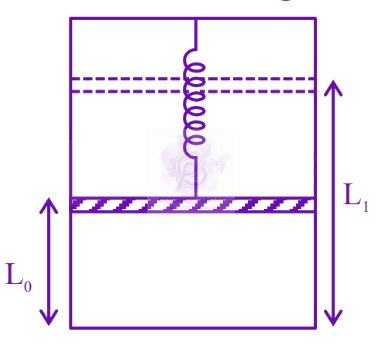
Two balls with same mass and initial velocity, are projected at different angles in such a way that maximum height reached by first ball is 8 times higher than that of the second ball. $T_1$ and $T_2$ are the total flying times of first and second ball, respectively, then the ratio of $T_1$ and $T_2$ is :
A physical quantity $Q$ is related to four observables $a, b, c, d$ as follows : $\mathrm{Q}=\frac{\mathrm{ab}{ }^4}{\mathrm{~cd}}$ where, $\mathrm{a}=(60 \pm 3) \mathrm{Pa} ; \mathrm{b}=(20 \pm 0.1) \mathrm{m} ; \mathrm{c}=(40 \pm 0.2) \mathrm{Nsm}^{-2}$ and $\mathrm{d}=(50 \pm 0.1) \mathrm{m}$, then the percentage error in Q is $\frac{x}{1000}$, where $x=$ ________ .
A cube having a side of 10 cm with unknown mass and 200 gm mass were hung at two ends of an uniform rigid rod of 27 cm long. The rod along with masses was placed on a wedge keeping the distance between wedge point and 200 gm weight as 25 cm. Initially the masses were not at balance. A beaker is placed beneath the unknown mass and water is added slowly to it. At given point the masses were in balance and half volume of the unknown mass was inside the water. (Take the density of unknown mass is more than that of the water, the mass did not absorb water and water density is $1 \mathrm{gm} / \mathrm{cm}^3$.) The unknown mass is ________ kg.