JEE Main Physics — Mechanics previous year questions with solutions.
Given below are two statements: one is labelled as Assertion A and the other is labelled as Reason R. Assertion A: Earth has atmosphere whereas moon doesn’t have any atmosphere. Reason R: The escape velocity on moon is very small as compared to that on earth. In the light of the above statements, choose the correct answer from the options given below:
An air bubble of diameter $6\mathrm{mm}$ rises steadily through a solution of density $1750\mathrm{kg}{m}^{-3}$ at the rate of $0.35\mathrm{cm}{s}^{-1}$. The co-efficient of viscosity of the solution (neglect density of air) is ________ Pas (given, $g=10m{s}^{-2}$).
A mercury drop of radius ${10}^{–3}m$ is broken into $125$ equal size droplets. Surface tension of mercury is $0.45N{m}^{–1}$ . The gain in surface energy is:
A spherical drop of liquid splits into $1000$ identical spherical drops. If ${u}_{i}$ is the surface energy of the original drop and ${u}_{f}$ is the total surface energy of the resulting drops, the (ignoring evaporation), $\frac{{u}_{f}}{{u}_{i}}=(\frac{10}{x})$. Then value of $x$ is ______:
In a screw gauge, there are $100$ divisions on the circular scale and the main scale moves by $0.5\mathrm{mm}$ on a complete rotation of the circular scale. The zero of circular scale lies $6$ divisions below the line of graduation when two studs are brought in contact with each other. When a wire is placed between the studs, $4$ linear scale divisions are clearly visible while 46$^{th}$ division the circular scale coincide with the reference line. The diameter of the wire is ______ $\times {10}^{-2}\mathrm{mm}.$
A circular plate is rotating in horizontal plane, about an axis passing through its centre and perpendicular to the plate, with an angular velocity $\omega$. A person sits at the centre having two dumbbells in his hands. When he stretched out his hands, the moment of inertia of the system becomes triple. If $E$ be the initial Kinetic energy of the system, then final Kinetic energy will be $\frac{E}{x}$. The value of $x$ is
Assuming the earth to be a sphere of uniform mass density, the weight of a body at a depth $d=\frac{R}{2}$ from the surface of earth, if its weight on the surface of earth is $200N$, will be : (Given $R=$ radius of earth)
For rolling spherical shell, the ratio of rotational kinetic energy and total kinetic energy is $\frac{x}{5}$. The value of $x$ is _____.
Two discs of same mass and different radii are made of different materials such that their thicknesses are $1\mathrm{cm}$ and $0.5\mathrm{cm}$ respectively. The densities of materials are in the ratio $3:5$. The moment of inertia of these discs respectively about their diameters will be in the ratio of $\frac{x}{6}$. The value of $x$ is ______.
An air bubble of volume $1{\mathrm{cm}}^{3}$ rises from the bottom of a lake $40m$ deep to the surface at a temperature of $12^{\circ}C.$ The atmospheric pressure is $1\times {10}^{5}\mathrm{Pa},$ the density of water is $1000\mathrm{kg}{m}^{-3}$ and $g=10m{s}^{-2}.$There is no difference of the temperature of water at the depth of $40m$ and on the surface. The volume of air bubble when it reaches the surface will be
Assume that the earth is a solid sphere of uniform density and a tunnel is dug along its diameter throughout the earth. It is found that when a particle is released in this tunnel, it executes a simple harmonic motion. The mass of the particle is $100g$. The time period of the motion of the particle will be (approximately) (take $g=10{\mathrm{ms}}^{-2}$, radius of earth $=6400\mathrm{km}$)
A stone of mass $1\mathrm{kg}$ is tied to end of a massless string of length $1m$. If the breaking tension of the string is $400N$, then maximum linear velocity, the stone can have without breaking the string, while rotating in horizontal plane, is:
The surface tension of soap solution is $3.5\times {10}^{-2}N{m}^{-1}$. The amount of work done required to increase the radius of soap bubble from $10\mathrm{cm}$ to $20\mathrm{cm}$ is _____$\times {10}^{-4}J$ . (take $\pi =\frac{22}{7}$)
A metal block of base area $0.20{m}^{2}$ is placed on a table, as shown in figure. A liquid film of thickness $0.25\mathrm{mm}$ is inserted between the block and the table. The block is pushed by a horizontal force of $0.1N$ and moves with a constant speed. If the viscosity of the liquid is $5.0\times {10}^{–3}\mathrm{Pl}$, the speed of block is ______ $\times {10}^{-3}m{s}^{-1}$. 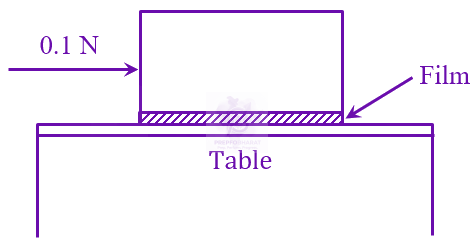
The time period of a satellite, revolving above earth's surface at a height equal to $R$ will be (Given $g={\pi }^{2}m{s}^{-2},R=$ radius of earth)
A vehicle of mass $200\mathrm{kg}$ is moving along a levelled curved road of radius $70m$ with angular velocity of $0.2\mathrm{rad}{s}^{-1}$. The centripetal force acting on the vehicle is:
The position-time graphs for two students $A$ and $B$ returning from the school to their homes are shown in figure. 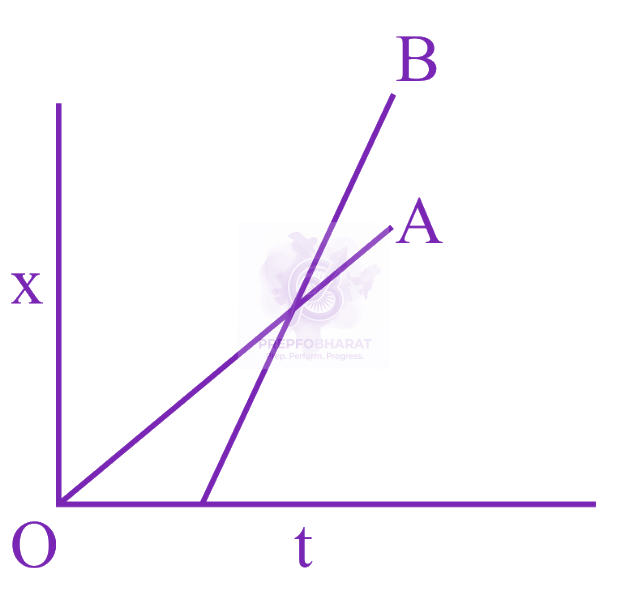 (A) $A$ lives closer to the school (B) $B$ lives closer to the school (C) $A$ takes lesser time to reach home (D) $A$ travels faster than $B$ (E) $B$ travels faster than $A$ Choose the correct answer from the options given below
As shown in the figure a block of mass $10\mathrm{kg}$ lying on a horizontal surface is pulled by a force F acting at an angle $30^{\circ}$, with horizontal. For ${\mu }_{s}=0.25$, the block will just start to move for the value of $F$: [Given g $=10m\cdot {s}^{–2}$] 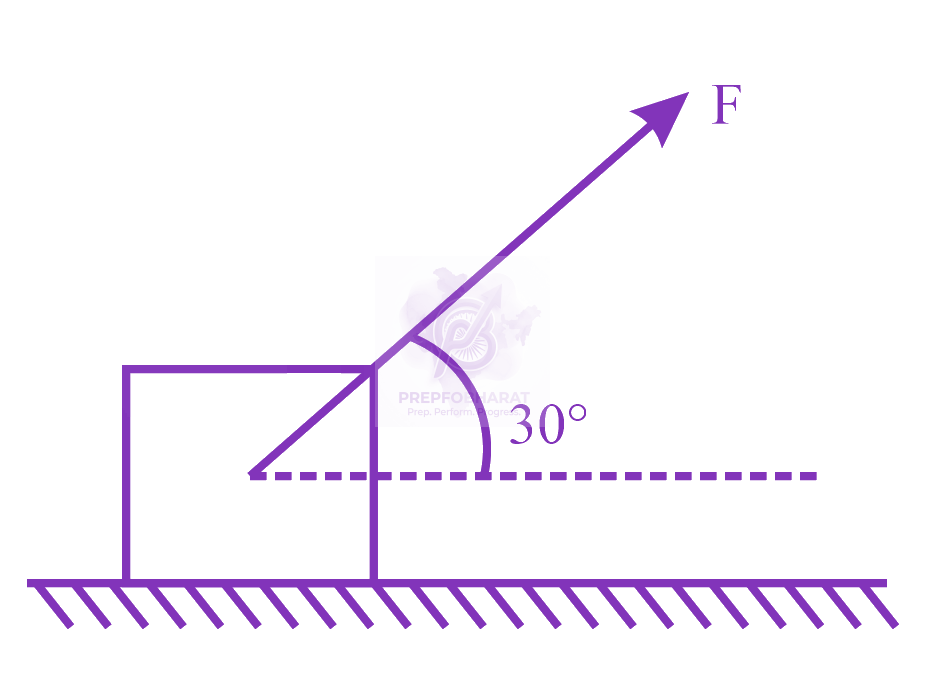
$100$ balls each of mass $m$ moving with speed $v$ simultaneously strike a wall normally and reflected back with same speed, in time $ts$. The total force exerted by the balls on the wall is
A block is fastened to a horizontal spring. The block is pulled to a distance $x=10\mathrm{cm}$ from its equilibrium position (at $x=0$) on a frictionless surface from rest. The energy of the block at $x=5\mathrm{cm}$ is $0.25J$. The spring constant of the spring is ______ $N{m}^{-1}$.
A ball is dropped from a height of $20m$. If the coefficient of restitution for the collision between ball and floor is $0.5$, after hitting the floor, the ball rebounds to a height of ______ $m$.
A body is released from a height equal to the radius $(R)$ of the earth. The velocity of the body when it strikes the surface of the earth will be: (Given $g=$ acceleration due to gravity on the earth.)
A spherical body of mass $2\mathrm{kg}$ starting from rest acquires a kinetic energy of $10000J$ at the end of ${5}^{\text{th }}$ second. The force acted on the body is _____ $N$.
A satellite is revolving around earth in a circular orbit. What will happen to its orbit if we suddenly stop it?