JEE Main Physics — Mechanics previous year questions with solutions.
An object is allowed to fall from a height $R$ above the earth, where $R$ is the radius of earth. Its velocity when it strikes the earth’s surface, ignoring air resistance, will be :
Form the $v-t$ graph shown, the ratio of distance to displacement in $25s$ of motion is: 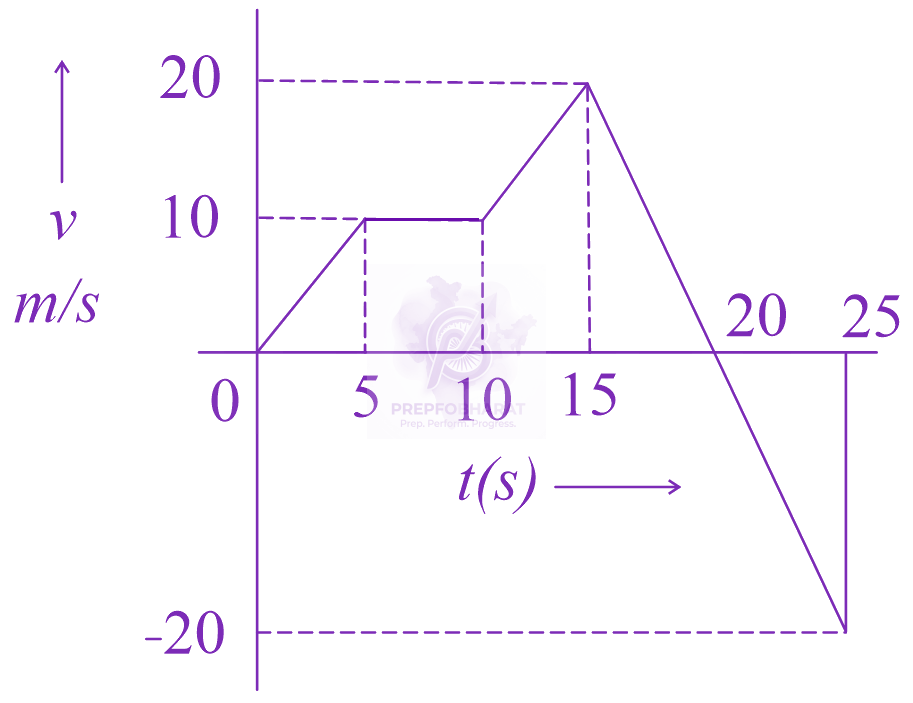
A block of mass $m$ slides down the plane inclined at angle $30^{\circ}$ with an acceleration $\frac{g}{4}$ . The value of coefficient of kinetic friction will be :
The trajectory of projectile, projected from the ground is given by $y=x-\frac{{x}^{2}}{20}$. Where $x$ and $y$ are measured in meter. The maximum height attained by the projectile will be.
Given below are two statements: one is labelled as Assertion A and the other is labelled as Reason R Assertion A: When you squeeze one end of a tube to get toothpaste out from the other end, Pascal’s principle is observed. Reason R: A change in the pressure applied to an enclosed incompressible fluid is transmitted undiminished to every portion of the fluid and to the walls of its container. In the light of the above statements, choose the most appropriate answer from the options given below.
Match List I with List II <table class="pyq-table"><tbody><tr><td colspan="2" rowspan="1">List I</td><td colspan="2" rowspan="1">List II</td></tr><tr><td>$A.$</td><td>Planck's constant $(h)$</td><td>$I.$</td><td>$[{M}^{1}{L}^{2}{T}^{-2}]$</td></tr><tr><td>$B.$</td><td>Stopping potential $({V}_{s})$</td><td>$\mathrm{II}.$</td><td>$[{M}^{1}{L}^{1}{T}^{-1}]$</td></tr><tr><td>$C.$</td><td>Work function $(\phi )$</td><td>$\mathrm{III}.$</td><td>$[{M}^{1}{L}^{2}{T}^{-1}]$</td></tr><tr><td>$D.$</td><td>Momentum $(p)$</td><td>$\mathrm{IV}.$</td><td>$[{M}^{1}{L}^{2}{T}^{-3}{A}^{-1}]$</td></tr></tbody></table>
A ball is thrown vertically upward with an initial velocity of $150m{s}^{-1}$. The ratio of velocity after $3s$ and $5s$ is $\frac{x+1}{x}$. The value of $x$ is _____. {take, $g=10m{s}^{-2}$}
A tennis ball is dropped on to the floor from a height of $9.8m$. It rebounds to a height $5.0m$. Ball comes in contact with the floor for $0.2s$. The average acceleration during contact is ______ $m{s}^{-2}$. [Given $g=10m{s}^{-2}$]
A planet has double the mass of the earth. Its average density is equal to that of the earth. An object weighing $W$ on earth will weigh on that planet:
A body of mass $(5\pm 0.5)\mathrm{kg}$ is moving with a velocity of $(20\pm 0.4)m{s}^{-1}.$ Its kinetic energy will be
An object of mass $m$ initially at rest on a smooth horizontal plane starts moving under the action of force $F=2N$. In the process of its linear motion, the angle $\theta$ (as shown in figure) between the direction of force and horizontal varies as $\theta =kx$, where $k$ is a constant and $x$ is the distance covered by the object from its initial position. The expression of kinetic energy of the object will be $E=\frac{n}{k}\mathrm{sin}\theta$. The value of $n$ is ______. 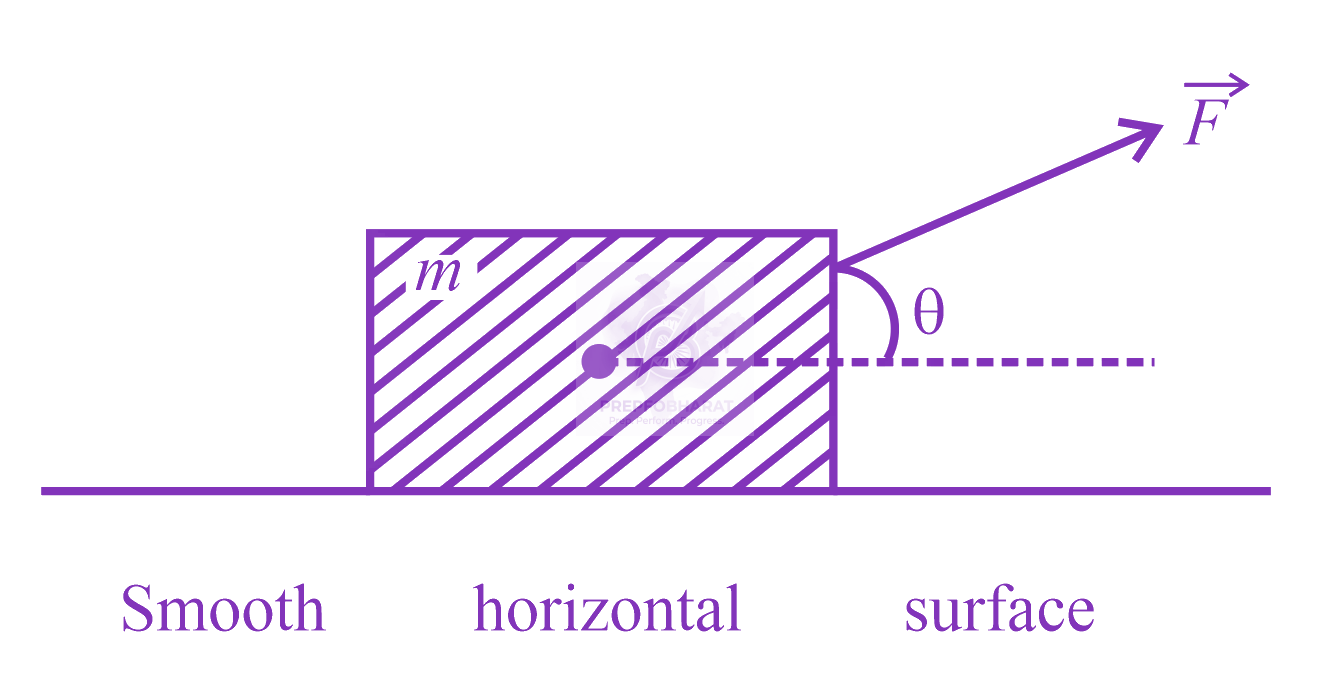
If $\vec{P}=3\hat{i}+\sqrt{3}\hat{j}+2\hat{k}$ and $\vec{Q}=4\hat{i}+\sqrt{3}\hat{j}+2.5\hat{k}$ then, the unit vector in the direction of $\vec{P}\times \vec{Q}$ is $\frac{1}{x}(\sqrt{3}\hat{i}+\hat{j}-2\sqrt{3}\hat{k})$. The value of $x$ is
A solid sphere is rolling on a horizontal plane without slipping. If the ratio of angular momentum about axis of rotation of the sphere to the total energy of moving sphere is $\pi :22$ then, the value of its angular speed will be$_________rad{s}^{-1}.$
A body of mass $200g$ is tied to a spring of spring constant $12.5N{m}^{-1}$, while the other end of spring is fixed at point $O$. If the body moves about $O$ in a circular path on a smooth horizontal surface with constant angular speed $5\mathrm{rad}{s}^{-1}$, then the ratio of extension in the spring to its natural length will be :
A car is moving on a circular path of radius $600m$ such that the magnitudes of the tangential acceleration and centripetal acceleration are equal. The time taken by the car to complete first quarter of revolution, if it is moving with an initial speed of $54\mathrm{km}{h}^{-1}$ is $t(1–{e}^{–\frac{\pi }{2}})s$. The value of $t$ is ______.
A cylindrical wire of mass$(0.4\pm 0.01)g$ has length $(8\pm 0.04)\mathrm{cm}$ and radius $(6\pm 0.03)\mathrm{mm}$. The maximum error in its density will be
A cylindrical wire of mass$(0.4\pm 0.01)g$ has length $(8\pm 0.04)\mathrm{cm}$ and radius $(6\pm 0.03)\mathrm{mm}$. The maximum error in its density will be
A car is moving with a constant speed of $20m{s}^{-1}$ in a circular horizontal track of radius $40m$. A bob is suspended from the roof of the car by a massless string. The angle made by the string with the vertical will be : (Take $g=10m{s}^{-2}$)
Young’s moduli of the material of wires A and B are in the ratio of $1:4$, while its area of cross sections are in the ratio of $1:3$. If the same amount of load is applied to both the wires, the amount of elongation produced in the wires A and B will be in the ratio of [Assume length of wires A and B are same]
The surface of water in a water tank of cross section area $750{\mathrm{cm}}^{2}$ on the top of a house is $hm$. above the tap level. The speed of water coming out through the tap of cross section area $500{\mathrm{mm}}^{2}$ is $30\mathrm{cm}{s}^{-1}$. At that instant, $\frac{dh}{dt}$ is $x\times {10}^{-3}m{s}^{-1}$. The value of $x$ will be ______.
A body of mass $10\mathrm{kg}$ is moving with an initial speed of $20m{s}^{-1}$. The body stops after $5s$ due to friction between body and the floor. The value of the coefficient of friction is: (Take acceleration due to gravity $g=10m{s}^{-2}$)
A projectile is projected at $30^{\circ}$ from horizontal with initial velocity $40m{s}^{-1}$. The velocity of the projectile at $t=2s$ from the start will be:
A hollow spherical ball of uniform density rolls up a curved surface with an initial velocity $3m{s}^{-1}$ (as shown in figure). Maximum height with respect to the initial position covered by it will be _____ $\mathrm{cm}$ (take, $g=10m{s}^{-2}$) 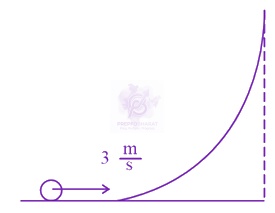
The maximum vertical height to which a man can throw a ball is $136m$. The maximum horizontal distance upto which he can throw the same ball is