JEE Main Physics — Electromagnetism previous year questions with solutions.
The velocity of certain ions that pass undeflected through crossed electric field $E=7.7 \mathrm{k} \mathrm{V} / \mathrm{m}$ and magnetic field $B=0.14 \mathrm{~T}$ is
A proton and a deuteron are both accelerated through the same potential difference and enter in a magnetic field perpendicular to the direction of the field. If the deuteron follows a path of radius $R$, assuming the neutron and proton masses are nearly equal, the radius of the proton's path will be
The electric potential $V(x)$ in a region around the origin is given by $V(x)=4 x^2$ volts. The electric charge enclosed in a cube of $1 \mathrm{~m}$ side with its centre at the origin is (in coulomb)
The magnetic force acting on charged particle of charge $2 \mu \mathrm{C}$ in magnetic field of $2 T$ acting in $y-$ direction, when the particle velocity is $(2 \hat{i}+3 \hat{j}) \times 10^6 \mathrm{~ms}^{-1}$ is
Magnetic flux through a coil of resistance $10 \Omega$ is changed by $\Delta \phi$ in $0.1 \mathrm{~s}$. The resulting current in the coil varies with time as shown in the figure. Then $|\Delta \phi|$ is equal to (in weber) 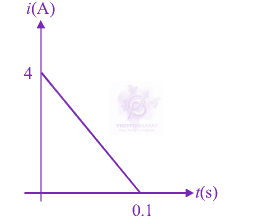
A coil of self inductance $L$ is connected at one end of two rails as shown in figure. A connector of length $l$, mass $m$ can slide freely over the two parallel rails. The entire set up is placed in a magnetic field of induction $B$ going into the page. At an instant $t=0$ an initial velocity $v_0$ is imparted to it and as a result of that it starts moving along $x$-axis. The displacement of the connector is represented by the figure. 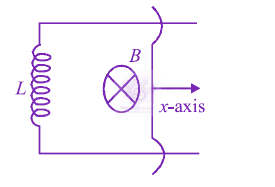
An electromagnetic wave in vacuum has the electric and magnetic fields $\vec{E}$ and $\vec{B}$, which are always perpendicular to each other. The direction of polarization is given by $\vec{X}$ and that of wave propagation by $\overrightarrow{\mathrm{k}}$. Then :
The circuit in figure consists of wires at the top and bottom and identical springs as the left and right sides. The wire at the bottom has a mass of $10 \mathrm{~g}$ and is $5 \mathrm{~cm}$ long. The wire is hanging as shown in the figure. The springs stretch $0.5 \mathrm{~cm}$ under the weight of the wire and the circuit has a total resistance of $12 \Omega$. When the lower wire is subjected to a static magnetic field, the springs, stretch an additional $0.3 \mathrm{~cm}$. The magnetic field is 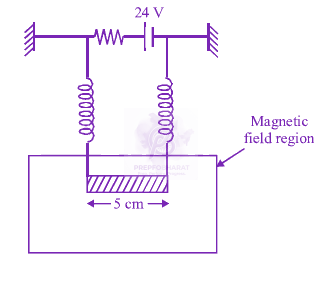
This question has Statement 1 and Statement 2 . Of the four choices given after the Statements, choose the one that best describes the two Statements. Statement 1: It is not possible to make a sphere of capacity 1 farad using a conducting material. Statement 2: It is possible for earth as its radius is $6.4 \times 10^6 \mathrm{~m}$.
The capacitor of an oscillatory circuit is enclosed in a container. When the container is evacuated, the resonance frequency of the circuit is $10 \mathrm{kHz}$. When the container is filled with a gas, the resonance frequency changes by $50 \mathrm{~Hz}$. The dielectric constant of the gas is
This question has Statement 1 and Statement 2. Of the four choices given after the Statements, choose the one that best describes the two Statements. Statement 1: Self inductance of a long solenoid of length $L$, total number of turns $\mathrm{N}$ and radius $\mathrm{r}$ is less than $\frac{\pi \mu_0 N^2 r^2}{L}$. Statement 2: The magnetic induction in the solenoid in Statement 1 carrying current $I$ is $\frac{\mu_0 N I}{L}$ in the middle of the solenoid but becomes less as we move towards its ends.
This question has Statement 1 and Statement 2. Of the four choices given after the Statements, choose the one that best describes the two Statements. Statement 1: The possibility of an electric bulb fusing is higher at the time of switching $\mathrm{ON}$. Statement 2: Resistance of an electric bulb when it is not lit up is much smaller than when it is lit up.
The frequency of $X$-rays; $\gamma$-rays and ultraviolet rays are respectively $a, b$ and $c$ then
Three resistors of $4 \Omega, 6 \Omega$ and $12 \Omega$ are connected in parallel and the combination is connected in series with a $1.5 \mathrm{~V}$ battery of $1 \Omega$ internal resistance. The rate of Joule heating in the $4 \Omega$ resistor is
In an $L C R$ circuit shown in the following figure, what will be the readings of the voltmeter across the resistor and ammeter if an a.c. source of $220 \mathrm{~V}$ and $100 \mathrm{~Hz}$ is connected to it as shown? 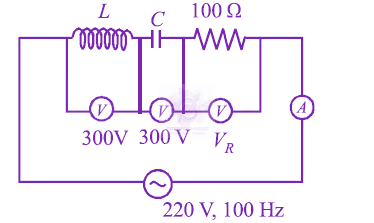
A radio transmitter transmits at $830 \mathrm{kHz}$. At a certain distance from the transmitter magnetic field has amplitude $4.82 \times 10^{-11} \mathrm{~T}$. The electric field and the wavelength are respectively
Two circuits (a) and (b) have charged capacitors of capacitance C, 2C and 3C with open switches. Charges on each of the capacitor are as shown in the figures. On closing the switches 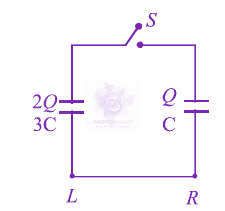 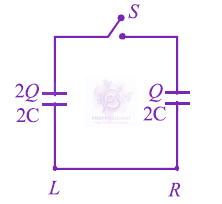 Circuit (a) Circuit (b)
Proton, Deuteron and alpha particle of the same kinetic energy are moving in circular trajectories in a constant magnetic field. The radii of proton, deuteron and alpha particle are respectively $r_p, r_d$ and $r_\alpha$. Which one of the following relations is correct?
A generator has armature resistance of $0.1 \Omega$ and develops an induced emf of $120 \mathrm{~V}$ when driven at its rated speed. Its terminal voltage when a current of $50 \mathrm{~A}$ is being drawn is
This question has Statement 1 and Statement 2. Of the four choices given after the Statements, choose the one that best describes the two Statements. Statement 1: A charged particle is moving at right angle to a static magnetic field. During the motion the kinetic energy of the charge remains unchanged. Statement 2: Static magnetic field exert force on a moving charge in the direction perpendicular to the magnetic field.
Three positive charges of equal value $q$ are placed at vertices of an equilateral triangle. The resulting lines of force should be sketched as in
This question has statement $1$ and statement $2$ . Of the four choices given after the statements, choose the one that best describes the two statements. An insulating solid sphere of radius $\mathrm{R}$ has a uniformly positive charge density $\rho$. As a result of this uniform charge distribution there is a finite value of electric potential at the centre of the sphere, at the surface of the sphere and also at a point out side the sphere. The electric potential at infinity is zero. Statement $1$: When a charge $q$ is taken from the centre to the surface of the sphere, its potential energy changes by $\frac{\mathrm{qp}}{3 \varepsilon_0}$ Statement $2$: The electric field at a distance $r(r < R)$ from the centre of the sphere is $\frac{\rho r}{3 \varepsilon_0}$
In a uniformly charged sphere of total charge $Q$ and radius $R$, the electric field $E$ is plotted as a function of distance from the centre. The graph which would correspond to the above will be
A bar magnet of length $6 \mathrm{~cm}$ has a magnetic moment of $4 \mathrm{~J} \mathrm{~T}^{-1}$. Find the strength of magnetic field at a distance of $200 \mathrm{~cm}$ from the centre of the magnet along its equatorial line.