JEE Main Physics — Electromagnetism previous year questions with solutions.
A current $i$ is flowing in a straight conductor of length $L$. The magnetic induction at a point on its axis at a distance $\frac{L}{4}$ from its centre will be :
Six equal resistances are connected between points $\mathrm{P}, \mathrm{Q}$ and $\mathrm{R}$ as shown in figure. Then net resistance will be maximum between : 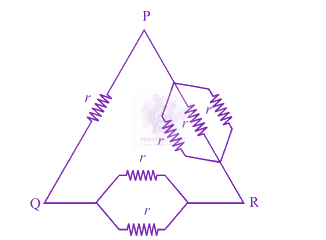
The surface charge density of a thin charged disc of radius $\mathrm{R}$ is $\sigma$. The value of the electric field at the centre of the disc is $\frac{\sigma}{2 \in_0}$. With respect to the field at the centre, the electric field along the axis at a distance $\mathrm{R}$ from the centre of the disc:
The magnetic field in a travelling electromagnetic wave has a peak value of $20nT$. The peak value of electric field strength is :
A liquid drop having 6 excess electrons is kept stationary under a uniform electric field of $25.5$ $\mathrm{kVm}^{-1}$. The density of liquid is $1.26 \times 10^3 \mathrm{~kg} \mathrm{~m}^{-3}$. The radius of the drop is (neglect buoyancy).
Two balls of same mass and carrying equal charge are hung from a fixed support of length $l$. At electrostatic equilibrium, assuming that angles made by each thread is small, the separation, $x$ between the balls is proportional to :
A point charge of magnitude $+1 \mu \mathrm{C}$ is fixed at $(0$, $0,0)$. An isolated uncharged spherical conductor, is fixed with its center at $(4,0,0)$. The potential and the induced electric field at the centre of the sphere is :
Two small equal point charges of magnitude $q$ are suspended from a common point on the ceiling by insulating mass less strings of equal lengths. They come to equilibrium with each string making angle $\theta$ from the vertical. If the mass of each charge is $m$, then the electrostatic potential at the centre of line joining them will be $$ \left(\frac{1}{4 \pi \in_0}=k\right) \text {. } $$
An LCR circuit as shown in the figure is connected to a voltage source $\mathrm{V}_{\mathrm{ac}}$ whose frequency can be varied. 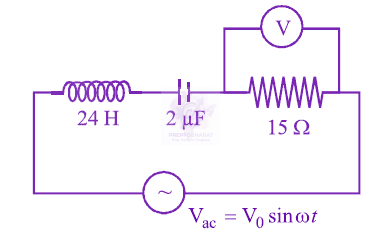 The frequency, at which the voltage across the resistor is maximum, is :
To establish an instantaneous current of $2 \mathrm{~A}$ through a $1 \mu \mathrm{F}$ capacitor ; the potential difference across the capacitor plates should be changed at the rate of:
Two capacitors ${C}_{1}$ and ${C}_{2}$ are charged to $\text{120 V}$ and $\text{200 V}$ respectively. It is found that by connecting them together the potential on each one can be made zero. Then:
This question has $Statement I$ and $Statement II$. Of the four choices given after the Statements, choose the one that best describes the two Statements. $Statement - I :$ Higher the range, greater is the resistance of ammeter. $Statement - II :$ To increase the range of ammeter, additional shunt needs to be used across it.
A shunt of resistance $1 ~\Omega$ is connected across a galvanometer of $120 ~\Omega$ resistance. A current of $5.5$ ampere gives full scale deflection in the galvanometer. The current that will give full scale deflection in the absence of the shunt is nearly :
Which of the four resistances $P, Q, R$ and $S$ generate the greatest amount of heat when a current flows from A to B ? 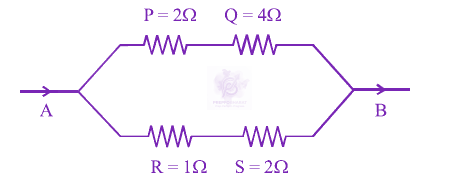
A metal sample carrying a current along $\mathrm{X-}$ axis with density $\mathrm{J}_{\mathrm{x}}$ is subjected to a magnetic field $\mathrm{B}_z$ (along $\mathrm{z-}$axis). The electric field $\mathrm{E}_{\mathrm{y}}$ developed along $\mathrm{Y}$-axis is directly proportional to $\mathrm{J}_{\mathrm{x}}$ as well as $\mathrm{B}_{\mathrm{z}}$. The constant of proportionality has SI unit.
A metallic rod of length $l$ is tied to a string of length $2l$ and made to rotate with angular speed $\omega$ on a horizontal table with one end of the string fixed. If there is a vertical magnetic field B in the region, the e.m.f. induced across the ends of the rod is: 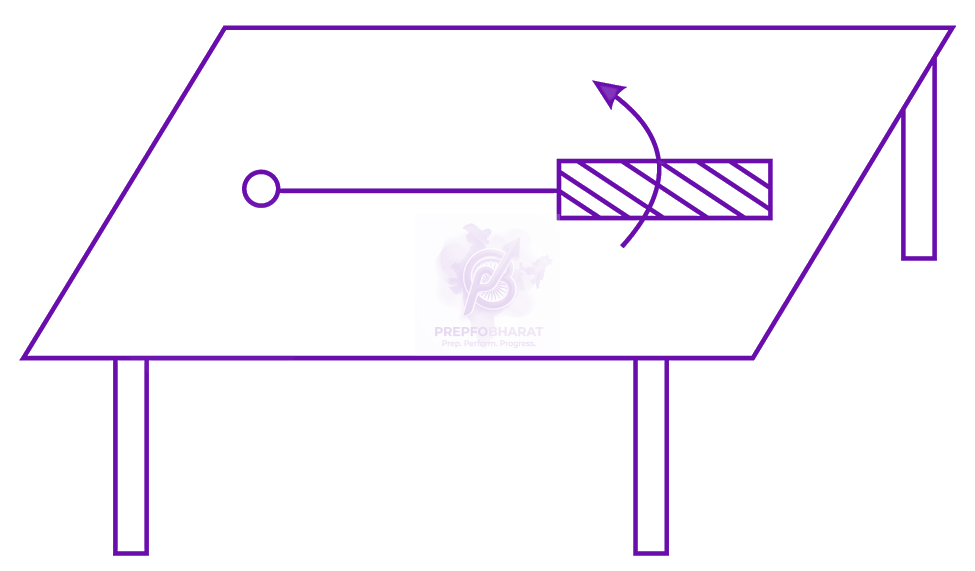
Select the correct statement from the following :
The gravitational field in a region is given by: $\vec{E}=(5 N / k g) \hat{i}+(12 N / k g) \hat{j}$ If the potential at the origin is taken to be zero, then the ratio of the potential at the points $(12 \mathrm{~m}, 0)$ and $(0,5 \mathrm{~m})$ is :
A parallel plate capacitor having a separation between the plates $\mathrm{d}$, plate area $\mathrm{A}$ and material with dielectric constant $\mathrm{K}$ has capacitance $\mathrm{C}_0$. Now one-third of the material is replaced by another material with dielectric constant $2 \mathrm{~K}$, so that effectively there are two capacitors one with area $\frac{1}{3} \mathrm{~A}$, dielectric constant $2 \mathrm{~K}$ and another with area $\frac{2}{3} \mathrm{~A}$ and dielectric constant $\mathrm{K}$. If the capacitance of this new capacitor is $\mathrm{C}$ then $\frac{\mathrm{C}}{\mathrm{C}_0}$ is
A plane electromagnetic wave in a non-magnetic dielectric medium is given by $\vec{E}=\vec{E}_0\left(4 \times 10^{-7} x-50 t\right)$ with distance being in meter and time in seconds. The dielectric constant of the medium is :
To find the resistance of a galvanometer by the half deflection method the following circuit is used with resistances $\mathrm{R}_1=9970 \mathrm{~W}, \mathrm{R}_2=30 \mathrm{~W}$ and $\mathrm{R}_3=0$. The deflection in the galvanometer is d. With $\mathrm{R}_3=107 \mathrm{~W}$ the deflection changed to $\frac{d}{2}$. The galvanometer resistance is approximately: 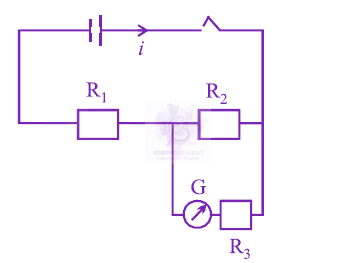
A dc source of emf $\mathrm{E}_1=100 \mathrm{~V}$ and internal resistance $r=0.5 \Omega$, a storage battery of emf $\mathrm{E}_2=90 \mathrm{~V}$ and an external resistance $\mathrm{R}$ are connected as shown in figure. For what value of R no current will pass through the battery? 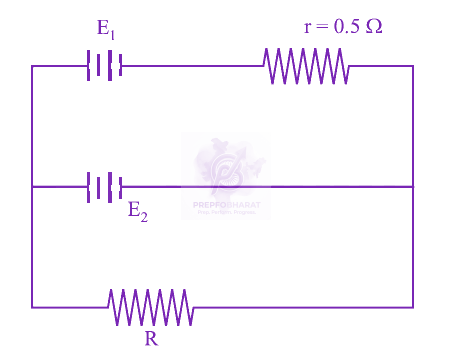
Photons of an electromagnetic radiation has an energy $11 \mathrm{keV}$ each. To which region of electromagnetic spectrum does it belong ?
Two short bar magnets of length $1cm$ each have magnetic moments $1.20A{m}^{2}$ and $1.00A{m}^{2}$ respectively. They are placed on a horizontal table parallel to each other with their $\text{N}$ poles pointing towards the south. They have a common magnetic equator and are separated by a distance of $20.0\mathrm{cm}$. The value of the resultant horizontal magnetic induction at the mid-point $\text{O}$ of the line joining their centres is close to ( Horizontal component of earth's magnetic induction is $3.6\times {10}^{-5}\mathrm{Wb}{m}^{-2}$ )