JEE Main Physics — Electromagnetism previous year questions with solutions.
The coercivity of a small magnet, where the ferromagnet gets demagnetised is $3\times {10}^{3}A/m$. The current required to be passed in a solenoid of length $10\mathrm{cm}$ and number of turns $100$, so that the magnet gets demagnetised when inside the solenoid is
A spherically symmetric charge distribution is characterised by a charge density having the following variations: $\rho(r)=\rho_o\left(1-\frac{r}{R}\right)$ for $r < R$ $\rho(\mathrm{r})=0$ for $r \geq \mathrm{R}$ Where $r$ is the distance from the centre of the charge distribution $\rho_{\mathrm{o}}$ is a constant. The electric field at an internal point $(r < R)$ is:
A parallel plate capacitor of area $60 \mathrm{~cm}^2$ and separation $3 \mathrm{~mm}$ is charged initially to $90 \mu \mathrm{C}$. If the medium between the plate gets slightly conducting and the plate loses the charge initially at the rate of $2.5 \times 10^{-8} \mathrm{C} / \mathrm{s}$, then what is the magnetic field between the plates ?
A series $\mathrm{LR}$ circuit is connected to an ac source of frequency $\omega$ and the inductive reactance is equal to $2 \mathrm{R}$. A capacitance of capacitive reactance equal to $\mathrm{R}$ is added in series with $\mathrm{L}$ and $\mathrm{R}$. The ratio of the new power factor to the old one is :
The amplitude of a damped oscillator decreases to 0.9 times its original magnitude in 5s. In another 10s it will decrease to $\alpha$ times its original magnitude, where $\alpha$ equals :
A rectangular loop of wire, supporting a mass $m$, hangs with one end in a uniform magnetic field $\vec{B}$ pointing out of the plane of the paper. A clockwise current is set up such that $i>m g / B a$, where $a$ is the width of the loop. Then : 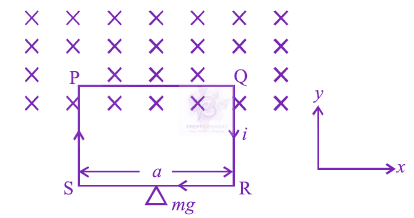
The supply voltage to a room is $120V$. The resistance of the lead wires is $6 \Omega$. A $60W$ bulb is already switched on. What is the decrease of voltage across the bulb, when a $240W$ heater is switched on in parallel to the bulb?
A circular loop of radius $0.3\mathrm{cm}$ lies parallel to a much bigger circular loop of radius $20\mathrm{cm}$. The centre of the small loop is on the axis of the bigger loop. The distance between their centres is$15$ $\mathrm{cm}$. If a current of $2.0A$ flows through the smaller loop, then the flux linked with a bigger loop is:
One of the two small circular coils, (none of them having any self - inductance) is suspended with a V-shaped copper wire, with plane horizontal. The other coil is placed just below the first one with plane horizontal. Both the coils are connected in series with a dc supply. The coils are found to attract each other with a force. Which one of the following statements is incorrect?
In an $\text{LCR}$ circuit as shown below both switches are open initially. Now switch ${\text{S}}_{1}$ is closed, ${\text{S}}_{2}$ kept open. ($\text{q}$ is charge on the capacitor and $\tau = \text{RC}$ is capacitive time constant). Which of the following statement is correct? 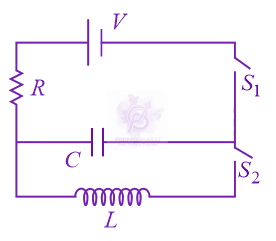
Consider a finite insulated, uncharged conductor placed near a finite positively charged conductor. The uncharged body must have a potential :
A particle of charge $16 \times 10^{-16} \mathrm{C}$ moving with velocity $10 \mathrm{~ms}^{-1}$ along $x$-axis enters a region where magnetic field of induction $\vec{B}$ is along the $y$-axis and an electric field of magnitude $10^4 \mathrm{Vm}^{-1}$ is along the negative $z$-axis. If the charged particle continues moving along $x$-axis, the magnitude of $\vec{B}$ is :
When resonance is produced in a series LCR circuit, then which of the following is not correct?
In a series $\mathrm{L}-\mathrm{C}-\mathrm{R}$ circuit, $\mathrm{C}=10^{-11}$ Farad, $\mathrm{L}=10^{-}$ ${ }^5$ Henry and $\mathrm{R}=100 \mathrm{Ohm}$, when a constant D.C. voltage $\mathrm{E}$ is applied to the circuit, the capacitor acquires a charge $10^{-9}$ C. The D.C. source is replaced by a sinusoidal voltage source in which the peak voltage $\mathrm{E}_0$ is equal to the constant D.C. voltage E. At resonance the peak value of the charge acquired by the capacitor will be :
An electric current is flowing through a circular coil of radius $\mathrm{R}$. The ratio of the magnetic field at the centre of the coil and that at a distance $2 \sqrt{2} R$ from the centre of the coil and on its axis is :
A charge Q is uniformly distributed over a long rod AB of length L as shown in the figure. The electric potential at the point O lying at a distance L from the end A is : 
Two coils, $\mathrm{X}$ and $\mathrm{Y}$, are kept in close vicinity of each other. When a varying current, $I(t)$, flows through coil $\mathrm{X}$, the induced $\operatorname{emf}(V(t))$ in coil $\mathrm{Y}$, varies in the manner shown here. The variation of $I(t)$, with time, can then be represented by the graph labelled as graph : 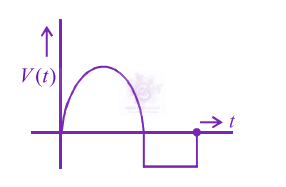 (A)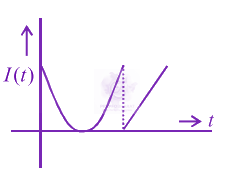 (B)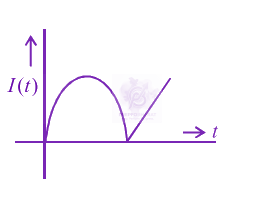 (C)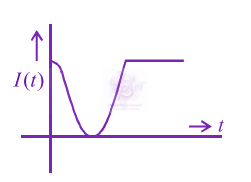 (D)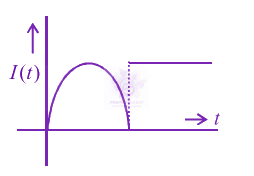
In the circuit shown here, the voltage across $\mathrm{E}$ and $\mathrm{C}$ are respectively $300 \mathrm{~V}$ and $400 \mathrm{~V}$. The voltage $\mathrm{E}$ of the ac source is : 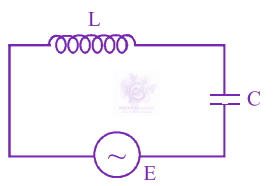
A uniform electric field $\vec{E}$ exists between the plates of a charged condenser. A charged particle enters the space between the plates and perpendicular to $\vec{E}$. The path of the particle between the plates is a:
This question has Statement-1 and Statement-2. Of the four choices given after the Statements, choose the one that best describes the two Statements. Statement 1: No work is required to be done to move a test charge between any two points on an equipotential surface. Statement 2 : Electric lines of force at the equipotential surfaces are mutually perpendicular to each other.
Choose the correct sketch of the magnetic field lines of a circular current loop shown by the dot $$ \text { and the cross } \otimes \text {. } $$
Two point dipoles of dipole moment $\vec{p}_1$ and $\vec{p}_2$ are at a distance $x$ from each other and $\vec{p}_1 || \vec{p}_2$. The force between the dipoles is :
In a metre bridge experiment null point is obtained at $40 \mathrm{~cm}$ from one end of the wire when resistance $\mathrm{X}$ is balanced against another resistance $\mathrm{Y}$. If $\mathrm{X} < \mathrm{Y}$, then the new position of the null point from the same end, if one decides to balance a resistance of $3 \mathrm{X}$ against $\mathrm{Y}$, will be close to :
A letter ${ }^{\prime} \mathrm{A}^{\prime}$ is constructed of a uniform wire with resistance $1.0 \Omega$ per $\mathrm{cm}$, The sides of the letter are $20 \mathrm{~cm}$ and the cross piece in the middle is $10 \mathrm{~cm}$ long. The apex angle is 60 . The resistance between the ends of the legs is close to: