JEE Main Physics — Electromagnetism previous year questions with solutions.
In a sensitive meter bridge apparatus the bridge wire should possess
A resistance $R$ and a capacitance $C$ are connected in series to a battery of negligible internal resistance through a key. The key is closed at $t=$ 0 . If after $t$ sec the voltage across the capacitance was seven times the voltage across $\mathrm{R}$, the value of $\mathrm{t}$ is
A coil is suspended in a uniform magnetic field, with the plane of the coil parallel to the magnetic lines of force. When a current is passed through the coil it starts oscillating; it is very difficult to stop. But if an aluminium plate is placed near to the coil, it stops. This is due to :
Currents of a 10 ampere and 2 ampere are passed through two parallel thin wires $A$ and $B$ respectively in opposite directions. Wire $A$ is infinitely long and the length of the wire $B$ is $2 \mathrm{~m}$. The force acting on the conductor $B$, which is situated at $10 \mathrm{~cm}$ distance from $A$ will be
The flat base of a hemisphere of radius a with no charge inside it lies in a horizontal plane. A uniform electric field $\vec{E}$ is applied at an angle $\frac{\pi}{4}$ with the vertical direction. The electric flux through the curved surface of the hemisphere is 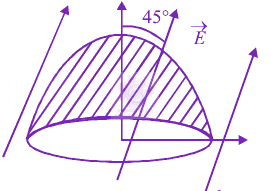
The resistance of a wire is $R$. It is bent at the middle by $180^{\circ}$ and both the ends are twisted together to make a shorter wire. The resistance of the new wire is
Two electric bulbs marked $25 \mathrm{~W}-220 \mathrm{~V}$ and $100 \mathrm{~W}-220 \mathrm{~V}$ are connected in series to a $440 \mathrm{~V}$ supply. Which of the bulbs will fuse?
A charge of total amount $Q$ is distributed over two concentric hollow spheres of radii $r$ and $R(R$ $>r$ ) such that the surface charge densities on the two spheres are equal. The electric potential at the common centre is
An electromagnetic wave with frequency $\omega$ and wavelength $\lambda$ travels in the $+y$ direction. Its magnetic field is along $+x$-axis. The vector equation for the associated electric field (of amplitude $E_0$ ) is
A charge $Q$ is uniformly distributed over the surface of non conducting disc of radius $R$. The disc rotates about an axis perpendicular to its plane and passing through its centre with an angular velocity $\omega$. As a result of this rotation a magnetic field of induction $B$ is obtained at the centre of the disc. If we keep both the amount of charge placed on the disc and its angular velocity to be constant and vary the radius of the disc then the variation of the magnetic induction at the centre of the disc will be represented by the figure
A $6.0$ volt battery is connected to two light bulbs as shown in figure. Light bulb 1 has resistance 3 ohm while light bulb 2 has resistance $6 \mathrm{ohm}$. Battery has negligible internal resistance. Which bulb will glow brighter? 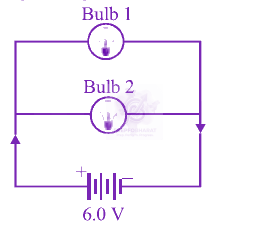
The figure shows an experimental plot for discharging of a capacitor in an $R-C$ circuit. The time constant $\tau$ of this circuit lies between: 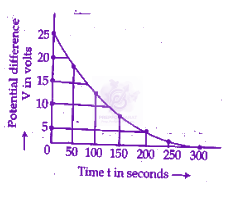
A series combination of $n_1$ capacitors, each of capacity $C_1$ is charged by source of potential difference $4 \mathrm{~V}$. When another parallel combination of $n_2$ capacitors each of capacity $C_2$ is charged by a source of potential difference $V$, it has the same total energy stored in it as the first combination has. The value of $C_2$ in terms of $C_1$ is then
Two identical charged spheres suspended from a common point by two massless strings of length I are initially a distance $d(d< < 1)$ apart because of their mutual repulsion. The charge begins to leak from both the spheres at a constant rate. As a result the charges approach each other with a velocity $v$. Then as a function of distance $x$ between them,
A boat is moving due east in a region where the earth's magnetic field is $5.0 \times 10^{-5} \mathrm{NA}^{-1} \mathrm{~m}^{-1}$ due north and horizontal. The boat carries a vertical aerial $2 \mathrm{~m}$ long. If the speed of the boat is $1.50 \mathrm{~ms}^{-1}$, the magnitude of the induced emf in the wire of aerial is :
A fully charged capacitor $C$ with initial charge $q_0$ is connected to a coil of self inductance $L$ at $t=0$. The time at which the energy is stored equally between the electric and the magnetic field is :
A resistor 'R' and $2 \mu \mathrm{F}$ capacitor in series is connected through a switch to $200 \mathrm{~V}$ direct supply. Across the capacitor is a neon bulb that lights up at $120 \mathrm{~V}$. Calculate the value of $R$ to make the bulb light up $5 \mathrm{~s}$ after the switch has been closed. $\left(\log _{10} 2.5=0.4\right)$
A current I flows in an infinitely long wire with cross section in the form of a semicircular ring of radius $\mathrm{R}$. The magnitude of the magnetic induction along its axis is
The electrostatic potential inside a charged spherical ball is given by $\phi=\alpha \rho^2+b$ where $r$ is the distance from the centre; $a, b$ are constants. Then the charge density inside ball is
In a series LCR circuit $R=200 \Omega$ and the voltage and the frequency of the main supply is $220 \mathrm{~V}$ and $50 \mathrm{~Hz}$ respectively. On taking out the capacitance from the circuit the current lags behind the voltage by $30^{\circ}$. On taking out the inductor from the circuit the current leads the voltage by $30^{\circ}$. The power dissipated in the LCR circuit is
A rectangular loop has a sliding connector PQ of length $\ell$ and resistance $\mathrm{R} \Omega$ and it is moving with a speed $v$ as shown. The set-up is placed in a uniform magnetic field going into the plane of the paper. The three currents $I_1, I_2$ and $I$ are 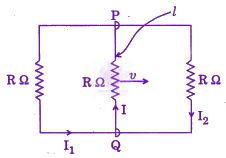
Two long parallel wires are at a distance $2 \mathrm{~d}$ apart. They carry steady equal current flowing out of the plane of the paper as shown. The variation of the magnetic field along the line $\mathrm{XX}$ ' is given by
Let $C$ be the capacitance of a capacitor discharging through a resistor R. Suppose $t_1$ is the time taken for the energy stored in the capacitor to reduce to half its initial value and $t_2$ is the time taken for the charge to reduce to one-fourth its initial value. Then the ratio $t_1 / t_2$ will be
Two identical charged spheres are suspended by strings of equal lengths. The strings make an angle of $30^{\circ}$ with each other. When suspended in a liquid of density $0.8 \mathrm{~g} \mathrm{~cm}^{-3}$, the angle remains the same. If density of the material of the sphere is $16 \mathrm{~g} \mathrm{~cm}^{-3}$, the dielectric constant of the liquid is