JEE Main Physics — Electromagnetism previous year questions with solutions.
If a source of power $4 \mathrm{~kW}$ produces $10^{20}$ photons/second, the radiation belong to a part of the spectrum called
In the circuit shown below, the key $\mathrm{K}$ is closed at $\mathrm{t}=0$. The current through the battery is 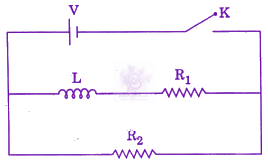
A thin semi-circular ring of radius $r$ has a positive charge $q$ distributed uniformly over it. The net field $\vec{E}$ at the centre $O$ is 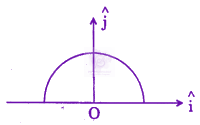
Let there be a spherically symmetric charge distribution with charge density varying as $\rho(r)=\rho_0\left(\frac{5}{4}-\frac{r}{R}\right)$ upto $r=R$, and $\rho(r)=0$ for $r>R$, where $r$ is the distance from the origin. The electric field at a distance $r(r < R)$ from the origin is given by
This question contains Statement-1 and Statement-2. Of the four choices given after the statements, choose the one that best describes the two statements. Statement - 1: For a charged particle moving from point $P$ to point $Q$, the net work done by an electrostatic field on the particle is independent of the path connecting point $P$ to point $Q$. Statement-2: The net work done by a conservative force on an object moving along a closed loop is zero
Due to the presence of the current $\mathrm{l}_1$ at the origin
This question contains Statement-1 and Statement-2. Of the four choices given after the statements, choose the one that best describes the two statements. Statement-1: The temperature dependence of resistance is usually given as $R=R_0(1+\alpha \Delta t)$. The resistance of a wire changes from $100 \Omega$ to $150 \Omega$ when its temperature is increased from $27^{\circ} \mathrm{C}$ to $227^{\circ} \mathrm{C}$. This implies that $\alpha=2.5 \times 10^{-3} /{ }^{\circ} \mathrm{C}$. Statement 2: $R=R_i(1+\alpha \Delta T)$ is valid only when the change in the temperature $\Delta T$ is small and $\Delta R=$ $\left(R-R_0\right) \ll R_0$.
Two points $P$ and $Q$ are maintained at the potentials of $10 \mathrm{~V}$ and $-4 \mathrm{~V}$ respectively. The work done in moving 100 electrons from $P$ to $Q$ is
Let $P(r)=\frac{Q}{\pi R^4} r$ be the charge density distribution for a solid sphere of radius $R$ and total charge $Q$. for a point ' $p$ ' inside the sphere at distance $r_1$ from the centre of the sphere, the magnitude of electric field is
A charge $Q$ is placed at each of the opposite corners of a square. A charge $q$ is placed at each of the other two corners. If the net electrical force on $Q$ is zero, then the $Q / q$ equals
The magnitude of the magnetic field $(B)$ due to loop $A B C D$ at the origin $(O)$ is
An inductor of inductance $\mathrm{L}=400 \mathrm{mH}$ and resistors of resistances $\mathrm{R}_1$ $=2 \Omega$ and $R_2=2 \Omega$ are connected to a battery of emf $12 \mathrm{~V}$ as shown in the figure. The internal resistance of the battery is negligible. The switch $S$ is closed at $t=0$. The potential drop across $L$ as a function of time is 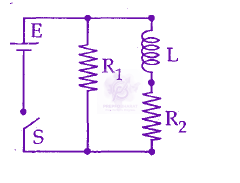
A $5 \mathrm{~V}$ battery with internal resistance $2 \Omega$ and a $2 \mathrm{~V}$ battery with internal resistance $1 \Omega$ are connected to a $10 \Omega$ resistor as shown in the figure. The current in the $10 \Omega$ resistor is 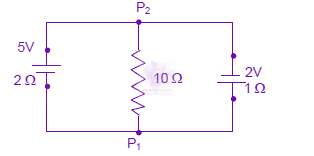
A parallel plate capacitor with air between the plates has a capacitance of $9 \mathrm{pF}$. The separation between its plates is ' $d$ '. The space between the plates is now filled with two dielectrics. One of the dielectrics has dielectric constant $k_1=3$ and thickness $\frac{d}{3}$ while the other one has dielectric constant $\mathrm{k}_2=6$ and thickness $\frac{2 \mathrm{~d}}{3}$. Capacitance of the capacitor is now
Relative permittivity and permeability of a material are $\varepsilon_{\mathrm{r}}$ and $\mu_{\mathrm{r}}$, respectively. Which of the following values of these quantities are allowed for a diamagnetic material?
Paragraph: Consider a block of conducting material of resistivity ' $\rho$ ' shown in the figure. Current 'l' enters at 'A' and leaves from ' $\mathrm{D}$ '. We apply superposition principle to find voltage ' $\Delta \mathrm{V}$ ' developed between ' $\mathrm{B}$ ' and ' $\mathrm{C}$ '. The calculation is done in the following steps: (i) Take current 'l' entering from 'A' and assume it to spread over a hemispherical surface in the block. (ii) Calculate field $E(r)$ at distance ' $r$ ' from $A$ by using Ohm's law $E=\rho j$, where $j$ is the current per unit area at ' $r$ '. (iii) From the ' $r$ ' dependence of $E(r)$, obtain the potential $V(r)$ at $r$. (iv) Repeat (i), (ii) and (iii) for current 'l' leaving ' $D$ ' and superpose results for ' $A$ ' and ' $D$ '.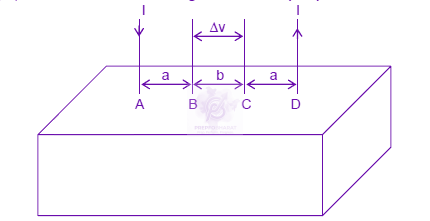 Question: $\Delta \mathrm{V}$ measured between $\mathrm{B}$ and $\mathrm{C}$ is
Two coaxial solenoids are made by winding thin insulated wire over a pipe of cross sectional area $A=$ $10 \mathrm{~cm}^2$ and length $=20 \mathrm{~cm}$. If one of the solenoids has 300 turns and the other 400 turns, their mutual inductance is $\left(\mu_0=4 \pi \times 10^{-7} \mathrm{Tm} \mathrm{A}^{-1}\right)$
A thin spherical shell of radius $R$ has charge $Q$ spread uniformly over its surface. Which of the following graphs most closely represents the electric field $E(r)$ produced by the shell in the range $0 \leq$ $r < \infty$, where $r$ is the distance from the centre of the shell?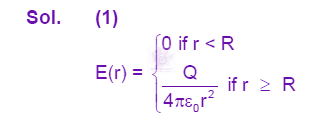
Paragraph: Consider a block of conducting material of resistivity ' $\rho$ ' shown in the figure. Current 'l' enters at 'A' and leaves from ' $\mathrm{D}$ '. We apply superposition principle to find voltage ' $\Delta \mathrm{V}$ ' developed between ' $\mathrm{B}$ ' and ' $\mathrm{C}$ '. The calculation is done in the following steps: (i) Take current 'l' entering from 'A' and assume it to spread over a hemispherical surface in the block. (ii) Calculate field $E(r)$ at distance ' $r$ ' from $A$ by using Ohm's law $E=\rho j$, where $j$ is the current per unit area at ' $r$ '. (iii) From the ' $r$ ' dependence of $E(r)$, obtain the potential $V(r)$ at $r$. (iv) Repeat (i), (ii) and (iii) for current 'l' leaving ' $D$ ' and superpose results for ' $A$ ' and ' $D$ '.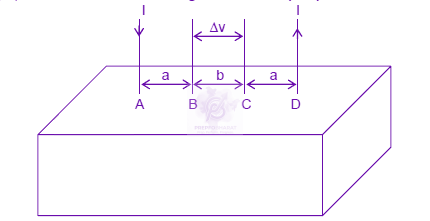 Question: For current entering at $A$, the electric field at a distance ' $r$ ' from $A$ is
A horizontal overhead power line is at a height of $4 \mathrm{~m}$ from the ground and carries a current of $100 \mathrm{~A}$ from east to west. The magnetic field directly below it on the ground is $\left(\mu_0=4 \pi \times 10^{-7} \mathrm{~T} \mathrm{~m} \mathrm{~A}^{-1}\right)$
A charged particle with charge $\mathrm{q}$ enters a region of constant, uniform and mutually orthogonal fields $\mathrm{\vec{E}}$ and $\mathrm{\vec{B}}$ with a velocity $\mathrm{\vec{v}}$ perpendicular to both $\mathrm{\vec{E}}$ and $\mathrm{\vec{B}}$, and comes out without any change in magnitude or direction of $\mathrm{\vec{v}}$. Then
In an a.c. circuit the voltage applied is $\mathrm{E}=\mathrm{E}_0 \sin \omega \mathrm{t}$. The resulting current in the circuit is $\mathrm{I}=\mathrm{I}_0 \sin \left(\omega \mathrm{t}-\frac{\pi}{2}\right)$. The power consumption in the circuit is given by
Charges are placed on the vertices of a square as shown. Let $\mathrm{E}$ be the electric field and $\mathrm{V}$ the potential at the centre. If the charges on $\mathrm{A}$ and $\mathrm{B}$ are interchanged with those on $\mathrm{D}$ and $\mathrm{C}$ respectively, then 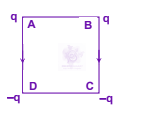
Two identical conducting wires $\mathrm{A O B}$ and $\mathrm{C O D}$ are placed at right angles to each other. The wire $\mathrm{AOB}$ carries an electric current $\mathrm{I_1}$ and $\mathrm{COD}$ carries a current $\mathrm{I_2}$. The magnetic field on a point lying at a distance ' $\mathrm{d}$ ' from $\mathrm{O}$, in a direction perpendicular to the plane of the wires $\mathrm{A O B}$ and $\mathrm{C O D}$, will be given by