JEE Main Physics — Electromagnetism previous year questions with solutions.
An ideal coil of $10 \mathrm{H}$ is connected in series with a resistance of $5 \Omega$ and a battery of $5 \mathrm{~V}$. $2$ second after the connection is made the current flowing in amperes in the circuit is
An electric charge $10^{-3} \mu \mathrm{C}$ is placed at the origin $(0,0)$ of $X-Y$ co-ordinate system. Two points $A$ and $\mathrm{B}$ are situated at $(\sqrt{2}, \sqrt{2})$ and $(2,0)$ respectively. The potential difference between the points $A$ and $B$ will be
The potential at a point $x$ (measured in $\mu \mathrm{m}$ ) due to some charges situated on the $\mathrm{x}$-axis is given by $\mathrm{V(x)=20 /\left(x^2-4\right)} \mathrm{~Volts}$. The electric field $\mathrm{E}$ at $\mathrm{x=4 ~\mu m}$ is given by
A parallel plate condenser with a dielectric of dielectric constant $\mathrm{K}$ between the plates has a capacity $\mathrm{C}$ and is charged to a potential $\mathrm{~V ~volts}$. The dielectric slab is slowly removed from between the plates and then reinserted. The net work done by the system in this process is
A charged particle moves through a magnetic field perpendicular to its direction. Then
A current $\mathrm{I}$ flows along the length of an infinitely long, straight, thin walled pipe. Then
If $\mathrm{g}_{\mathrm{E}}$ and $\mathrm{g}_{\mathrm{m}}$ are the accelerations due to gravity on the surfaces of the earth and the moon respectively and if Millikan's oil drop experiment could be performed on the two surfaces, one will find the ratio $\frac{\text { electronic charge on the moon }}{\text { electronic charge on the earth }}$ to be
The resistance of a wire is $5 \mathrm{~ohm}$ at $50^{\circ} \mathrm{C}$ and $6 \mathrm{~ohm}$ at $100^{\circ} \mathrm{C}$. The resistance of the wire at $0^{\circ} \mathrm{C}$ will be
A battery is used to charge a parallel plate capacitor till the potential difference between the plates becomes equal to the electromotive force of the battery. The ratio of the energy stored in the capacitor and the work done by the battery will be
A long straight wire of radius ' $a$ ' caries a steady current $\mathrm{i}$. The current is uniformly distributed across its cross section. The ratio of the magnetic field at $\frac{a}{2}$ and $2 a$ is
In a region, steady and uniform electric and magnetic fields are present. These two fields are parallel to each other. A charged particle is released from rest in this region. The path of the particle will be a
The current $\mathrm{I}$ drawn from the 5 volt source will be 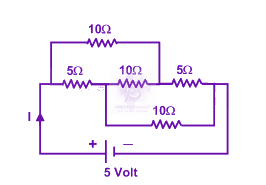
The flux linked with a coil at any instant ' $t$ ' is given by $\phi=10 t^2-50 t+250$ The induced emf at $t=3 \mathrm{~s}$ is
In a Wheatstone's bridge, there resistances $\mathrm{P}, \mathrm{Q}$ and $\mathrm{R}$ connected in the three arms and the fourth arm is formed by two resistances $\mathrm{S}_1$ and $\mathrm{S}_2$ connected in parallel. The condition for bridge to be balanced will be
The Kirchhoff's first law $\left(\sum i=0\right)$ and second law $\left(\sum i R=\sum E\right)$, where the symbols have their usual meanings, are respectively based on
The rms value of the electric field of the light coming from the Sun is $720 \mathrm{~N} / \mathrm{C}$. The average total energy density of the electromagnetic wave is
In a series resonant LCR circuit, the voltage across $R$ is 100 volts and $R=1 \mathrm{k} \Omega$ with $C=2 \mu \mathrm{F}$. The resonant frequency $\omega$ is $200 \mathrm{rad} / \mathrm{s}$. At resonance the voltage across $L$ is
Two insulating plates are both uniformly charged in such a way that the potential difference between them is $V_2-V_1=20 \mathrm{~V}$. (i.e. plate 2 is at a higher potential). The plates are separated by $d=0.1 \mathrm{~m}$ and can be treated as infinitely large. An electron is released from rest on the inner surface of plate 1 . What is its speed when it hits plate $2 ?$ $\left(\mathrm{e}=1.6 \times 10^{-19} \mathrm{C}, \mathrm{m}_{\mathrm{e}}=9.11 \times 10^{-31} \mathrm{~kg}\right)$ 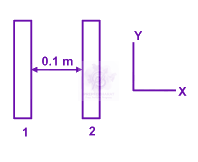
A thermocouple is made from two metals, Antimony and Bismuth. If one junction of the couple is kept hot and the other is kept cold then, an electric current will
The resistance of a bulb filament is $100 \Omega$ at a temperature of $100^{\circ} \mathrm{C}$. If its temperature coefficient of resistance be $0.005$ per ${ }^{\circ} \mathrm{C}$, its resistance will become $200 \Omega$ at a temperature of
A material ' $B$ ' has twice the specific resistance of ' $A$ '. A circular wire made of ' $B$ ' has twice the diameter of a wire made of ' $A$ '. Then for the two wires to have the same resistance, the ratio $\ell_A / \ell_B$ of their respective lengths must be
An inductor $(L=100 \mathrm{mH})$, a resistor $(R=100 \Omega)$ and a battery $(E=100 \mathrm{~V})$ are initially connected in series as shown in the figure. After a long time the battery is disconnected after short circuiting the points $A$ and $B$. The current in the circuit $1 \mathrm{~mm}$ after the circuit is 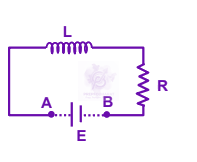
In an $\mathrm{AC}$ generator, a coil with $\mathrm{N}$ turns, all of the same area $\mathrm{A}$ and total resistance $\mathrm{R}$, rotates with frequency $\omega$ in a magnetic field $B$. The maximum value of emf generated in the coil is "
A long solenoid has 200 turns per $\mathrm{cm}$ and carries a current $\mathrm{i}$. The magnetic field at its centre is $6.28 \times 10^{-2}$ Weber $/ \mathrm{m}^2$. Another long solenoid has 100 turns per $\mathrm{cm}$ and it carries a current $\mathrm{i} / 3$. The value of the magnetic field at its centre is