JEE Main 2006 — Electromagnetism
Physics Electromagnetism questions from JEE Main 2006.
Other Years
18 Electromagnetism Questions from 2006
In a region, steady and uniform electric and magnetic fields are present. These two fields are parallel to each other. A charged particle is released from rest in this region. The path of the particle will be a
The Kirchhoff's first law $\left(\sum i=0\right)$ and second law $\left(\sum i R=\sum E\right)$, where the symbols have their usual meanings, are respectively based on
In a series resonant LCR circuit, the voltage across $R$ is 100 volts and $R=1 \mathrm{k} \Omega$ with $C=2 \mu \mathrm{F}$. The resonant frequency $\omega$ is $200 \mathrm{rad} / \mathrm{s}$. At resonance the voltage across $L$ is
The flux linked with a coil at any instant ' $t$ ' is given by $\phi=10 t^2-50 t+250$ The induced emf at $t=3 \mathrm{~s}$ is
An inductor $(L=100 \mathrm{mH})$, a resistor $(R=100 \Omega)$ and a battery $(E=100 \mathrm{~V})$ are initially connected in series as shown in the figure. After a long time the battery is disconnected after short circuiting the points $A$ and $B$. The current in the circuit $1 \mathrm{~mm}$ after the circuit is 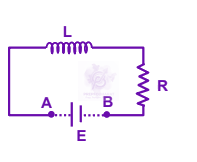
The rms value of the electric field of the light coming from the Sun is $720 \mathrm{~N} / \mathrm{C}$. The average total energy density of the electromagnetic wave is
The current $\mathrm{I}$ drawn from the 5 volt source will be 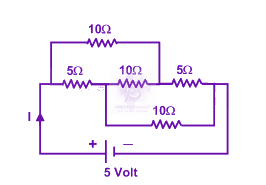
Needles $\mathrm{N}_1, \mathrm{~N}_2$ and $\mathrm{N}_3$ are made of a ferromagnetic, a paramagnetic and a diamagnetic substance respectively. A magnet when brought close to them will
In a Wheatstone's bridge, there resistances $\mathrm{P}, \mathrm{Q}$ and $\mathrm{R}$ connected in the three arms and the fourth arm is formed by two resistances $\mathrm{S}_1$ and $\mathrm{S}_2$ connected in parallel. The condition for bridge to be balanced will be
A thermocouple is made from two metals, Antimony and Bismuth. If one junction of the couple is kept hot and the other is kept cold then, an electric current will
A material ' $B$ ' has twice the specific resistance of ' $A$ '. A circular wire made of ' $B$ ' has twice the diameter of a wire made of ' $A$ '. Then for the two wires to have the same resistance, the ratio $\ell_A / \ell_B$ of their respective lengths must be
Two insulating plates are both uniformly charged in such a way that the potential difference between them is $V_2-V_1=20 \mathrm{~V}$. (i.e. plate 2 is at a higher potential). The plates are separated by $d=0.1 \mathrm{~m}$ and can be treated as infinitely large. An electron is released from rest on the inner surface of plate 1 . What is its speed when it hits plate $2 ?$ $\left(\mathrm{e}=1.6 \times 10^{-19} \mathrm{C}, \mathrm{m}_{\mathrm{e}}=9.11 \times 10^{-31} \mathrm{~kg}\right)$ 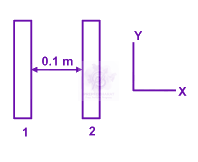
In an $\mathrm{AC}$ generator, a coil with $\mathrm{N}$ turns, all of the same area $\mathrm{A}$ and total resistance $\mathrm{R}$, rotates with frequency $\omega$ in a magnetic field $B$. The maximum value of emf generated in the coil is "
A long solenoid has 200 turns per $\mathrm{cm}$ and carries a current $\mathrm{i}$. The magnetic field at its centre is $6.28 \times 10^{-2}$ Weber $/ \mathrm{m}^2$. Another long solenoid has 100 turns per $\mathrm{cm}$ and it carries a current $\mathrm{i} / 3$. The value of the magnetic field at its centre is
An electric bulb is rated 220 volt $-100$ watt. The power consumed by it when operated on 110 volt will be
The resistance of a bulb filament is $100 \Omega$ at a temperature of $100^{\circ} \mathrm{C}$. If its temperature coefficient of resistance be $0.005$ per ${ }^{\circ} \mathrm{C}$, its resistance will become $200 \Omega$ at a temperature of
A electric dipole is placed at an angle of $30^{\circ}$ to a non-uniform electric field. The dipole will experience
Two spherical conductors $A$ and $B$ of radii $1 \mathrm{~mm}$ and $2 \mathrm{~mm}$ are separated by a distance of $5 \mathrm{~cm}$ and are uniformly charged. If the spheres are connected by a conducting wire then in equilibrium condition, the ratio of the magnitude of the electric fields at the surface of spheres $A$ and $B$ is