JEE Main 2002 — Electromagnetism
Physics Electromagnetism questions from JEE Main 2002.
Other Years
22 Electromagnetism Questions from 2002
A conducting square loop of side $L$ and resistance $R$ moves in its plane with a uniform velocity $v$ perpendicular to one of its sides. A magnetic induction B constant in time and space, pointing perpendicular and into the plane at the loop exists everywhere with half the loop outside the field, as shown in figure. The induced emf is 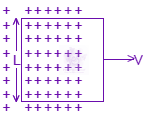
Infra red radiation is detected by
Which of the following are not electromagnetic waves?
A charged particle $q$ is placed at the centre $O$ of cube of length $L$ (A B C D E F G H). Another same charge $q$ is placed at a distance $L$ from $O$. Then the electric flux through $A B C D$ is 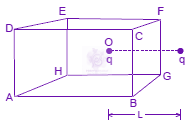
If an electron and a proton having same momenta enter perpendicular to a magnetic field, then
Wires 1 and 2 carrying currents $i_1$ and $i_2$ respectively are inclined at an angle $\theta$ to each other. What is the force on a small element dl of wire 2 at a distance of $\mathrm{r}$ from wire 1 (as shown in the figure) due to the magnetic field of wire 1 ? 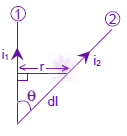
The inductance between A and D is 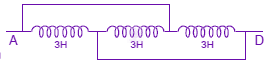
The power factor of an $A C$ circuit having resistance $(R)$ and inductance $(L)$ connected in series and an angular velocity $\omega$ is
If there are n capacitors in parallel connected to V volt source, then the energy stored is equal to
In a transformer, number of turns in the primary coil are 140 and that in the secondary coil are 280. If current in primary coil is $4 \mathrm{~A}$, then that in the secondary coil is
The mass of product liberated on anode in an electrochemical cell depends on (where t is the time period, for which the current is passed)
If in a circular coil $A$ of radius $R$, current I is flowing and in another coil $B$ of radius $2 R$ a current $2 \mathrm{l}$ is flowing, then the ratio of the magnetic fields $\mathrm{B}_{\mathrm{A}}$ and $\mathrm{B}_{\mathrm{B}}$, produced by them will be
Capacitance (in $F$ ) of a spherical conductor with radius $1 \mathrm{~m}$ is
On moving a charge of 20 coulombs by $2 \mathrm{~cm}, 2 \mathrm{~J}$ of work is done, then the potential difference between the points is
A wire when connected to $220 \mathrm{~V}$ mains supply has power dissipation $\mathrm{P}_1$. Now the wire is cut into two equal pieces which are connected in parallel to the same supply. Power dissipation in this case is $P_2$ Then $P_2: P_1$ is
If a current is passed through a spring then the spring will
If an ammeter is to be used in place of a voltmeter, then we must connect with the ammeter a
If a charge $q$ is placed at the centre of the line joining two equal charges $Q$ such that the system is in equilibrium then the value of $q$ is
If in the circuit, power dissipation is $150 \mathrm{~W}$, then $\mathrm{R}$ is 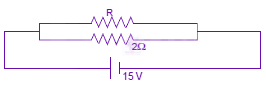
The time period of a charged particle undergoing a circular motion in a uniform magnetic field is independent of its
Electromagnetic waves are transverse in nature is evident by
By increasing the temperature, the specific resistance of a conductor and a semiconductor