Probability & Statistics PYQ — Page 15
JEE Main Mathematics — Probability & Statistics previous year questions with solutions.
All Probability & Statistics Questions (389)
Let $A$ and $E$ be any two events with positive probabilities Statement I: $P(E/A)\geq P(A/E)P(E).$ Statement II: $P(A/E)\geq P(A\cap E).$
A set $\mathrm{S}$ contains 7 elements. A non-empty subset $A$ of $S$ and an element $x$ of $S$ are chosen at random. Then the probability that $\mathrm{x} \in \mathrm{A}$ is:
Let $\bar{X}$ and M.D. be the mean and the mean deviation about $\bar{X}$ of $n$ observations $\mathrm{x}_{\mathrm{i}}, \mathrm{i}=1,2$,n. If each of the observations is increased by 5 , then the new mean and the mean deviation about the new mean, respectively, are :
The probability of a man hitting a target is $\frac{2}{5}$. He fires at the target $k$ times $(k$, a given number). Then the minimum $k$, so that the probability of hitting the target at least once is more than $\frac{7}{10}$, is :
$\mathrm{A}, \mathrm{B}, \mathrm{C}$ try to hit a target simultaneously but independently. Their respective probabilities of hitting the targets are $\frac{3}{4}, \frac{1}{2}, \frac{5}{8}$. The probability that the target is hit by A or B but not by $\mathrm{C}$ is :
Mean of 5 observations is 7 . If four of these observations are $6,7,8,10$ and one is missing then the variance of all the five observations is :
If the median and the range of four numbers $\{x, y, 2 x+y, x-y\}$, where $0 < y < x < 2 y$, are 10 and 28 respectively, then the mean of the numbers is :
In a set of $2 n$ observations, half of them are equal to ' $\mathrm{a}$ ' and the remaining hall are equal to ' $-\mathrm{a}^{\prime}$ '. If the standard deviation of all the observations is 2 ; then the value of $|a|$ is :
All the students of a class performed poorly in Mathematics. The teacher decided to give grace marks of $10$ to each of the students. Which of the following statistical measures will not change even after the grace marks were given ?
The mean of a data set consisting of 20 observations is 40 . If one observation 53 was wrongly recorded as 33 , then the correct mean will be:
Given two independent events, if the probability that exactly one of them occurs is $\frac{26}{49}$ and the probability that none of them occurs is $\frac{15}{49}$, then the probability of more probable of the two events is :
If the events $\mathrm{A}$ and $\mathrm{B}$ are mutually exclusive events such that $\mathrm{P}(\mathrm{A})=\frac{3 x+1}{3}$ and $\mathrm{P}(\mathrm{B})=\frac{1-x}{4}$, then the set of possible values of $x$ lies in the interval :
There are two balls in an urn. Each ball can be either white or black. If a white ball is put into the urn and there after a ball is drawn at random from the urn, then the probability that it is white is
Let $\mathrm{x}_1, \mathrm{x}_2, \ldots \ldots, \mathrm{x}_{\mathrm{n}}$ be $\mathrm{n}$ observations, and let $\overline{\mathrm{x}}$ be their arithematic mean and $\sigma^2$ be their variance. Statement $1$: Variance of $2 x_1, 2 x_2, \ldots \ldots, 2 x_n$ is $4 \sigma^2$. Statement $2$: Arithmetic mean of $2 \mathrm{x}_1, 2 \mathrm{x}_2, \ldots . ., 2 \mathrm{x}_{\mathrm{n}}$ is $4 \overline{\mathrm{x}}$.
If six students, including two particular students $A$ and $B$, stand in a row, then the probability that $A$ and $B$ are separated with one student in between them is
Statement 1: The variance of first $n$ odd natural numbers is $\frac{n^2-1}{3}$ Statement 2: The sum of first $\mathrm{n}$ odd natural number is $n^2$ and the sum of square of first $n$ odd natural numbers is $\frac{n\left(4 n^2+1\right)}{3}$.
A number $n$ is randomly selected from the set $\{1,2,3, \ldots ., 1000\}$. The probability that $\frac{\sum_{i=1}^n i^2}{\sum_{i=1}^n i}$ is an integer is
The frequency distribution of daily working expenditure of families in a locality is as follows: 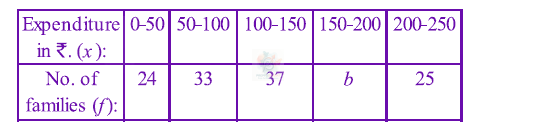 If the mode of the distribution is $₹ 140$, then the value of $b$ is
Three numbers are chosen at random without replacement from $\{1,2,3, \ldots . .8\}$. The probability that their minimum is $3$ , given that their maximum is $6$ , is
If the mean of $4,7,2,8,6$ and a is 7 , then the mean deviation from the median of these observations is
The median of 100 observations grouped in classes of equal width is 25 . If the median class interval is 20-30 and the number of observations less than 20 is 45 , then the frequency of median class is
If $C$ and $D$ are two events such that $C \subset D$ and $P(D) \neq 0$, then the correct statement among the following is
If the mean deviation about the median of the numbers $\mathrm{a}, 2 \mathrm{a}, \ldots, 50 \mathrm{a}$ is 50 , then $|\mathrm{a}|$ equals
An urn contains nine balls of which three are red, four are blue and two are green. Three balls are drawn at random without replacement from the urn. The probability that the three balls have different colour is