Let 2x=t
5+∣t−1∣=t2−2t
⇒g(t)∣t−1∣=f(t)(t2−2t−5)
Since, 2x>0∀x∈R⇒t>0
From the graph, we have
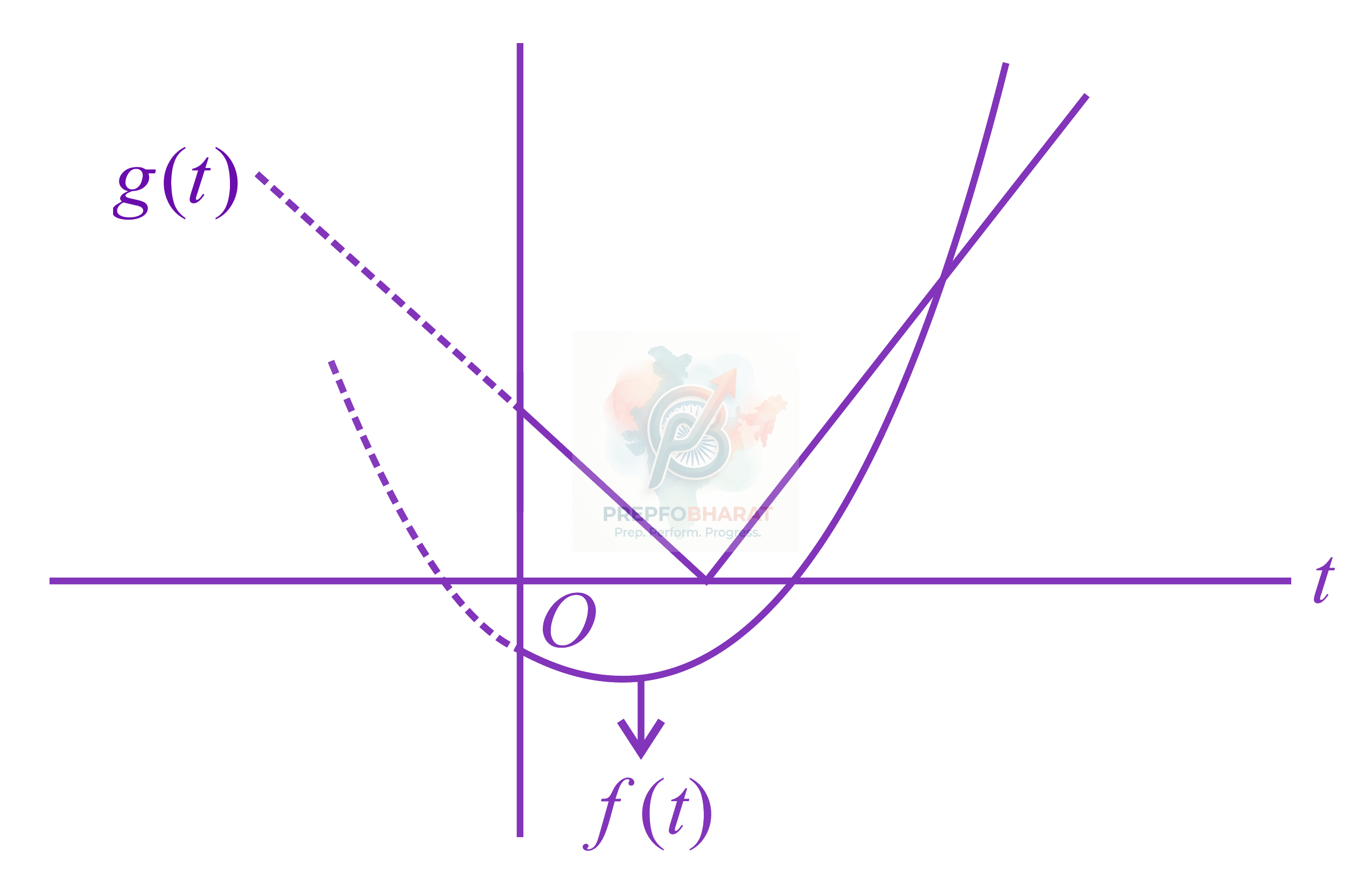
It is clear from the graph that the two graphs have only one point of intersection.
So, number of real roots of the given equation is 1.
JEE Main 2019 — Mathematics Algebra
The number of real roots of the equation 5+∣2x−1∣=2x(2x−2) is :
Held on 10 Apr 2019 · Verified 6 Jul 2026.
2
3
1
4
Sign in to track your attempts and accuracy.
Sign in to keep a private note on this question. Nothing you write is ever public.
The number of elements in the set $S = \left\{(r, k) : k \in \mathbb{Z} \text{ and } {}^{36}C_{r+1} = \dfrac{6\left({}^{35}C_r\right)}{(k^2 - 3)}\right\}$, is :
Suppose $\mathrm{a}, \mathrm{b}, \mathrm{c}$ are in A.P. and $\mathrm{a}^{2}, 2 \mathrm{~b}^{2}, \mathrm{c}^{2}$ are in G.P. If $\mathrm{a}<\mathrm{b}<\mathrm{c}$ and $\mathrm{a}+\mathrm{b}+\mathrm{c}=1$, then $9\left(\mathrm{a}^{2}+\mathrm{b}^{2}+\mathrm{c}^{2}\right)$ is equal to $\_\_\_\_$ .
Let $S=\left\{z \in \mathbb{C}: 4 z^{2}+\bar{z}=0\right\}$. Then $\sum_{z \in S}|z|^{2}$ is equal to:
Let $S=\{z: 3 \leqslant|2 z-3(1+i)| \leqslant 7\}$ be a set of complex numbers. Then $\min _{z \in S}\left|\left(z+\frac{1}{2}(5+3 i)\right)\right|$ is equal to :
Let $A = \begin{bmatrix} 1 & 0 & 0 \\ 3 & 1 & 0 \\ 9 & 3 & 1 \end{bmatrix}$ and $B = [b_{ij}]$, $1 \leq i, j \leq 3$. If $B = A^{99} - I$, then the value of $\dfrac{b_{31} - b_{21}}{b_{32}}$ is :
Work through every JEE Main Algebra PYQ, year by year.