JEE Main Chemistry — Physical Chemistry previous year questions with solutions.
Complete combustion of $3g$ of ethane gives $x\times {10}^{22}\text{molecules}$ of water. The value of $x$ is ______ (Round off to the Nearest Integer). $[\text{Use}:{N}_{A}=6.023\times {10}^{23};\text{Atomic masses in}u:C:12.0;O:16.0;H:1.0]$
The wavelength of electrons accelerated from rest through a potential difference of $40\mathrm{kV}$ is $X\times {10}^{-12}m.$ The value of $x$ is. (Nearest integer) Given: Mass of electron $=9.1\times {10}^{-31}\mathrm{kg}$ Charge on an electron $=1.6\times {10}^{-19}C$ Planck's constant $=6.63\times {10}^{-34}\mathrm{Js}$
In order to prepare a buffer solution of $\mathrm{pH}5.74$, sodium acetate is added to acetic acid. If the concentration of acetic acid in the buffer is $1.0M,$ the concentration of sodium acetate in the buffer is ______$M.$ (Round off to the Nearest Integer). $[\mathrm{Given}:\mathrm{pKa}(\text{acetic acid})=4.74]$
Which one of the following given graphs represents the variation of rate constant $(k)$ with temperature $(T)$ for an endothermic reaction?
The number of atoms in $8g$ of sodium is $x\times {10}^{23}.$ The value of $x$ is _____ . (Nearest integer) $[\text{ Given : }{N}_{A}=6.02\times {10}^{23}{\mathrm{mol}}^{-1}\text{ Atomic mass of }\mathrm{Na}=23.0u]$
Given below are two statements: Statement I : The limiting molar conductivity of $\mathrm{KCl}$ (strong electrolyte) is higher compared to that of $\mathrm{CH}_{3} \mathrm{COOH}$ (weak electrolyte). Statement II : Molar conductivity decreases with decrease in concentration of electrolyte. In the light of the above statements, choose the most appropriate answer from the options given below:
The reaction of sulphur in alkaline medium is given below: ${S}_{8(s)}+a{\mathrm{OH}}_{(\mathrm{aq})}^{-}\rightarrow b{S}_{(\mathrm{aq})}^{2-}+c{S}_{2}{O}_{3(\mathrm{aq})}^{2-}+d{H}_{2}{O}_{(l)}$ The values of '$a$' is______ (Integer answer)
Copper reduces ${\mathrm{NO}}_{3}^{-}$ into $\mathrm{NO}$ and ${\mathrm{NO}}_{2}$ depending upon the concentration of ${\mathrm{HNO}}_{3}$ in solution. (Assuming fixed $[{\mathrm{Cu}}^{2+}]$ and ${P}_{\mathrm{NO}}={P}_{{\mathrm{NO}}_{2}}$), the ${\mathrm{HNO}}_{3}$ concentration at which the thermodynamic tendency for reduction of ${\mathrm{NO}}_{3}^{-}$ into $\mathrm{NO}$ and ${\mathrm{NO}}_{2}$ by copper is same is ${10}^{x}M$. The value of $2x$ is ___. (Rounded-off to the nearest integer) [Given, ${E}_{{\mathrm{Cu}}^{2+}/\mathrm{Cu}}^{o}=0.34V,{E}_{{\mathrm{NO}}_{3}^{-}/\mathrm{NO}}^{o}=0.96V,{E}_{{\mathrm{NO}}_{3}^{-}/{\mathrm{NO}}_{2}}^{o}=0.79V$ and at $298K$, $\frac{\mathrm{RT}}{F}(2.303)=0.059$]
The solubility of $\mathrm{Ca}{(\mathrm{OH})}_{2}$ in water is : [Given : The solubility product of $\mathrm{Ca}{(\mathrm{OH})}_{2}$ in water $=5.5\times {10}^{-6}$]
For the following graphs, 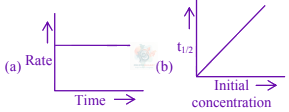 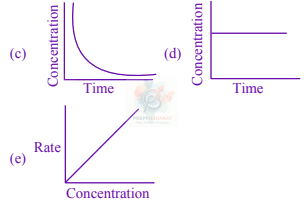 Choose from the options given below, the correct one regarding order of reaction is :
Identify the process in which change in the oxidation state is five :
The density of $\mathrm{NaOH}$ solution is $1.2g{\mathrm{cm}}^{-3}.$ The molality of this solution is $m$ (Round off to the Nearest Integer): [Use : Atomic masses : $\mathrm{Na}:23.0uO:16.0u$ $H:1.0u$ Density of ${H}_{2}O:1.0g{\mathrm{cm}}^{-3}]$
Consider the reaction ${N}_{2}{O}_{4}(g)\rightleftharpoons 2{\mathrm{NO}}_{2}(g)$ The temperature at which ${K}_{C}=20.4$ and ${K}_{P}=600.1,$ is ______ $K$. (Round off to the Nearest Integer). [Assume all gases are ideal and $R=0.0831L$ bar ${K}^{-1}{\mathrm{mol}}^{-1}]$
$224\mathrm{mL}$ of ${\mathrm{SO}}_{2(g)}$ at $298K$ and $1\mathrm{atm}$ is passed through $100\mathrm{mL}$ of $0.1M\mathrm{NaOH}$ solution. The non-volatile solute produced is dissolved in $36g$ of water. The lowering of vapour pressure of solution (assuming the solution is dilute) ($P{^{\circ}}_{({H}_{2}O)}=24\mathrm{mm}$ of $\mathrm{Hg}$) is $x\times {10}^{-2}\mathrm{mm}$ of $\mathrm{Hg}$ the value of $x$ is (Integer answer)
Which of the following is an intensive property?
The elevation in boiling point of a solution depends on:
$1.22g$ of an organic acid is separately dissolved in $100g$ of benzene $({K}_{b}=2.6K\mathrm{kg}{\mathrm{mol}}^{-1})$ and $100g$ of acetone $({K}_{b}=1.7K\mathrm{kg}{\mathrm{mol}}^{-1}).$ The acid is known to dimerize in benzene but remain as a monomer in acetone. The boiling point of the solution in acetone increases by $0.17^{\circ}C.$ The increase in boiling point of solution in benzene in$C\circ$ is $x\times {10}^{-2}.$ The value of $x$ is (Nearest integer) [Atomic mass : $C=12.0,H=1.0,O=16.0$]
The molar solubility of $\mathrm{Zn}(\mathrm{OH}{)}_{2}$ in $0.1\mathrm{MNaOH}$ solution is $x\times {10}^{-18}M.$ The value of $x$ is _____ . (Nearest integer) $(\text{Given : The solubility product of }\mathrm{Zn}(\mathrm{OH}{)}_{2}\text{is}2\times {10}^{-20})$
$2\mathrm{NO}(g)+{\mathrm{Cl}}_{2}(g)\rightleftharpoons 2\mathrm{NOCl}(s)$ This reaction was studied at $-10^{\circ}C$ and the following data was obtained $\begin{matrix}\mathrm{run} & [\mathrm{NO}{]}_{0} & {[{\mathrm{Cl}}_{2}]}_{0} & {r}_{0} \\ 1 & 0.10 & 0.10 & 0.18 \\ 2 & 0.10 & 0.20 & 0.35 \\ 3 & 0.20 & 0.20 & 1.40\end{matrix}$ $[\mathrm{NO}{]}_{0}$ and ${[{\mathrm{Cl}}_{2}]}_{0}$ are the initial concentrations and ${r}_{0}$ is the initial reaction rate. The overall order of the reaction is (Round off to the Nearest Integer).
For the reaction $A\rightarrow B,$ the rate constant $k$ (in ${s}^{-1}$) is given by ${\mathrm{log}}_{10}k=20.35-\frac{(2.47\times {10}^{3})}{T}$ The energy of activation in $\mathrm{kJ}{\mathrm{mol}}^{-1}$ is ________ . (Nearest integer) [Given : $R=8.314J{K}^{-1}{\mathrm{mol}}^{-1}$]
The inactivation rate of a viral preparation is proportional to the amount of virus. In the first minute after preparation, $10%$ of the virus is inactivated. The rate constant for viral inactivation is $___\times {10}^{-3}{\mathrm{min}}^{-1}.$ (Nearest integer) [Use : $\mathrm{ln}10=2.303;{\mathrm{log}}_{10}3=0.477$ property of logarithm$:\mathrm{log}{x}^{y}=y\mathrm{log}x]$
An accelerated electron has a speed of $5\times {10}^{6}{\mathrm{ms}}^{-1}$ with an uncertainty of $0.02%$. The uncertainty in finding its location while in motion is $x\times {10}^{-9}m$. The value of $x$ is __________. (Nearest integer) [Use mass of electron$=9.1\times {10}^{-31}\mathrm{kg}$, $h=6.63\times {10}^{-34}\mathrm{Js},\pi =3.14]$
Assume a cell with the following reaction ${\mathrm{Cu}}_{(s)}+2{\mathrm{Ag}}^{+}(1\times {10}^{-3}M)\rightarrow {\mathrm{Cu}}^{2+}(0.250M)+2{\mathrm{Ag}}_{(s)}$ ${E}_{\mathrm{cell}}^{\circ }=2.97V$ ${E}_{\mathrm{cell}}$ for the above reaction is $V.$ (Nearest integer) $[$ Given : $\mathrm{log}2.5=0.3979,T=298K]$
For a chemical reaction $A+B=C+D$ $({\Delta }_{r}{H}^{\Theta }=80\mathrm{kJ}{\mathrm{mol}}^{-1})$ the entropy change ${\Delta }_{r}{S}^{\Theta }$ depends on the temperature $T$ (in $K$) as ${\Delta }_{r}{S}^{\Theta }=2T({\mathrm{JK}}^{-1}{\mathrm{mol}}^{-1})$. Minimum temperature at which it will become spontaneous is $K$. (Integer)