JEE Main Chemistry — Physical Chemistry previous year questions with solutions.
The number of endothermic process/es from the following is _______. A. ${I}_{2}(g)\rightarrow 2I(g)$ B. $\mathrm{HCl}(g)\rightarrow H(g)+\mathrm{Cl}(g)$ C. ${H}_{2}O(l)\rightarrow {H}_{2}O(g)$ D. $C(s)+{O}_{2}(g)\rightarrow {\mathrm{CO}}_{2}(g)$ E. Dissolution of ammonium chloride in water
Consider the following data Heat of combustion of ${H}_{2}(g)=–241.8\mathrm{kJ}{\mathrm{mol}}^{–1}$ Heat of combustion of $C(s)=–393.5\mathrm{kJ}{\mathrm{mol}}^{–1}$ Heat of combustion of ${C}_{2}{H}_{5}\mathrm{OH}(l)$$=–1234.7\mathrm{kJ}{\mathrm{mol}}^{–1}$ The heat of formation of ${C}_{2}{H}_{5}\mathrm{OH}(l)$ is $(–)$ _____ $\mathrm{kJ}{\mathrm{mol}}^{–1}$ (Nearest integer).
Water decomposes at $2300K$ ${H}_{2}O(g)\rightarrow {H}_{2}(g)+\frac{1}{2}{O}_{2}(g)$ The percent of water decomposing at $2300K$ and 1 bar is _____ (Nearest integer). Equilibrium constant for the reaction is $2\times {10}^{-3}$ at $2300K$
At $298K$, the solubility of silver chloride in water is $1.434\times {10}^{-3}g{L}^{-1}$. The value of $-{\mathrm{logK}}_{\mathrm{sp}}$ for silver chloride is (Given mass of Ag is $107.9g{\mathrm{mol}}^{-1}$, and mass of $\mathrm{Cl}$ is $35.5g{\mathrm{mol}}^{-1}$ )
When the hydrogen ion concentration $[{H}^{+}]$changes by a factor of $1000$ , the value of $\mathrm{pH}$ of the solution
The number of incorrect statement/s from the following is ______________ A. The successive half lives of zero order reactions decreases with time. B. A substance appearing as reactant in the chemical equation may not affect the rate of reaction C. Order and molecularity of a chemical reaction can be a fractional number D. The rate constant units of zero and second order reaction are $\mathrm{molL}-1{s}^{-1}$ and ${\mathrm{mol}}^{-1}L{s}^{-1}$ respectively
A molecule undergoes two independent first order reactions whose respective half lives are $12\mathrm{min}$ and $3\mathrm{min}$. If both the reactions are occurring then the time taken for the $50%$ consumption of the reactant is ______ $\mathrm{min}$. (Nearest integer)
The rate constant for a first order reaction is $20{\mathrm{min}}^{-1}$. The time required for the initial concentration of the reactant to reduce to its $\frac{1}{32}$ level is $______\times {10}^{-2}\mathrm{min}$. (Nearest integer)
$A\rightarrow B$ The rate constants of the above reaction at $200K$ and $300K$ are $0.03{\mathrm{min}}^{-1}$ and $0.05{\mathrm{min}}^{-1}$ respectively. The activation energy for the reaction is $J$ (Nearest integer) (Given : In $10=2.3$ $R=8.3J{K}^{-1}{\mathrm{mol}}^{-1}$ $\mathrm{log}5=0.70$ $\mathrm{log}3=0.48$ $\mathrm{log}2=0.30$
The number of units, which are used to express concentration of solutions from the following is _________. (Mass percent, Mole, Mole fraction, Molarity, ppm, Molality.)
For a chemical reaction $A+B\rightarrow$ Product, the order is $1$ with respect to $A$ and $B$.<table class="pyq-table"><tbody><tr><td>Rate $\mathrm{mol}{L}^{-1}{S}^{-1}$</td><td>[A] $\mathrm{mol}{L}^{-1}$</td><td>[B] $\mathrm{mol}{L}^{-1}$</td></tr><tr><td>$0.10$</td><td>$20$</td><td>$0.5$</td></tr><tr><td>$0.40$</td><td>$x$</td><td>$0.5$</td></tr><tr><td>$0.80$</td><td>$40$</td><td>$y$</td></tr></tbody></table>What is the value of $x$ and $y$?
An aqueous solution of volume $300{\mathrm{cm}}^{3}$ contains $0.63g$ of protein. The osmotic pressure of the solution at $300K$ is $1.29\mathrm{mbar}$. The molar mass of the protein is ${\mathrm{gmol}}^{-1}$. Given : $R=0.083{L}_{\mathrm{bar}}{K}^{-1}{\mathrm{mol}}^{-1}$
If compound $A$ reacts with $B$ following first order kinetics with rate constant $2.011\times {10}^{-3}{s}^{-1}$. The time taken by A (in seconds) to reduce from $7g$ to $2g$ will be _____ . (Nearest Integer) $[\mathrm{log}5=0.698,\mathrm{log}7=0.845,\mathrm{log}2=0.301]$
For the first order reaction $A\rightarrow B$ the half life is $30\mathrm{min}$. The time taken for $75%$ completion of the reaction is mm. (Nearest integer) Given : $\mathrm{log}2=0.3010$ $\mathrm{log}3=0.4771$ $\mathrm{log}5=0.6989$
For certain chemical reaction $X\rightarrow Y$, the rate of formation of product is plotted against the time as shown in the figure. The number of Correct statement/s from the following is _____ 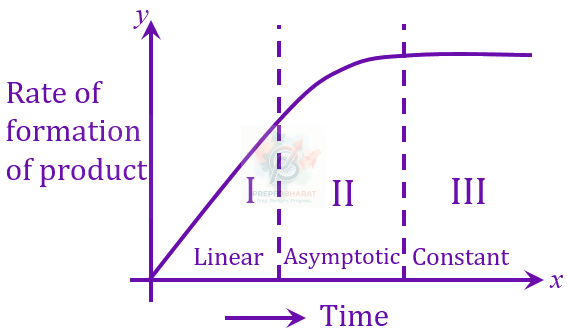 (A) Over all order of this reaction is one (B) Order of this reaction can't be determined (C) In region-I and III, the reaction is of first and zero order respectively (D) In region-II, the reaction is of first order (E) In region-II, the order of reaction is in the range of $0.1$ to $0.9$.
The resistivity of a $0.8M$ solution of an electrolyte is $5\times {10}^{-3}\Omega cm$. Its molar conductivity is ${10}^{4}{\Omega }^{-1}{\mathrm{cm}}^{2}{\mathrm{mol}}^{-1}$. (Nearest integer)
Which one of the following sets of ions represents a collection of isoelectronic species? (Given : Atomic Number $:F:9,\mathrm{Cl}:17,\mathrm{Na}=11$ $\mathrm{Mg}=12,\mathrm{Al}=13,K=19,\mathrm{Ca}=20,\mathrm{Sc}=21)$
Given (A) $2\mathrm{CO}(g)+{O}_{2}(g)\rightarrow 2{\mathrm{CO}}_{2}(g){\Delta H}_{1}^{o}=-x\mathrm{kJ}{\mathrm{mol}}^{-1}$ (B) $C(\mathrm{graphite})+{O}_{2}(g)\rightarrow {\mathrm{CO}}_{2}(g){\Delta H}_{2}^{o}=-y\mathrm{kJ}{\mathrm{mol}}^{-1}$ The $\Delta {H}^{o}$ for the reaction $C(\mathrm{graphite})+\frac{1}{2}{O}_{2}(g)\rightarrow \mathrm{CO}(g)$ is
The vapour pressure of $30%(w/v)$, aqueous solution of glucose is ________ $\mathrm{mm}\mathrm{Hg}$ at ${25}^{\circ }C$. [Given: The density of $30%(w/v)$, aqueous solution of glucose is $1.2g{\mathrm{cm}}^{–3}$ and vapour pressure of pure water is $24\mathrm{mm}\mathrm{Hg}$.] (Molar mass of glucose is $180g{\mathrm{mol}}^{–1}$)
The total number of intensive properties from the following is........... Volume, Molar heat capacity, molarity, ${E}_{\mathrm{cell}}^{o}$,Gibbs free energy change, Molar mass, Mole
A litre of buffer solution contains $0.1$ mole of each of ${\mathrm{NH}}_{3}$ and ${\mathrm{NH}}_{4}\mathrm{Cl}$. On the addition of $0.02$ mole of $\mathrm{HCl}$ by dissolving gaseous $\mathrm{HCl}$, the $\mathrm{pH}$ of the solution is found to be $_____\times {10}^{-3}$ (Nearest integer) Given: ${\mathrm{pK}}_{b}({\mathrm{NH}}_{3})=4.745$ $\mathrm{log}2=0.301$ $\mathrm{log}3=0.477$ $T=298K]$
For the adsorption of hydrogen on platinum, the activation energy is $30\mathrm{kJ}{\mathrm{mol}}^{–1}$ and for the adsorption of hydrogen on nickel, the activation energy is $41.4\mathrm{kJ}{\mathrm{mol}}^{–1}.$ The logarithm of the ratio of the rates of chemisorption on equal areas of the metals at $300K$ is $_______$ (Nearest integer) Given: $\mathrm{In}10=2.3$ $R=8.3J{K}^{-1}{\mathrm{mol}}^{-1}$
The equilibrium constant for the reaction $\mathrm{Zn}(s)+{\mathrm{Sn}}^{2+}(\mathrm{aq})\rightleftharpoons {\mathrm{Zn}}^{2+}(\mathrm{aq})+\mathrm{Sn}(s)$ is $1\times {10}^{20}$ at $298K$. The magnitude of standard electrode potential of $\mathrm{Sn}/{\mathrm{Sn}}^{2+}$ if ${E}_{{\mathrm{Zn}}^{2*}/\mathrm{Zn}}^{0}=-0.76V$ is _____ $\times {10}^{-2}V$. (Nearest integer) Given : $\frac{2.303\mathrm{RT}}{F}=0.059V$
Evaluate the following statements for their correctness. A. The elevation in boiling point temperature of water will be same for $0.1M$ $\mathrm{NaCl}$ and $0.1M$ urea. B. Azeotropic mixture boil without change in their composition. C. Osmosis always takes place from hypertonic to hypotonic solution. D. The density of $32%$ ${H}_{2}{\mathrm{SO}}_{4}$ solution having molarity $4.09M$ is approximately $1.26g{\mathrm{mL}}^{–1}$. E. A negatively charged sol is obtained when $\mathrm{KI}$ solution is added to silver nitrate solution. Choose the correct answer from the options given below: